
Pocket watch · Suisse
The polished gold hunter case has two glazed bezels
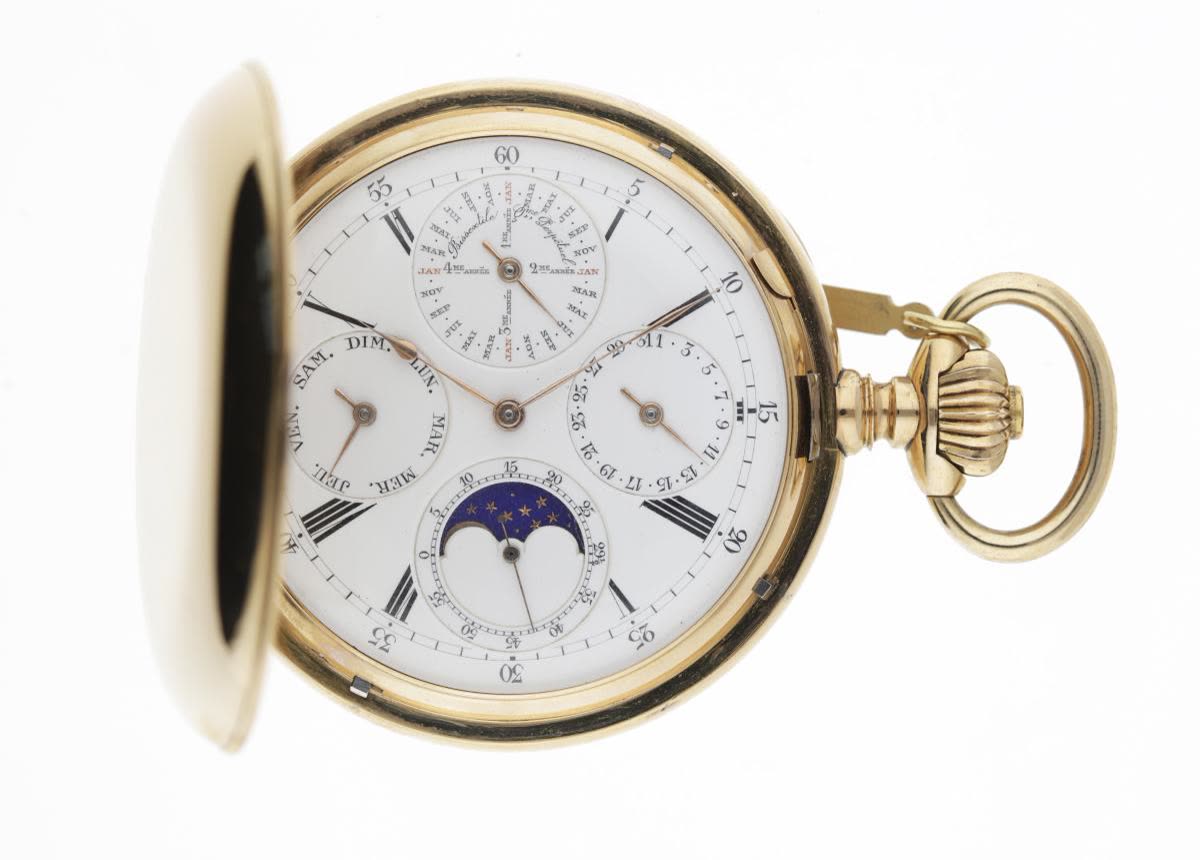
VerifiedThe white enamel dial has four sunk auxillary dials. At the top, a hand indicates the month on a graduated four-year circle; on the left, the days of the week; on the right, the date; and at the bottom, a seconds dial with an aperture indicates the phases and age of the moon.
Technical facts
- Inventory number
- MIH I-360
- Object type
- Pocket watch
- Place of production
- Suisse
- Dating
- 1880 - 1900
- Materials and techniques (catalogue wording)
- or, émail, laiton, acier
- Dimensions (catalogue)
- dimensions min/max: 51 x 60 mm; Dimensions: 52.0 x 72.8 x 16.2 mm; poids: 117 g
- Inscriptions (catalogue)
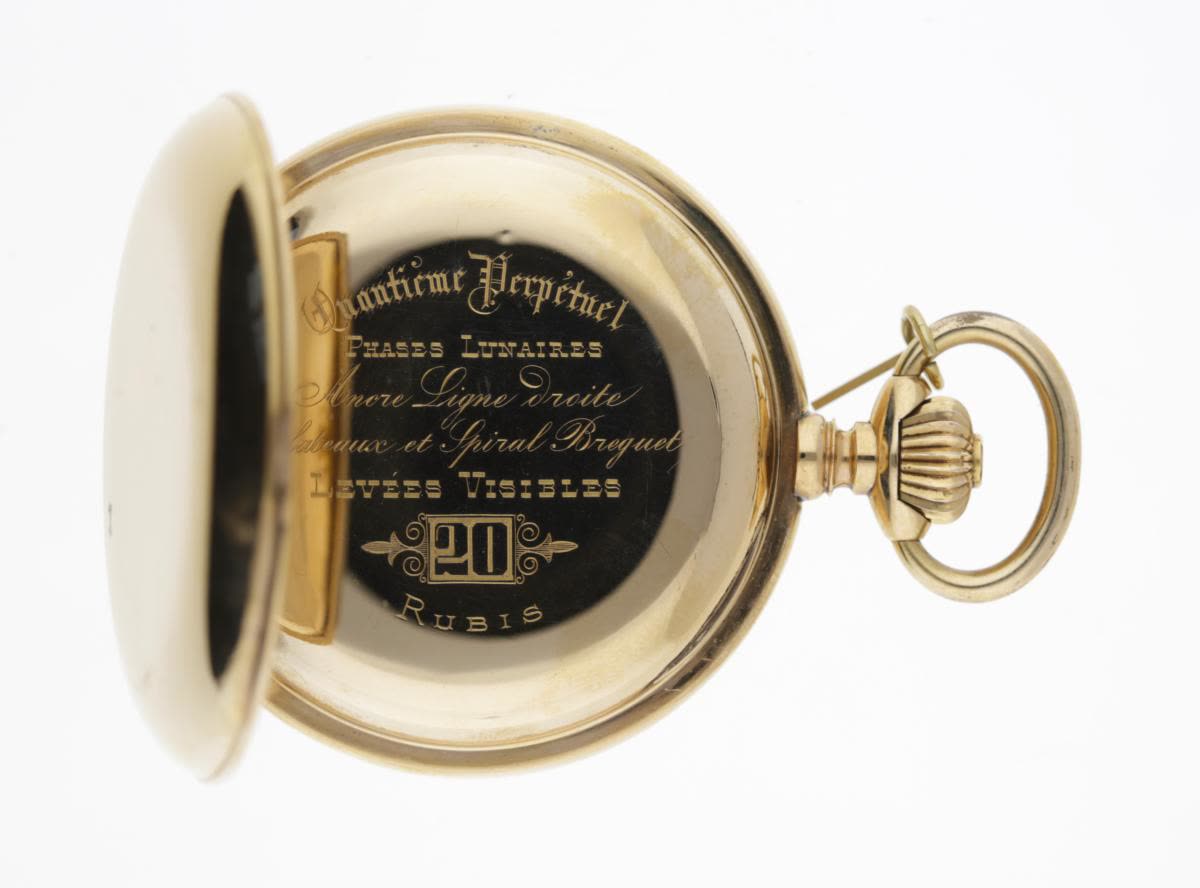
- 14K (Boîtier); N° 5009 (Boîtier); Quantième Perpétuel Phases Lunaires Ancre Ligne droite Plateaux et Spiral Breguet Levées visibles 20 Rubis (Cuvette)
Historical significance
- The white enamel dial has four sunk auxillary dials. At the top, a hand indicates the month on a graduated four-year circle; on the left, the days of the week; on the right, the date; and at the bottom, a seconds dial with an aperture indicates the phases and age of the moon.
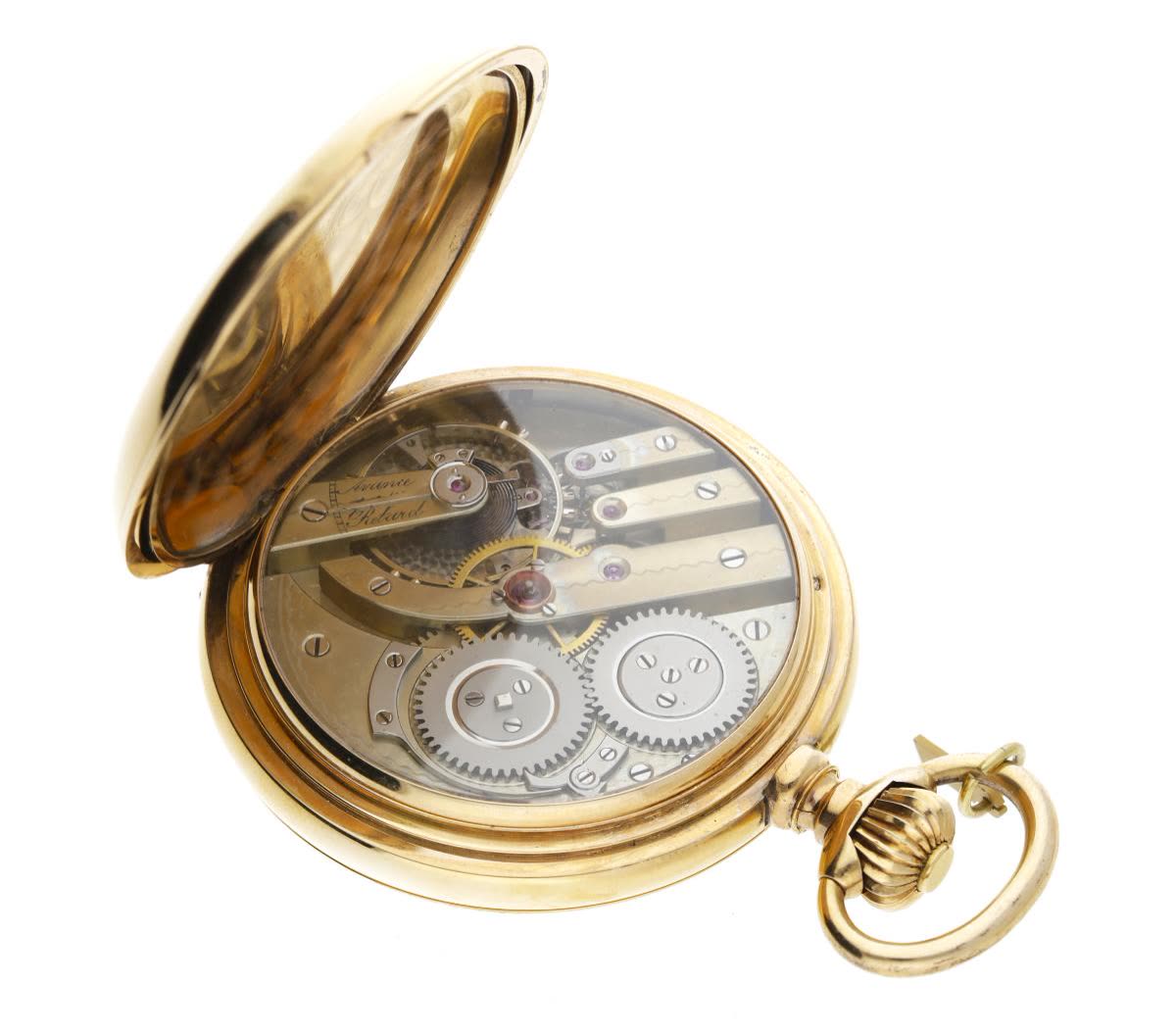
- The movement has a straight-line lever escapement, a large compensation balance with gold screws, and a blued steel balance spring with a Breguet overcoil. The perpetual calendar mechanism is mounted on a steel plate independent of the movement.
- Developed in its definitive form around 1853 in the Joux Valley by Elisée Golay and Louis-Elisée Piguet, the perpetual calendar mechanism is adjusted to take into account the different lengths of the months in the Gregorian calendar, as well as the leap years. Only programmed until 2100, current perpetual calendars cannot account for 2100, 2200 and 2300, which will not be century leap years.
- Very few exact perpetual calendars have ever been made. These have an additional mechanism fitted with a wheel which turns once every four hundred years, thus avoiding the error caused by the suppression of the 29 February in century leap years.
Photographs
Photographs are illustrative examples of the type, not necessarily the exact object described. Verify details against the source file page.
Sources & references
- Musée international d'horlogerie, online collection record, inv. I-360: https://collection.mih.ch/fr/collection/item/37921/
Where sources disagree, the disagreement is stated rather than resolved silently.