
Pocket watch · Strasbourg
Round enamelled watch
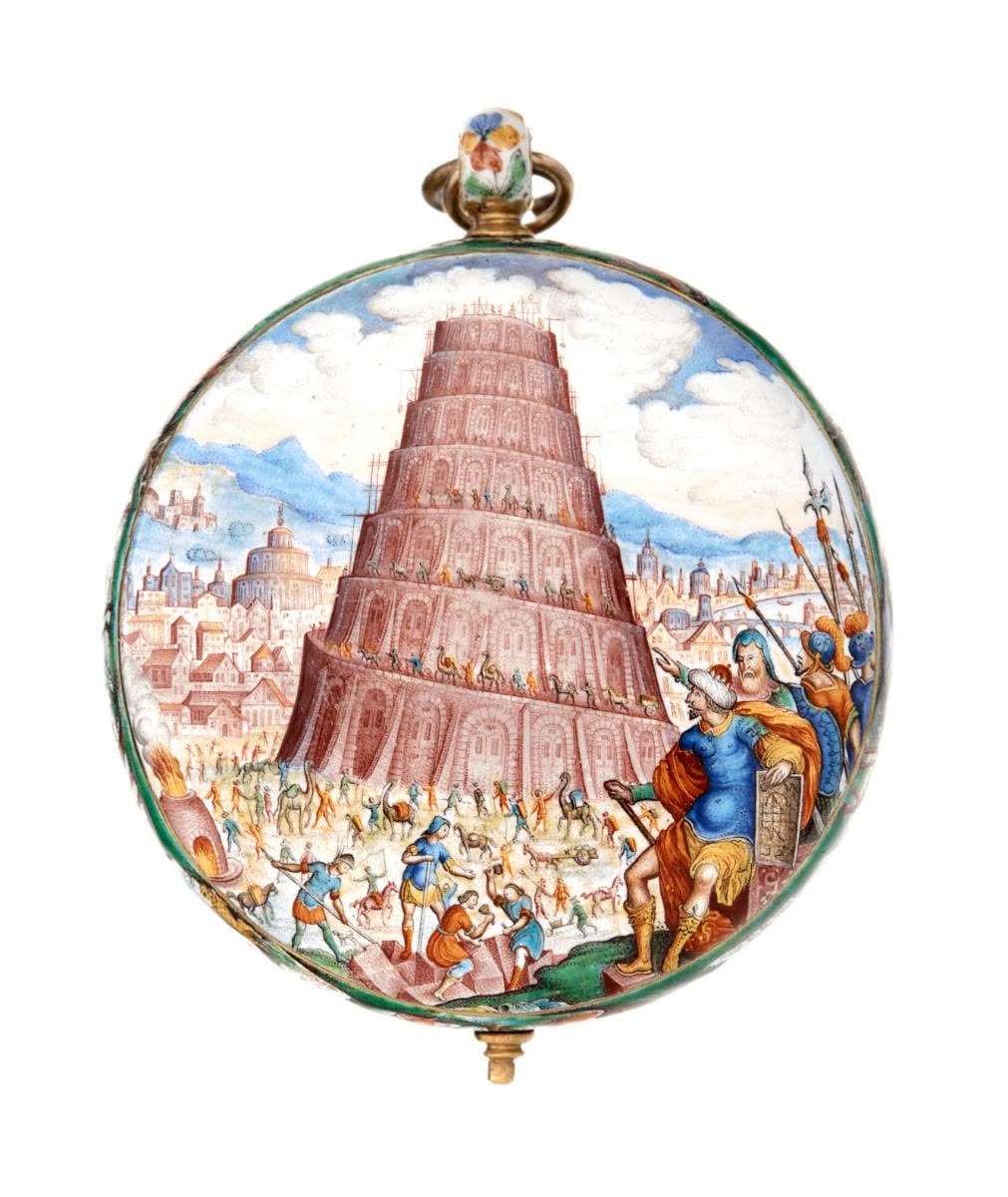
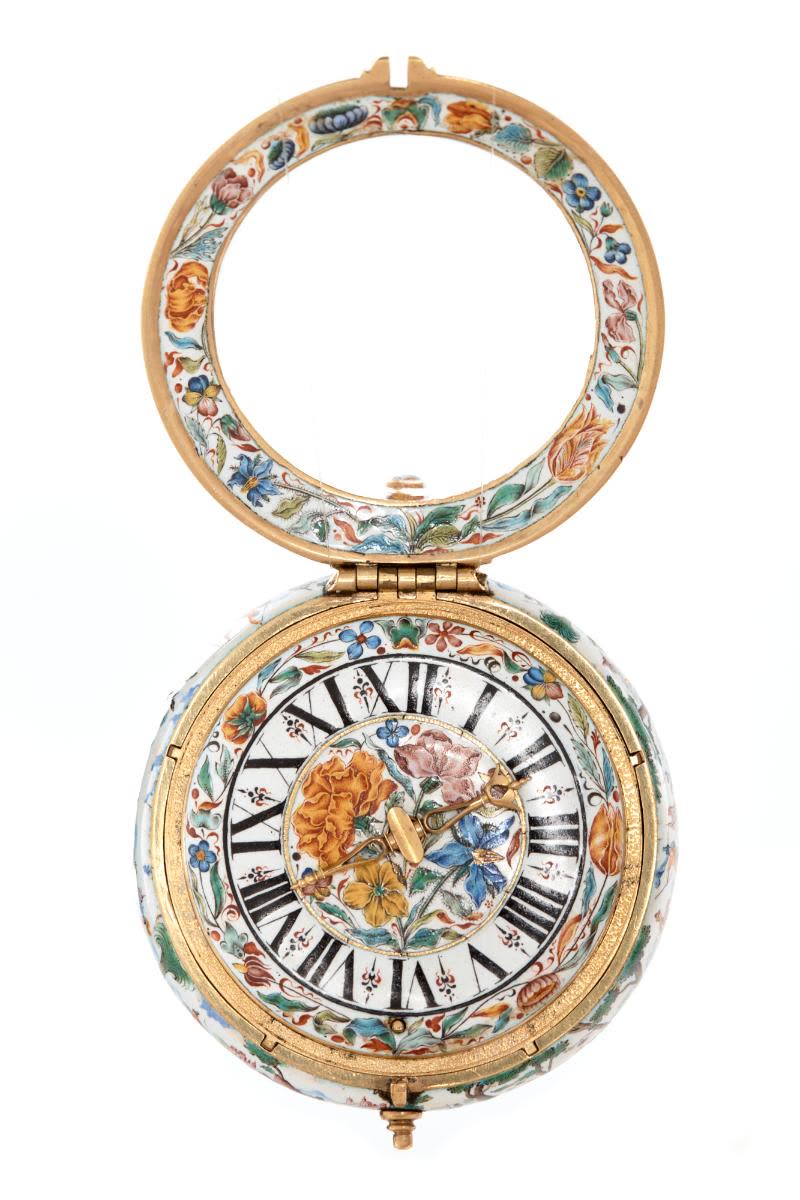
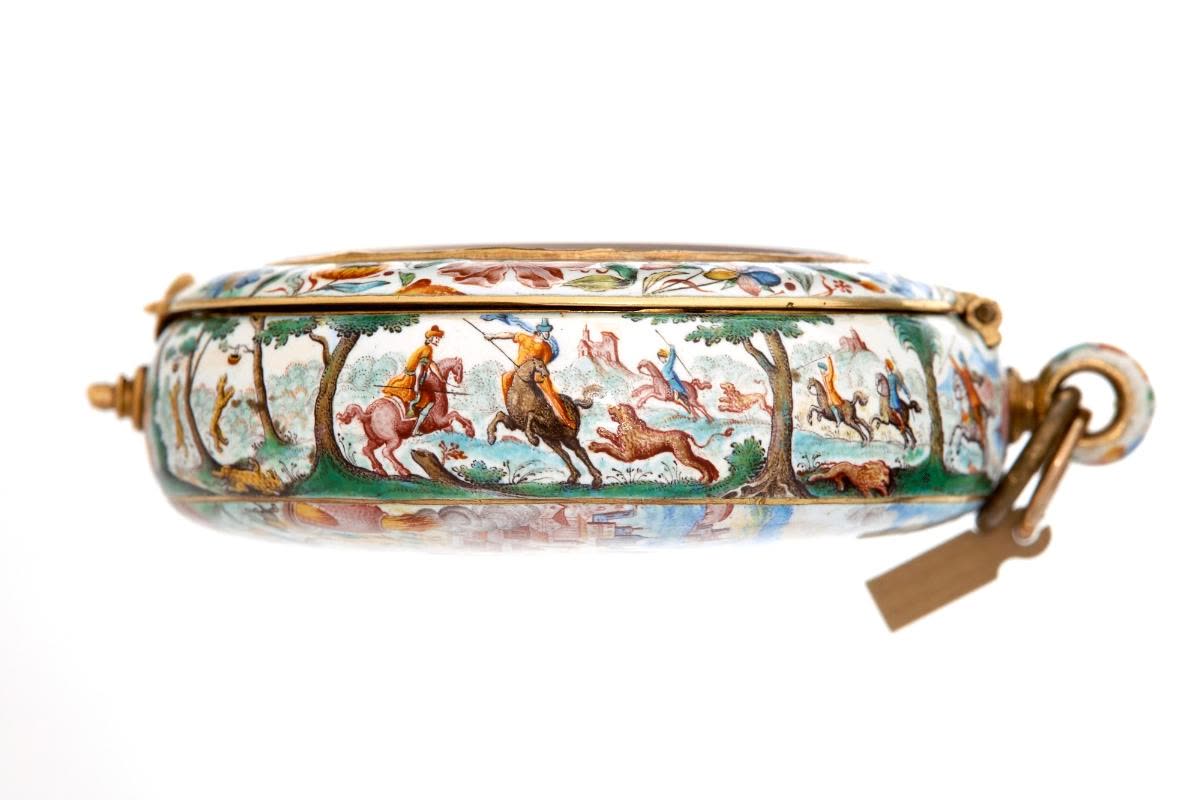
VerifiedA biblical scene painted in enamel decorates the back of the case: The Construction of the Tower of Babel. In the foreground, King Nimrod holds the architectural plan. The case middle is adorned with exotic hunting scenes, reminding that the giant, King of Babel, was a renowned hunter. Realistic decorations of flowers embellish the counter-enamel, the bezel and the centre of the dial.
Technical facts
- Inventory number
- MIH I-1331
- Object type
- Pocket watch
- Place of production
- Strasbourg
- Dating
- 1640
- Materials and techniques (catalogue wording)
- or, émail, laiton
- Dimensions (catalogue)
- dimensions min/max: 46 x 50 mm; Diamètre: 47 mm. Epaisseur: 16 mm.
- Inscriptions (catalogue)
- M. Wentzel A Strasbourg (Mouvement)
Historical significance
- A biblical scene painted in enamel decorates the back of the case: The Construction of the Tower of Babel. In the foreground, King Nimrod holds the architectural plan. The case middle is adorned with exotic hunting scenes, reminding that the giant, King of Babel, was a renowned hunter. Realistic decorations of flowers embellish the counter-enamel, the bezel and the centre of the dial.
- The dial, with its black enamel Roman numerals on a white enamel ground, is also decorated with multi-coloured flowers.
- The movement has a verge escapement, an annular balance, and a fusee with steel chain. The balance-cock and the click are pierced with strawberry-flower scrolls.
- There are several similar extant illustrations of the building of the tower: the illustration by Matthäus Merian, for example, which appears in Icones Biblicae (Strasbourg, 1625). Several scenes on the middle are copied from engravings by the same artist (Lucas Heinrich Wütrich, 1966, tome 1, illus. 174, 175, 176, 182, 183) as Hans Boeckh illustrates in one of his studies.
- The kind of decoration on the counter-enamel became fashionable in the middle of the 17th century, particularly through collections of engravings, like those of J. Caillart, A Book of All Kinds of Leaves for the goldsmith's art (1629), and F. Lefebre, A Book of Flowers and Leaves for the goldsmith's art (1635).
Photographs
Photographs are illustrative examples of the type, not necessarily the exact object described. Verify details against the source file page.
Sources & references
- Musée international d'horlogerie, online collection record, inv. I-1331: https://collection.mih.ch/fr/collection/item/37187/
Where sources disagree, the disagreement is stated rather than resolved silently.