
Precision pocket-chronometer movement submitted for observatory rating trials · Germany
Glashütte Observatory Trial Chronometer Movements
Needs researchGlashütte's manufacturers, alongside Swiss and other European makers, submitted movements to observatory precision trials (a formal published-rating competition among manufacturers, comparable in purpose to the Swiss trials at Neuchâtel and Geneva), and results are a documented, comparable historical record rather than a marketing claim.
Technical facts
- Typical features
- Free-sprung balance, precision-adjusted escapement, often a swan-neck or similar micrometric regulator
Historical significance
- Glashütte's manufacturers, alongside Swiss and other European makers, submitted movements to observatory precision trials (a formal published-rating competition among manufacturers, comparable in purpose to the Swiss trials at Neuchâtel and Geneva), and results are a documented, comparable historical record rather than a marketing claim.
- As with other observatory-trial claims, specific rating results should be cited from the trial's own published results for a named movement and year, not inferred generically from the Glashütte name.
Background
Precision pocket watches made in Glashütte were entered in competitive trials: Phillips records that a flying one-minute tourbillon pocket watch, No. 3834, won first prize in the precision pocket-watch trial at the German Naval Observatory in Hamburg in 1939/1940. That watch was completed around 1934 by Hans Carl Conrad at the D.U.S., the German Watchmaking School, under Professor Alfred Helwig, who regulated the tourbillon himself. A. Lange & Söhne's precision production ranged from observation watches for naval use to marine chronometers, and its precision pieces adopted Guillaume bimetallic balances of nickel-steel.
Written from the sources listed under Sources (makers, museums, auction houses and specialist publications are paraphrased, not reproduced); each statement was checked against the cited text, and claims a maker makes about its own work are attributed to it.
Construction and mechanism
- Lange's half-second chronometer deck watch No. 92307, of about 1937, combines a Glashütte pivoted detent escapement with a power-reserve indicator.
- Professor Alfred Helwig made a model of a chronometer escapement with constant force in 1927.
Later history
- By the end of the Second World War, A. Lange & Söhne had made about 13,500 precision watches for military use, including roughly 5,450 deck watches and around 600 standardized chronometers.
Photographs
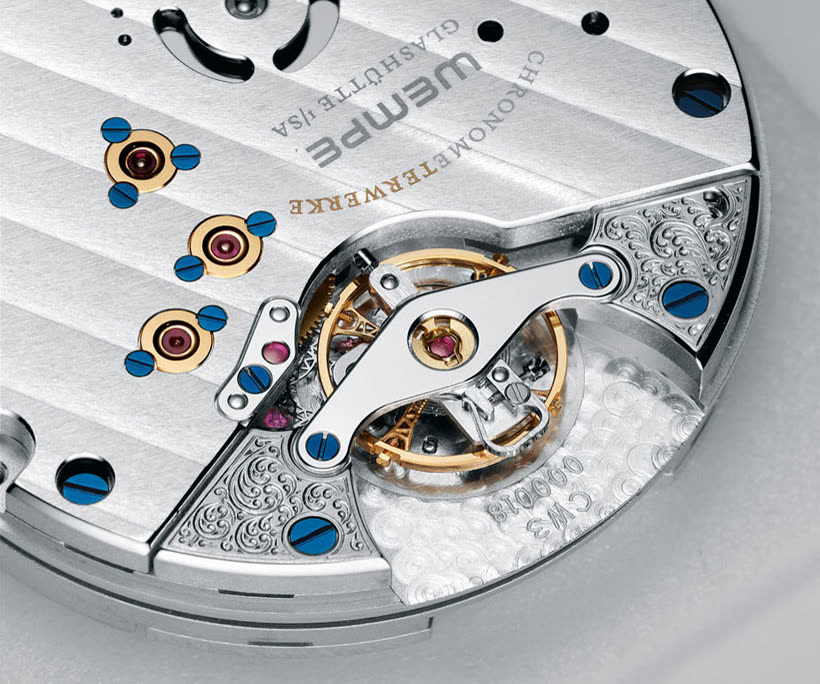
Photographs are illustrative examples of the type, not necessarily the exact object described. Verify details against the source file page.
Sources & references
- Commemorating 150 years since the passing of Ferdinand Adolph Lange, Phillips, retrieved 2026-10-30 (paraphrased; text © the publisher)
- Deutsches Uhrenmuseum Glashütte, published exhibition and archival materials
Where sources disagree, the disagreement is stated rather than resolved silently.