
Component record · Train
Intermediate Wheel
Partially verifiedA wheel placed between two others to carry motion across a gap or to reverse its direction, without being part of the main ratio-setting train.
What it does
Transfers drive where two wheels cannot mesh directly: in keyless and setting work, automatic winding, indirect centre-seconds drives, calendars and chronographs.
How it works
A plain intermediate (idler) wheel turns in the opposite direction to the wheel driving it, so it is used to restore the required direction of rotation. Because it simply passes teeth along, an idler does not change the overall ratio between the wheels on either side of it.
Where an intermediate wheel has its own pinion (a compound wheel), it also changes speed. Indirect centre-seconds movements, for example, use an intermediate wheel to bring the seconds drive to the centre of the dial from a fourth wheel placed off-centre.
Intermediate wheels in the keyless work and calendar run only occasionally, so their main problems are dirt and wear on posts rather than continuous running wear.
Evolution
Their use grew with complicated layouts: keyless work in the nineteenth century, indirect seconds and calendar modules in the twentieth.
Known variations
- Plain idler wheels
- Compound intermediate wheels with their own pinion
- Intermediate wheels in calendar and chronograph modules
Identification for collectors
- A wheel driven by one wheel and driving another, with no hand or indicator of its own
- In indirect centre-seconds calibres a spring-tensioned intermediate drive is visible on the back of the movement
Common failure modes
- Worn posts or pivots letting the wheel tilt
- Missing or bent teeth
- Loss during service because of its small size
Photographs
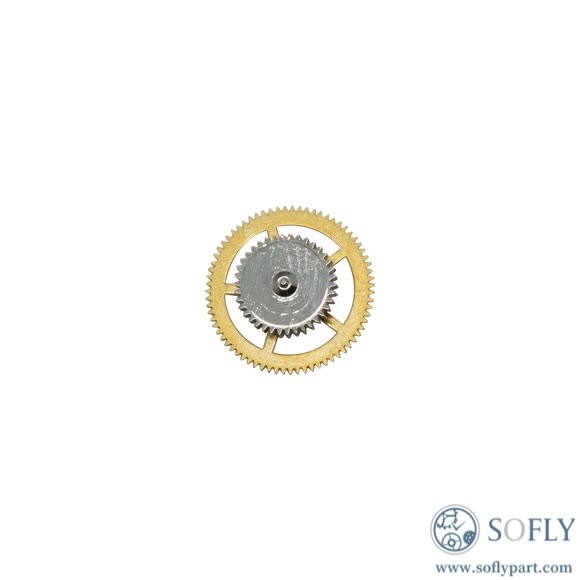
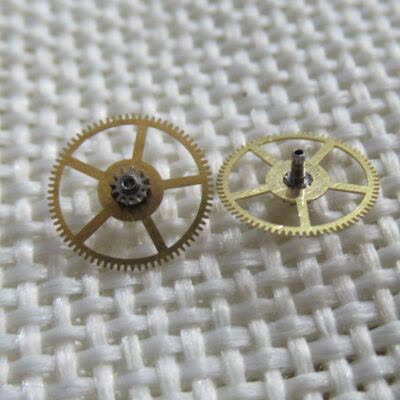


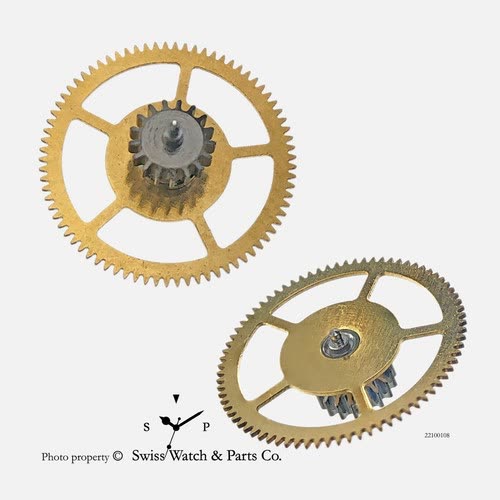
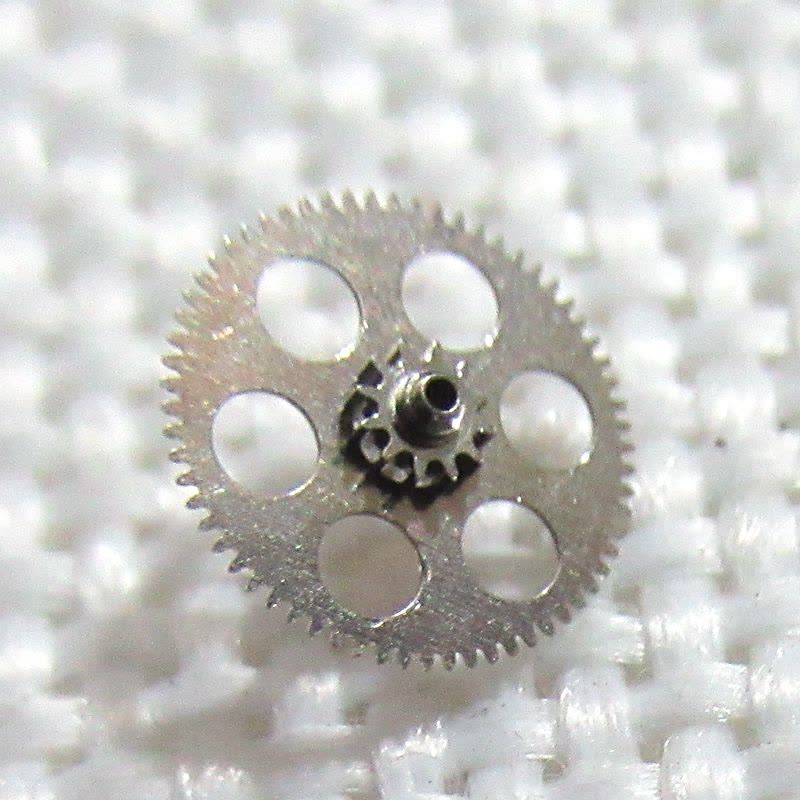
Photographs are illustrative examples of the type, not necessarily the exact object described. Verify details against the source file page.
Sources & references
- de Carle, D., Practical Watch Repairing
- de Carle, D., Watch and Clock Encyclopedia
- Fried, H. B., The Watch Repairer's Manual
- Daniels, G., Watchmaking
Where sources disagree, the disagreement is stated rather than resolved silently.