
Clock type · Domestic
Digital Mechanical (Plato) Clocks
Partially verifiedClocks displaying the time on flipping numbered plates rather than hands and a dial.
Background
The Plato clock was developed by American inventor Eugene L. Fitch, who patented the device in 1902 to provide an instant time display using rotating plates for hours and minutes. Production of these clocks began between 1904 and 1906, financed by Conrad Hubert of the American Everready Company, and they achieved significant commercial success with approximately 40,000 units sold.
The final prototype featured lightweight celluloid plates with die-cut ears that functioned as pivots, which eliminated the need for ball bearings used in earlier experimental designs. While early models were manufactured by the Ansonia Clock Company in the United States, licenses were also granted to French firms to produce 30-hour and 8-day versions of the clock.
Written from the sources listed below; each statement was checked against the cited text.
Recognising one
- Early Plato clocks may be identified by glass domes and alternative winding mechanisms.
- The name Plato is derived from the term plate-o in reference to the plate mechanism used in the design.
Condition and survival
- Durability was a known issue in early designs as the plates were prone to warping beyond repair over time.
Movement & mechanism
- Spring-driven movement with a vertical shaft
- Numbered plates (leaves) are released one by one
- Regulated by a balance wheel
Identification
- Glass cylinder showing flipping numbered plates
- No hands
- Brass or silvered top and base
Terminology
- Flip clock
- Leaf clock
- Plato clock
Known variations
- Carriage-clock style and novel versions
Collecting notes
Condition and originality are paramount. For technical clocks like regulators or atmospheric clocks, the completeness of the original mechanism is more important than case condition. For decorative clocks (Boulle, Empire), the quality of the case craft is central.
Photographs
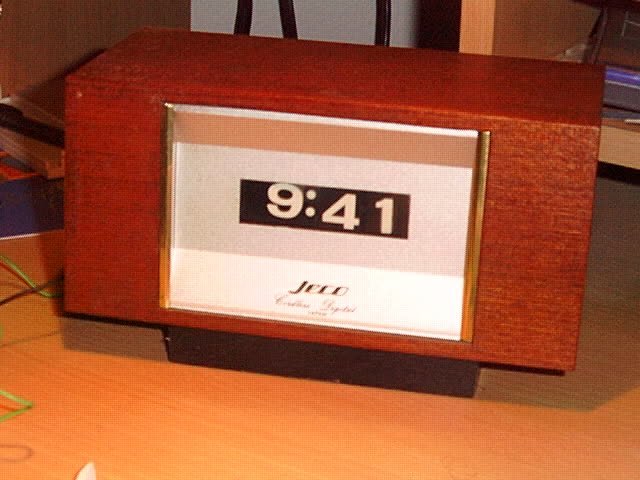
Photographs are illustrative examples of the type, not necessarily the exact object described. Verify details against the source file page.
Sources & references
- Flip clock, Wikipedia (English), retrieved 2026-10-28 (text CC BY-SA 4.0)
- Britten, F. J., Old Clocks and Watches and Their Makers
- Museum catalogue records
Where sources disagree, the disagreement is stated rather than resolved silently.