
Skip to content
The Encyclopedia of Horology

Clock · Wall clock

Yoka Van Den Brink Wall Clock

Partially verified

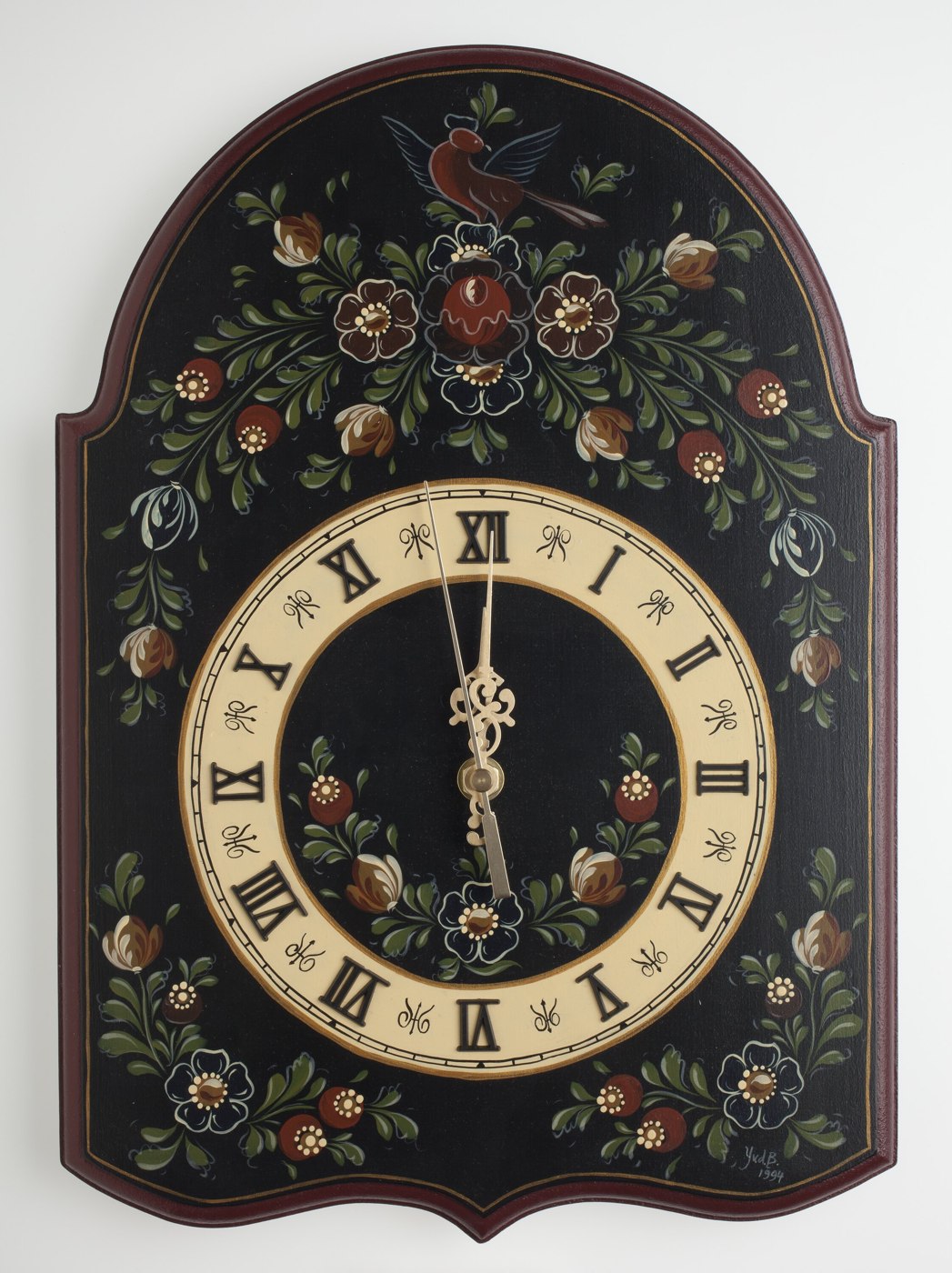
This wall clock, created in 1994 in Newport, Victoria, is a craft-wood construction featuring hand-painted decorations in the Hindeloopen folk art style. The clock is decorated with traditional motifs including scrolls, buds, birds, and floral patterns, set against a black ground with terracotta and gold-painted edges. The circular dial is gold-toned with black Roman numerals and ornate, brass-colored hands. The clock is powered by a battery-operated mechanism. The reverse side of the clock contains a hand-painted inscription by the maker, Yoka Van Den Brink, indicating the work was completed in 1994.

The front of the wooden wall clock, showing the hand-painted floral decoration and the circular dial with Roman numerals.
The front of the wooden wall clock, showing the hand-painted floral decoration and the circular dial with Roman numerals. — Museums Victoria. Rights pending — permission not yet requested. Original source

Catalogue identity

Source
collections.museumsvictoria.com.au
Category
Clock · Wall clock
Maker / attribution
Yoka Van Den Brink
Reference
Not recorded
Catalogue / lot identifier
SH 931258
Source-reported date
1994
Source-reported place
Australia

Source-reported attribution and specifications are not independent authentication. A listing does not establish present ownership, current display, availability or permission to reproduce.

Object description

Construction and Design

The wall clock is constructed from craft wood and displays an arched, shaped silhouette. The primary visual aesthetic is defined by the application of Hindeloopen folk art motifs, a tradition originating from the Dutch port of Hindeloopen. The front surface is finished in black, serving as a background for elaborate hand-painted decorations including floral scrolls, leaves, and a prominent bird motif. The edges of the wood are finished in terracotta and gold tones.

The dial consists of a gold-colored circular insert featuring black Roman numerals. Centered on the dial are ornate brass-colored hands that contrast with the darker color scheme of the clock face. The overall composition balances the geometric constraint of the Roman numeral dial with the organic, flowing lines of the painted folk motifs that extend across the entire face of the housing.

Evidence for this section
  • “Wooden wall clock constructed from craft wood and painted in t the Hindeloopen folk art style.”
  • “The face of the clock is black and the edges are painted terracotta and gold, the inner face of the clock is gold with roman numerals in black.”

Signature and Maker Details

The clock is attributed to Yoka Van Den Brink, who created the piece in 1994 while based in Newport, Victoria, Australia. The authenticity and origin of the piece are confirmed by a hand-painted inscription located on the reverse side of the clock casing. This inscription provides not only the artist's name and the year of production but also a contact telephone number, placing the object within the context of the maker's local activity in the Melbourne area.

This signature confirms the provenance of the object as a specific example of 20th-century Australian-based folk art production, documenting the transfer of traditional Dutch decorative techniques to a contemporary Australian setting.

Evidence for this section
  • “Association: type: Maker, name: Mrs Yoka Van Den Brink, date: 1994, locality: Newport”
  • “On the back, handpainted: Handpainted with love by Yoka Van Den Brink ph 03 391 2541 1994.”

Functional Mechanism

While the exterior of the clock serves as a canvas for traditional folk art, the internal mechanism is a standard battery-powered movement. This technical choice contrasts with the historical references implied by the Hindeloopen decorative style, representing a contemporary approach to the production of functional domestic objects.

The source confirms the reliance on an internal battery for the operation of the brass-colored hands, situating the clock as a modern craft object that utilizes contemporary technology to maintain its timekeeping function within a domestic environment.

Evidence for this section
  • “The mechanism is battery powered.”
  • “The clock has also been painted with various floral motifs and has ornate brass coloured hands.”

Open research questions

  • What specific craft wood species was utilized by the maker for this project?
  • Are there other documented examples of Yoka Van Den Brink's clocks featuring Hindeloopen motifs in private or public collections?

Source evidence

Recorded claims and source quotations for Yoka Van Den Brink Wall Clock
FieldSource-reported valueSource quotation
MakerYoka Van Den Brink“Maker, name: Mrs Yoka Van Den Brink”
Date1994“date: 1994”
Dimensions25.5 cm x 1 cm x 36 cm“25.5 cm (Length), 1 cm (Width), 36 cm (Height)”
Registration NumberSH 931258“Registration number: SH 931258”
Place of CreationNewport, Victoria, Australia“locality: Newport, region: Greater Melbourne, state: Victoria, country: Australia”
Mechanism TypeBattery powered“The mechanism is battery powered.”
SignatureHandpainted on the back“On the back, handpainted: Handpainted with love by Yoka Van Den Brink ph 03 391 2541 1994.”

Visible details

  • The clock face features a gold-toned circular dial with black Roman numerals.
  • The painted decoration includes floral scrolls, buds, and a central bird motif at the top.
  • The casing has an arched top and a shaped bottom edge.
  • The hands are metal with ornate pierced patterns.

Research qualifications

  • The exact type of wood used in construction is not specified in the source.
  • The technical specifications of the battery-powered movement are not detailed beyond the power source.

Photograph identity and source facts were screened before import; rights clearance remains pending.

Consulted source

Clock - Yoka Van Den brink, Hindeloopen, 1994

Reviewed 2026-10-26 · Record 1bcac6ba79

Terms in this record

Glossary explanations for terms named in this object’s record.