
Skip to content
The Encyclopedia of Horology

Pocket watch · Automaton pocket watch

Watch with automaton by Charles Clay

Partially verified

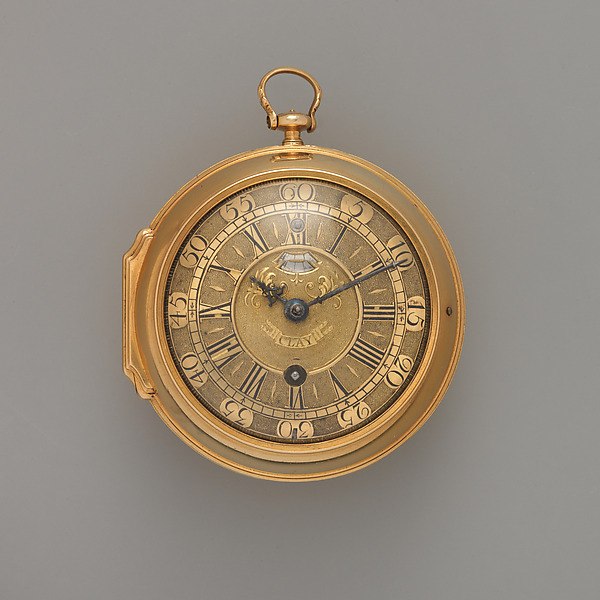
This watch with an integrated automaton was produced in London circa 1720 by the watchmaker Charles Clay (1695–1740). The watch, which measures 2 1/8 inches (5.4 cm) in diameter, features a case constructed from gold and silver. The dial is fashioned from champlevé gold and displays the maker's signature, "CLAY," prominently across the center. The watch incorporates an internal automaton mechanism, which is revealed when the hinged cover is opened, displaying a scene rendered in enamel. This specific horological specimen is held in the collection of The Metropolitan Museum of Art in New York. The object is officially catalogued under accession number 89.2.92 and was part of the gift of Joseph W. Drexel in 1889.

Detailed view of the enamel automaton scene and the open case, featuring the gold and silver construction of the watch.
Detailed view of the enamel automaton scene and the open case, featuring the gold and silver construction of the watch. — The Metropolitan Museum of Art, Gift of Joseph W. Drexel, 1889. Rights pending — permission not yet requested. Original source

Catalogue identity

Source
orbiscollectibles.com
Category
Pocket watch · Automaton pocket watch
Maker / attribution
Charles Clay
Reference
Not recorded
Catalogue / lot identifier
89.2.92
Source-reported date
ca. 1720
Source-reported place
British, London

Source-reported attribution and specifications are not independent authentication. A listing does not establish present ownership, current display, availability or permission to reproduce.

Object description

Case and Dial Construction

The watch is housed in a case manufactured from a combination of gold and silver. When closed, the case protects the timekeeping surface, but it must be opened to operate or view the specific automaton functions incorporated within the watch mechanism.

The dial itself is constructed from champlevé gold. It features roman numerals for the hour indications and a separate outer track for minute intervals. The signature of the maker, "CLAY," is applied across the center portion of the dial, immediately below the hand arbor, providing clear identification of the watchmaker responsible for its creation during his active period in London.

Evidence for this section
  • “Case: gold and silver; Dial: champlevé gold”
  • “The museum records its materials as: Case: gold and silver; Dial: champlevé gold.”

Automaton Mechanism

A distinctive feature of this horological object is the integrated automaton mechanism. When the case is opened, it reveals an enamel scene, which is visible in the provided photographs. The scene depicts figures in a landscape setting, integrated into the internal arrangement of the watch.

The mechanism was designed by Charles Clay, who is recognized for his work in both watches and larger clockwork automata. The specific scene present in this watch is rendered in polychrome enamel, providing an artistic focal point that differentiates the object from standard timepieces of the era.

Evidence for this section
  • “Watch with automaton”
  • “Watch with automaton made by Charles Clay (British, 1695–1740)”

Provenance and Documentation

The watch is part of the European Sculpture and Decorative Arts collection at The Metropolitan Museum of Art. It was acquired by the museum as part of the gift of Joseph W. Drexel in 1889. It is assigned the accession number 89.2.92 within the museum's database.

The current record for this item is based on museum documentation. While the object is attributed to Charles Clay and dated to circa 1720, the museum does not suggest this represents the entirety of the maker's output or the definitive typology of such devices, as these remain subjects for continued horological study and cross-referencing.

Evidence for this section
  • “The Metropolitan Museum of Art holds this object as 89.2.92”
  • “Gift of Joseph W. Drexel, 1889”

Open research questions

  • What is the specific nature of the movement and the escapement type utilized in this Charles Clay watch?
  • How do the internal automaton figures interact with the gear train of the watch?

Source evidence

Recorded claims and source quotations for Watch with automaton by Charles Clay
FieldSource-reported valueSource quotation
MakerCharles Clay (British, 1695–1740)“Watchmaker: Charles Clay (British, 1695–1740)”
Dateca. 1720“ca. 1720”
Place of originLondon, Great Britain“British, London”
Dimensions2 1/8 in. (5.4 cm)“Diameter: 2 1/8 in. (5.4 cm)”
MaterialsGold, silver, and champlevé gold“Case: gold and silver; Dial: champlevé gold”
Museum Accession89.2.92“89.2.92”
CreditGift of Joseph W. Drexel, 1889“Gift of Joseph W. Drexel, 1889”

Visible details

  • Champlevé gold dial
  • Hinged front cover containing the automaton scene
  • Signature 'CLAY' on the dial center
  • Applied enamel scene depicting figures in a landscape

Research qualifications

  • Wider type classification is not independently verified
  • Maker attribution and specific horological technical details require further independent research

Photograph identity and source facts were screened before import; rights clearance remains pending.

Consulted source

Watch with automaton

Reviewed 2026-11-02 · Record afa3120680

Terms in this record

Glossary explanations for terms named in this object’s record.