
Skip to content
The Encyclopedia of Horology

Pocket watch · Skull-form watch

Watch in the form of a human skull

Partially verified

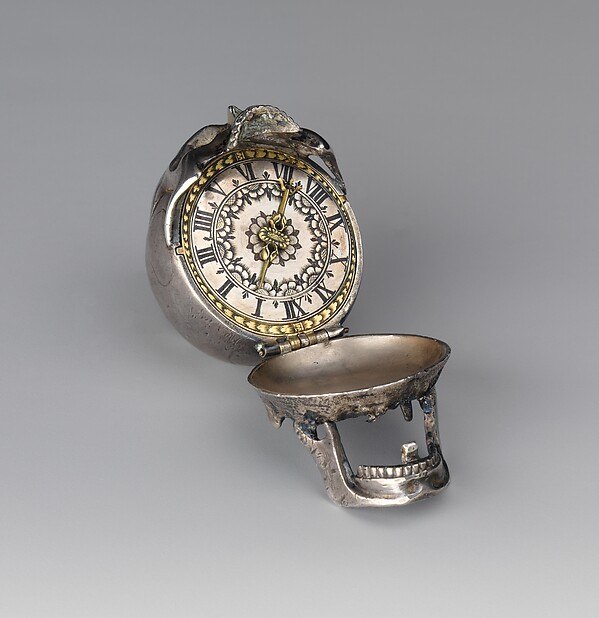
This watch, held by The Metropolitan Museum of Art (accession number 17.190.1575), is constructed in the form of a human skull. The object consists of a silver case, which is dated to circa 1810–1820, containing a movement attributed to Isaac Penard (Swiss, 1619–1676) that is dated to approximately 1650. The dial is made of silver and features niello decoration. The internal movement is composed of gilded brass and steel. Overall dimensions for the piece are 2 × 1 3/8 × 1 9/16 inches (5.1 × 3.5 × 4 cm). The watch is attributed to the Geneva region of Switzerland. The construction displays a distinct separation in the temporal origins of its components, with the skull-shaped housing being a later addition to the earlier horological mechanism.

The skull-form watch shown with the jaw open, revealing the silver and niello dial.
The skull-form watch shown with the jaw open, revealing the silver and niello dial. — The Metropolitan Museum of Art, New York. Rights pending — permission not yet requested. Original source

Catalogue identity

Source
orbiscollectibles.com
Category
Pocket watch · Skull-form watch
Maker / attribution
Isaac Penard
Reference
Not recorded
Catalogue / lot identifier
17.190.1575
Source-reported date
case ca. 1810–20, movement ca. 1650
Source-reported place
Switzerland

Source-reported attribution and specifications are not independent authentication. A listing does not establish present ownership, current display, availability or permission to reproduce.

Object description

Case and Dial Construction

The watch is housed in a silver case fashioned in the likeness of a human skull. The design incorporates a hinged lower jaw, which opens to reveal the internal dial. The skull itself is rendered with anatomical features, including the cranium and facial structure. A suspension ring is fixed to the superior portion of the cranium, indicating its intended use as a pendant or portable timepiece.

The watch dial, visible when the jaw is opened, is constructed from silver and features nielloed decorative elements. Roman numerals are used for the hour markers, arranged around a central engraved floral motif. The surrounding chapter ring is framed by a narrow band of gold-colored metal, which contrasts with the silver finish of the skull and the dial plate.

Evidence for this section
  • “Watch in the form of a human skull”
  • “Case: silver; Dial: silver, partly nielloed”

Movement and Signature

The movement is identified as having been produced by the Swiss watchmaker Isaac Penard. The back plate of the movement bears an inscription or signature attributed to the maker, which is visible in the provided photographic documentation.

The integration of a movement from circa 1650 into a case dated between 1810 and 1820 indicates that this watch is a composite object. The movement shows evidence of hand-finishing, including engraved bridge work that secures the gear train components. The interaction between the earlier movement and the later case suggests an intentional preservation of the clockwork mechanism within a renewed housing.

Evidence for this section
  • “movement ca. 1650”
  • “made by Isaac Penard (Swiss, 1619–1676)”
  • “Movement: gilded brass and steel”

Provenance and Documentation

The object is held by The Metropolitan Museum of Art in the Department of European Sculpture and Decorative Arts under the accession number 17.190.1575. The museum acquired the item as part of a gift from J. Pierpont Morgan in 1917. The records confirm the materials used in its construction and provide a clear distinction between the dating of the exterior case and the interior movement.

The record serves as a reference for the physical parameters of the watch, including its dimensions. The institution maintains the object in the public domain, making detailed viewings of its components available for research and study.

Evidence for this section
  • “The Metropolitan Museum of Art holds this object as 17.190.1575”
  • “Gift of J. Pierpont Morgan, 1917”

Open research questions

  • What is the history of the movement's assembly into the 19th-century skull case?
  • Are there similar extant examples of Penard movements housed in 19th-century commemorative skull cases?

Source evidence

Recorded claims and source quotations for Watch in the form of a human skull
FieldSource-reported valueSource quotation
MakerIsaac Penard (Swiss, 1619–1676)“Watch in the form of a human skull made by Isaac Penard (Swiss, 1619–1676)”
Case dateca. 1810–20“case ca. 1810–20”
Movement dateca. 1650“movement ca. 1650”
Case materialSilver“Case: silver”
Dial materialSilver, partly nielloed“Dial: silver, partly nielloed”
Movement materialGilded brass and steel“Movement: gilded brass and steel”
Dimensions2 × 1 3/8 × 1 9/16 in. (5.1 × 3.5 × 4 cm)“Overall: 2 × 1 3/8 × 1 9/16 in. (5.1 × 3.5 × 4 cm).”
Accession number17.190.1575“17.190.1575”

Visible details

  • Case is modelled as a human skull with a hinged jaw
  • Dial features Roman numerals and decorative niello work
  • Movement is engraved with the signature of the maker
  • Suspension loop is attached to the top of the cranium

Research qualifications

  • The discrepancy between the movement date (circa 1650) and the case date (circa 1810–20) indicates a composite assembly
  • Maker attribution to Isaac Penard requires independent verification against horological records

Photograph identity and source facts were screened before import; rights clearance remains pending.

Consulted source

Watch in the form of a human skull

Reviewed 2026-11-02 · Record ec6a96cec5

Terms in this record

Glossary explanations for terms named in this object’s record.