
Skip to content
The Encyclopedia of Horology

Clock · Wall clock

Wandklok, met een zich aan de bovenzijde verjongend, door een timpaan gedekt blad

Partially verified

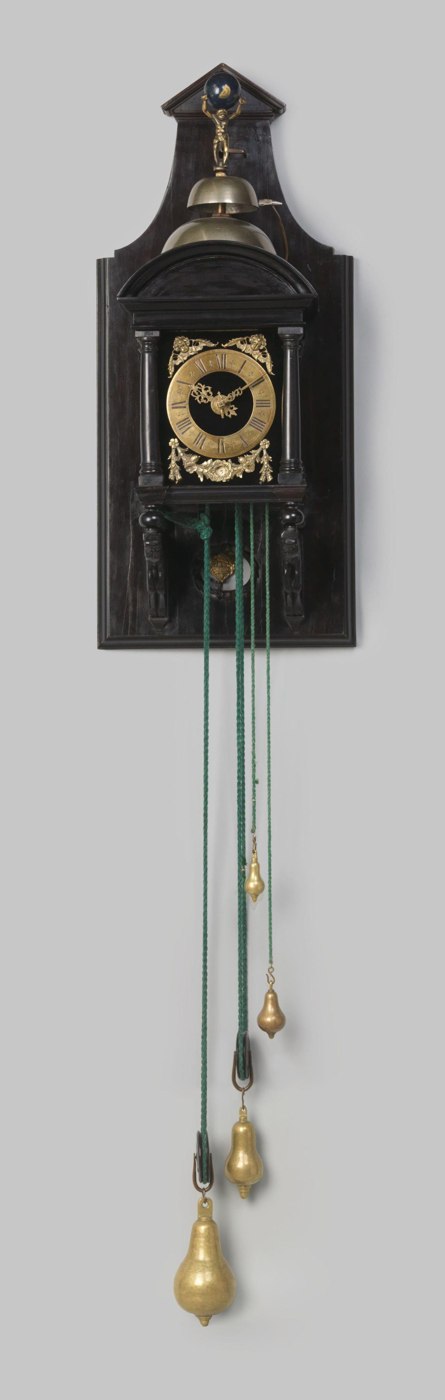
This Dutch wall clock, dated to approximately 1690, is attributed to the clockmaker Jan Copies of Westzaan. The timepiece features an upwardly tapering backboard finished with ebony veneer over an oak core, topped by a pediment. A central structure supported by solid ebony consoles, modeled as kneeling figures, houses four columns of the Tuscan order supporting an entablature with a segmented gable. The copper dial, set against a black fabric ground, is embellished with cast copper cherub corner mounts and a floral garland at the base. The pendulum aperture is oval and framed by a laurel wreath, featuring a small bird perched atop a basket of fruit.

Wall clock by Jan Copies, ca. 1690, featuring an ebony-veneered case with an Atlas figure.
Wall clock by Jan Copies, ca. 1690, featuring an ebony-veneered case with an Atlas figure. — Rijksmuseum. Rights pending — permission not yet requested. Original source

Catalogue identity

Source
www.rijksmuseum.nl
Category
Clock · Wall clock
Maker / attribution
Jan Copies
Reference
BK-NM-3451
Catalogue / lot identifier
BK-NM-3451
Source-reported date
ca. 1690
Source-reported place
Netherlands

Source-reported attribution and specifications are not independent authentication. A listing does not establish present ownership, current display, availability or permission to reproduce.

Object description

Case and Dial Construction

The wall clock is constructed with an oak core finished in ebony veneer. The backboard tapers toward the top and is capped by a pediment. Beneath the primary clock structure, two solid ebony consoles are sculpted into the forms of kneeling nude figures. These support the main body, which features four columns in the Tuscan order that uphold an entablature and a segmented gable.

The copper dial is mounted onto a black fabric background. It is decorated with cast copper cherub figures in the corners and a floral garland along the lower edge. Within the dial area, an oval window is surrounded by a laurel wreath and contains the pendulum, which depicts a bird perched on a fruit basket. A brass bell sits prominently above the main housing, surmounted by a figure of Atlas.

Evidence for this section
  • “Hangklok, belijmd met ebbenhout op eikenhouten kern.”
  • “Op het zich aan de bovenzijde verjongende, door een timpaan gedekte blad zijn de massief ebben consoles bevestigd.”
  • “De koperen wijzerplaat staat op een onderlaag van zwart laken tussen gegoten koperen cherubs als hoekstukken en een guirlande onderaan.”
  • “In een ovaal met lauwerkrans verschijnt de slinger met een vogel die op een vruchtkorf zit.”

Signatures and Marks

The clock bears a signature on the dial reading 'Jan Kopies, Westzanen', attributing the work to the maker active in the late 17th century. While historical records acknowledge an alternative attribution to Jan Koogies, this is explicitly rejected by the cataloguing body.

In addition to the exterior signature, the clock's internal movement mechanism contains stamped markings. These include the sequence '1718 // 8 // - // 24', which provides supplementary technical identification for the internal components.

Evidence for this section
  • “Gemerkt op de wijzerplaat: Jan Kopies, Westzanen”
  • “uurwerkmaker: Jan Copies, Westzaan”
  • “uurwerkmaker: Jan Koogies, Westzaan [verworpen toeschrijving]”
  • “merk, binnenwerk: ‘1718 // 8 // - // 24’”

Condition and Provenance

The clock has been part of the Rijksmuseum collection since its acquisition in 1877. The historical record indicates a specific modification to the decorative elements: the globe held by the figure of Atlas is not original to the clock but is instead a later replacement.

The physical state of the clock reflects its age, with brass weights and cords remaining as the primary driving force for the timekeeping mechanism. The object remains documented in the public domain within the museum's institutional collection.

Evidence for this section
  • “aankoop 1877”

Open research questions

  • What is the significance of the numerical markings found on the internal movement?
  • Did Jan Copies produce similar clocks with other mythological figures in place of Atlas?

Source evidence

Recorded claims and source quotations for Wandklok, met een zich aan de bovenzijde verjongend, door een timpaan gedekt blad
FieldSource-reported valueSource quotation
MakerJan Copies“Jan Copies”
Dateca. 1690“ca. 1690”
MaterialsEbony veneer on oak, copper, brass“belijmd met ebbenhout op eikenhouten kern”
Dimensions76 cm x 34 cm x 23 cm“hoogte 76 cm x breedte 34 cm x diepte 23 cm”
SignedJan Kopies, Westzanen“Gemerkt op de wijzerplaat: Jan Kopies, Westzanen”
Internal markings1718 // 8 // - // 24“merk, binnenwerk: ‘1718 // 8 // - // 24’”

Visible details

  • The figure of Atlas atop the clock is described as having a replaced sphere.
  • The pendulum aperture is circular and features a bird perched on a fruit basket.
  • The clock is driven by cord-suspended brass weights.
  • The dial is mounted on a black fabric underlay.

Research qualifications

  • The source notes a rejected attribution to 'Jan Koogies'.
  • The globe held by the figure of Atlas is identified as a reproduction.

Photograph identity and source facts were screened before import; rights clearance remains pending.

Consulted source

Wall clock, with an upwardly tapering backboard capped by a pediment

Reviewed 2026-11-02 · Record 372f2c2251

Terms in this record

Glossary explanations for terms named in this object’s record.