
Skip to content
The Encyclopedia of Horology

Clock · Wall clock

Wall Clock by Lewis F. Day

Partially verified

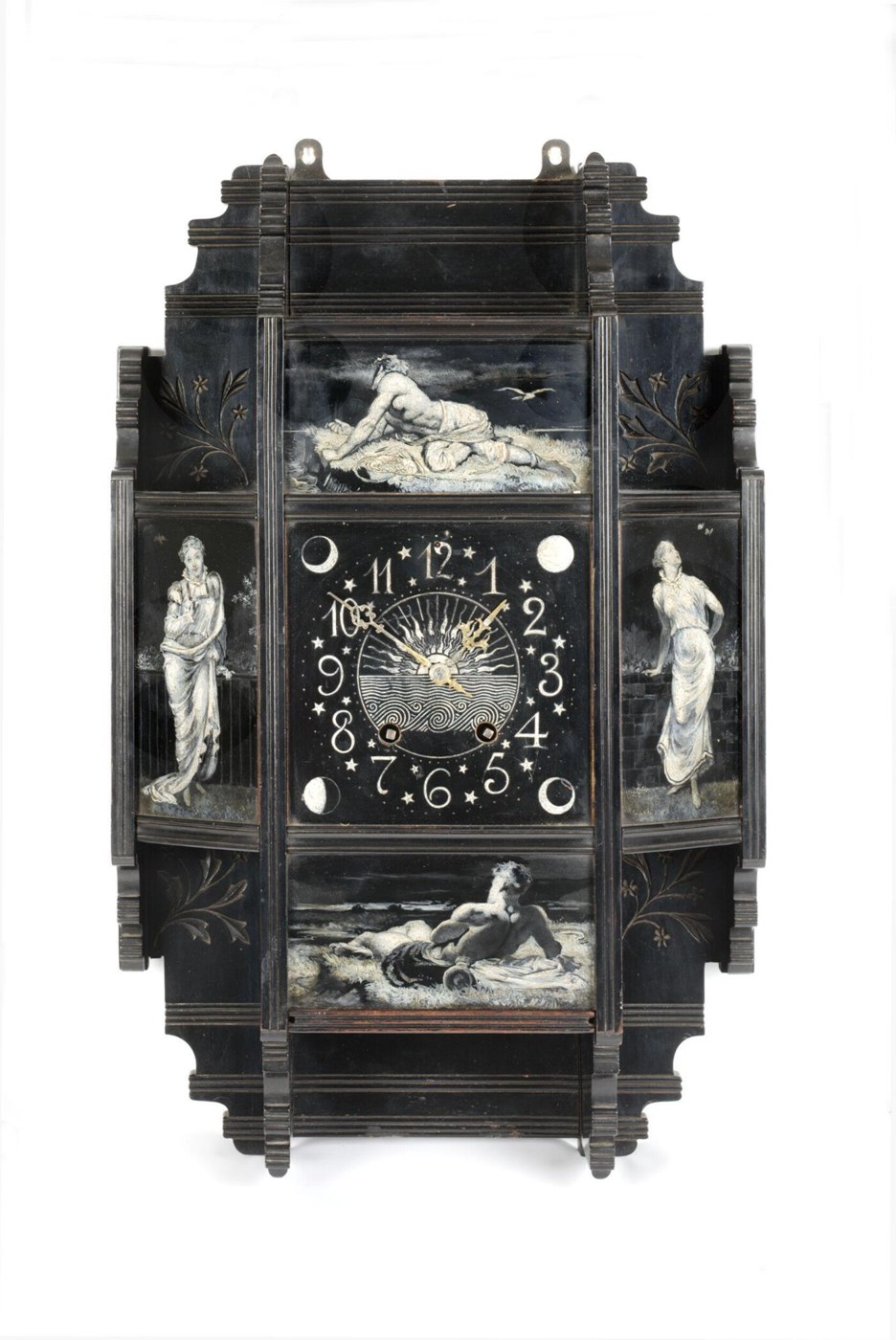
This wall clock, produced in 1879, was designed by Lewis Foreman Day. The construction utilizes mahogany, which is ebonized and decorated with paintings in the grisaille technique. Unlike many of Day's clock designs intended for shelves or brackets, this piece is specifically designed for wall mounting. The surrounding ebonized case incorporates several figurative elements: the male figure of 'The Fowler' above the dial, 'The Shepherd' below, and two female figures flanking the sides, which are interpreted as personifications of Sunlight and Moonlight. The design incorporates incised decoration and shaped mouldings. The clock is signed 'Lewis F Day 1879'. While the specific manufacturer of the movement remains unknown, the design was potentially retailed through Howell & James of Regent Street, London.

Wall clock designed by Lewis Foreman Day, 1879, with grisaille figurative panels and celestial dial, featuring numerals 1-12.
Wall clock designed by Lewis Foreman Day, 1879, with grisaille figurative panels and celestial dial, featuring numerals 1-12. — Victoria and Albert Museum, London. Rights pending — permission not yet requested. Original source

Catalogue identity

Source
collections.vam.ac.uk
Category
Clock · Wall clock
Maker / attribution
Lewis Foreman Day
Reference
W.27-2008
Catalogue / lot identifier
W.27-2008
Source-reported date
1879
Source-reported place
United Kingdom

Source-reported attribution and specifications are not independent authentication. A listing does not establish present ownership, current display, availability or permission to reproduce.

Object description

Design and Case Construction

The case features a prominent central projecting section that houses the dial, framed by shaped mouldings and incised decorative elements.

The ornamentation is executed in the grisaille technique, a monochromatic painting style that provides depth and detail to the figures integrated into the case. These figures are arranged in a specific hierarchy: 'The Fowler' is situated above the clock face, and 'The Shepherd' is positioned below. Flanking the central dial are two female figures in draped gowns, identified as representations of Sunlight and Moonlight based on parallel works by the designer.

Evidence for this section
  • “Wall mounted clock, the central projecting section with the clock face painted with a sunrise or sunset over the ocean”
  • “incised decoration and shaped mouldings frame the clock face and figures”
  • “The figure of the shepherd below the clock face and that of the fowler, or hunter of wild birds, above, are from Day's series of designs showing country trades”

Dial and Imagery

The dial of the clock serves as the visual focal point, integrated into the central projection of the case. It is painted with an evocative scene of a sunrise or sunset over a stylized ocean. The composition includes four representations of the phases of the moon, which are positioned at the quarters of the dial. Stars are distributed across the background, reinforcing a celestial theme.

The integration of Japanese-inspired patterns into the dial design is consistent with broader artistic trends prevalent in London at the time of manufacture. The overall composition aligns with the designer's practice of utilizing figurative panels to create a cohesive decorative unit for domestic interiors.

Evidence for this section
  • “the central projecting section with the clock face painted with a sunrise or sunset over the ocean, four quarters of the moon and stars”
  • “Their draped gowns, the Japanese-inspired decoration on the centre of the clock face, and the design of the ebonised case, are characteristic of the Aesthetic style”

Production and Attribution

The object is signed 'Lewis F Day 1879' and represents an identified design by the designer and critic Lewis Foreman Day. Although Day was a prolific designer of objects for varied domestic industries, including ceramics and furniture, this specific wall clock is known to be one of only two documented examples. The identity of the firm that manufactured the clock mechanism remains unrecorded, though it is suggested that the piece may have passed through the retail channels of Howell & James in London.

The designer's usage of specific figures across different media, such as tiles and vases, allows for the classification of these panels within his broader body of work. Comparisons with the second existing example of this design reveal that elements such as the positioning of figures could be adjusted, confirming the flexibility with which Day approached the assembly of his decorative designs.

Evidence for this section
  • “This wall clock, signed and dated 1879, is one of two known examples of this design by Day”
  • “The maker of the clock is not known”
  • “Day's designs were sufficiently versatile for him to use the two female figures on the clock face for his designs for a pair of vases shown at the Paris Exhibition in 1878”

Open research questions

  • What is the manufacturer of the clock movement housed within the ebonized case?
  • Are there specific technical records indicating the retail history of this piece through Howell & James?

Source evidence

Recorded claims and source quotations for Wall Clock by Lewis F. Day
FieldSource-reported valueSource quotation
MakerLewis Foreman Day“Maker: Day, Lewis Foreman (designer)”
Date1879“Date: 1879”
Place of originLondon“Place of origin: London (made)”
MaterialsMahogany, ebonised, paint“Materials and techniques: Mahogany, ebonised and painted en grisaille”
Dimensions60 cm x 38 cm x 15 cm“Dimensions: Height: 60 cm; Width: 38 cm; Depth: 15 cm”
SignatureLewis F Day 1879“Marks and inscriptions: Lewis F Day 1879”
Provenance notePossibly retailed by Howell & James“many of Day's clock designs were retailed by Howell & James of Regent Street, London, who may have included this wall clock among their stock.”

Visible details

  • Ebonized mahogany case with hand-painted en grisaille figurative panels
  • Clock dial features a central sunburst motif above an ocean landscape
  • The dial includes decorative renderings of four lunar phases
  • Movement is housed in the upper section with a visible gong structure

Research qualifications

  • The manufacturer of the clock movement is not identified
  • The specific symbolic meaning of the female figures is based on interpretation of similar motifs used on other Day designs

Photograph identity and source facts were screened before import; rights clearance remains pending.

Consulted source

Wall clock

Reviewed 2026-10-26 · Record 6bbb05ff91

Terms in this record

Glossary explanations for terms named in this object’s record.