
Skip to content
The Encyclopedia of Horology

Tool · English vertical disc dial

Vertical Disc Dial

Partially verified

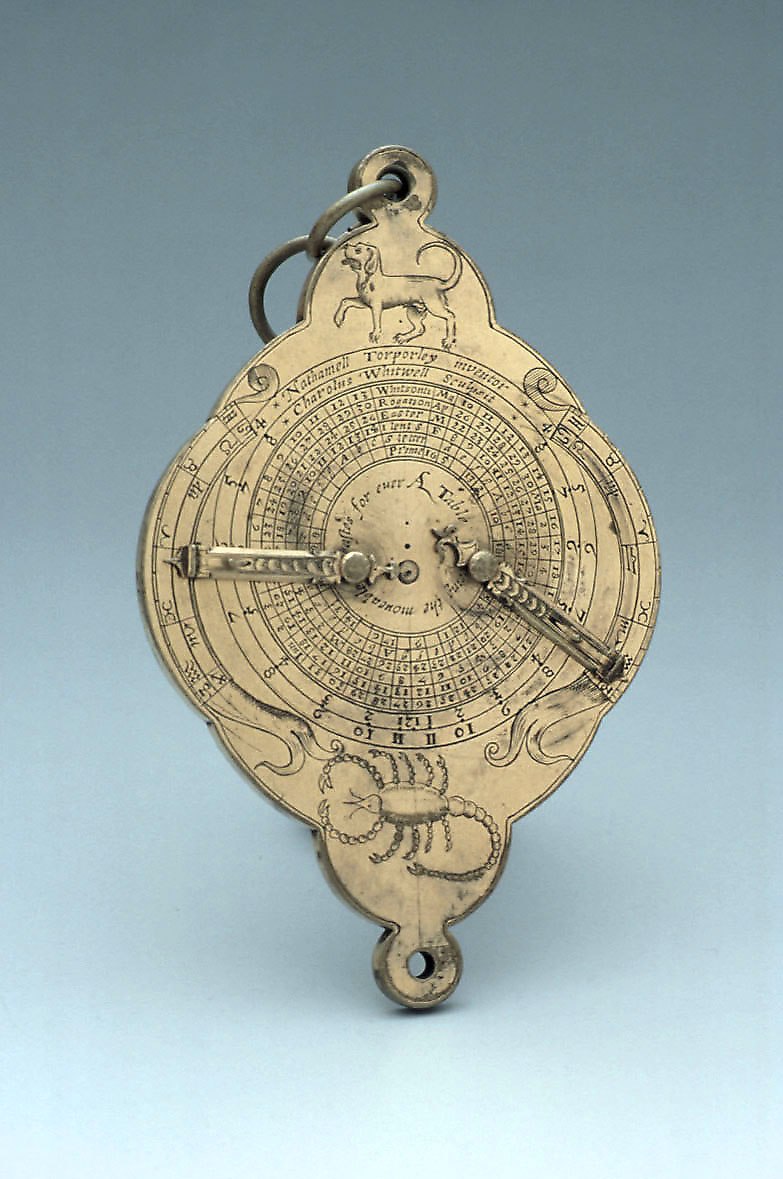
This gilt brass vertical disc dial measures 110 x 70 x 4 mm and is attributed to the English maker Charles Whitwell, dated 1593. The instrument features a roughly oval plate equipped with two hanging rings. One side of the dial displays two vertical dials with folding gnomons, marked for hours 8-12-8 and 4-12-4, accompanied by zodiacal symbols for seasonal adjustments. A central table provides information on moveable feasts. The other side includes a quadrant of degrees, a zodiac and calendar scale, and a table of epacts. The device is adorned with figures of a dog and a scorpion, along with foliate and arabesque motifs. While signed by Whitwell and inventor Nathaniell Torporley, the instrument's authenticity has been questioned by scholars citing constructional inconsistencies, including specific screw threading and variations in the signature script.

Frontal view of the vertical disc dial showing the folding gnomons, zodiacal symbols, and central table for moveable feasts.
Frontal view of the vertical disc dial showing the folding gnomons, zodiacal symbols, and central table for moveable feasts. — Museum of the History of Science, Oxford. Rights pending — permission not yet requested. Original source

Catalogue identity

Source
www.mhs.ox.ac.uk
Category
Tool · English vertical disc dial
Maker / attribution
Charles Whitwell
Reference
Not recorded
Catalogue / lot identifier
52101
Source-reported date
1593
Source-reported place
England

Source-reported attribution and specifications are not independent authentication. A listing does not establish present ownership, current display, availability or permission to reproduce.

Object description

Instrument Construction and Function

The dial is constructed from a gilt brass plate, roughly oval in shape, featuring two hanging rings for orientation. One face serves as the primary timekeeping surface, incorporating two vertical dials with folding gnomons. These are divided for hours between 8 to 12 to 8 and 4 to 12 to 4. Seasonal adjustments are facilitated by zodiacal symbols positioned alongside the dials. The face also houses a central circular table intended for determining moveable feasts, listing dates for the winter solstice, Rogation, Easter, Lent, and prime letters.

The reverse side of the plate provides further astronomical data. It includes a quadrant graduated from 0 to 90 degrees and a zodiacal scale divided by single degrees. A secondary calendar scale tracks months and specific days, while a central table provides epacts and dominical letters. An additional scale at the lower edge is numbered up to 12 across a 60-degree arc. The alidade is equipped with folding sight-vanes and decorated with arabesque engravings.

Evidence for this section
  • “The dial consists of a roughly oval plate with two hanging rings.”
  • “On one side of the dial are two vertical dials with folding gnomons for hours numbered from 8 to 12 to 8 and from 4 to 12 to 4.”
  • “On the other side of the plate is a quadrant of degrees divided from [0?] to 90? by 1? and numbered by 10?”
  • “The alidade, with folding sight-vanes, is engraved with arabesques”

Signatures and Inscriptions

The instrument bears two primary signatures on the dial side, identifying Nathaniell Torporley as the inventor and Charles Whitwell as the engraver. These are executed as '[star] Nathaniell Torporley inventor [star]' and '[star] Charolus Whitwell sculpsit [star]'. The central area of the calendar side includes an inscription: 'S letter G Prime 17 Epact [star] 1593'.

Scholars have noted inconsistencies regarding the signature, specifically the inclusion of an 'h' in the maker's first name, which appears as 'Charolus'. These orthographic differences are considered by some to be evidence against the object's attribution to the established workshop of the period.

Evidence for this section
  • “On the same circle are the signatures '[star] Nathaniell Torporley inventor [star]' and '[star] Charolus Whitwell sculpsit [star]'.”
  • “the intrusive 'h' in Whitwell's first name is suspicious, as he normally signs 'Carolus'.”

Authenticity and Condition

Questions regarding the authenticity of the dial arise from its constructional features. Specific concerns identified by researchers include the use of an acanthus leaf pattern on the alidades and the presence of a 30 Whitworth/90 metric thread on the central bolt, which functions within an original tapping. These elements have led some scholars to categorize the instrument as potentially spurious despite the presence of signed inscriptions.

Furthermore, the central bolt assembly is believed to have been modified over time, with the screw currently serving as a later replacement. While the lettering style displays similarities to Whitwell’s known work, the constructional evidence has resulted in ongoing scrutiny regarding whether the object is a contemporary work of the 1593 date or a later manufacture.

Evidence for this section
  • “Soma scholars have raised doubts about the authenticity of the instrument, citing as evidence some of the constructional details of the instrument”
  • “the 30 Whitworth/90 metric thread on the central bolt which screws into an original tapping.”
  • “the screw appears to be a later replacement.”

Open research questions

  • What specific chemical or metallurgical analysis has been conducted to date the brass alloy of the plate?
  • Are there other known instruments by Torporley or Whitwell that share these specific constructional inconsistencies?

Source evidence

Recorded claims and source quotations for Vertical Disc Dial
FieldSource-reported valueSource quotation
MakerCharles Whitwell“Signed by Charles Whitwell”
InventorNathaniell Torporley“[star] Nathaniell Torporley inventor [star]”
MaterialGilt brass“Gilt brass”
Dimensions110 x 70 x 4 mm“110 x 70 x 4 mm”
Dated1593“Dated 1593”
Inventory Number52101“Inventory number 52101”

Visible details

  • Dog and scorpion figures are engraved on the plate
  • Alidade features folding sight-vanes
  • Instrument is made of gilt brass
  • Two hanging rings are present for suspension

Research qualifications

  • Authenticity has been questioned by scholars citing constructional details
  • The alidade screw may be a later replacement
  • The 'h' in 'Charolus' is noted as atypical compared to other known Whitwell signatures

Photograph identity and source facts were screened before import; rights clearance remains pending.

Consulted source

Vertical Disc Dial

Reviewed 2026-10-26 · Record 4081121b21

Terms in this record

Glossary explanations for terms named in this object’s record.