
Skip to content
The Encyclopedia of Horology

Tool · Iberian vertical disc dial

Vertical Disc Dial

Partially verified

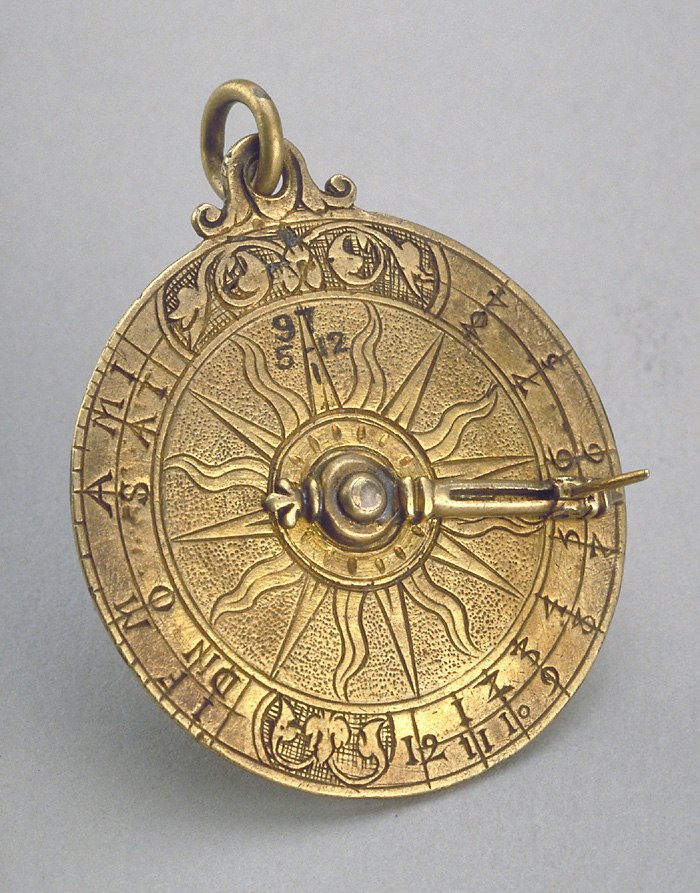
This late 16th-century Spanish vertical disc dial is a bronze portable horological instrument measuring 42 mm in diameter. The dial, held in the collection of the British Museum, is unsigned and designed for vertical suspension. It functions by being oriented towards the sun while the user adjusts a folding pin gnomon to the appropriate time of the year. The device features an integral suspension ring and is decorated with a relief portrait of King Philip of Spain on one side, including an inscription referencing his titles. The opposing side presents the timekeeping face, which integrates an alidade, a folding gnomon, and engraved hour scales ranging from 4 to 12 to 8. The central portion of the dial displays a sun effigy set against a dotted background, accompanied by foliage ornamentation at the top and bottom edges. The instrument was donated by Max Rosenheim in 1897.

Vertical disc dial showing the front face with alidade, folding gnomon, sun motif, and engraved time/month scales.
Vertical disc dial showing the front face with alidade, folding gnomon, sun motif, and engraved time/month scales. — © British Museum, London. Rights pending — permission not yet requested. Original source

Catalogue identity

Source
www.mhs.ox.ac.uk
Category
Tool · Iberian vertical disc dial
Maker / attribution
Not established
Reference
Not recorded
Catalogue / lot identifier
MLA 1897, 5-12.1
Source-reported date
Late 16th century
Source-reported place
Spain

Source-reported attribution and specifications are not independent authentication. A listing does not establish present ownership, current display, availability or permission to reproduce.

Object description

Design and Ornamentation

The disc dial is constructed from bronze and measures 42 mm in diameter. It is equipped with a small suspension ring, allowing the user to hang the device vertically for observation. One side of the bronze plate is occupied by a relief medal-style bust of King Philip of Spain. The King is depicted wearing armour and a laurel wreath, surrounded by a Latin inscription that denotes his royal titles.

The reverse side serves as the time-telling face. It is embellished with foliage designs at the top and bottom positions. The center of the plate features a stylized sun effigy set within a background of stippled or dotted detail, providing a decorative focal point for the functional components of the dial.

Evidence for this section
  • “This bronze disc dial with suspension ring has on one side a medal bust in relief, of Philip of Spain in armour with a laurel wreath, surrounded by the inscription ' ? PHILIPPVS ? D ? G ? HISP ? ET ? ANGLIA ? REX ?'.”

Timekeeping Functionality

The instrument functions as a vertical disc dial, which requires the user to hold it in a vertical orientation relative to the sun. It includes an adjustable alidade that supports a folding pin gnomon. The user must position this gnomon according to the time of the year to properly calibrate the instrument for seasonal changes.

The hour scale is engraved along the outer portion of the face, marked from 4 to 12 to 8 on the right side. On the left side of the dial, there are engraved initials representing the names of the months, which assist in setting the gnomon. Once the instrument is correctly aligned, the shadow cast by the pin gnomon indicates the time on the peripheral scale.

Evidence for this section
  • “In use, the instrument has to be held vertical in the sun's direction, and the folding pin gnomon set to the time of the year. The shadow of the gnomon will then read the time on the opposite side of the dial .”
  • “The other side of the disc has an alidade with folding pin gnomon and hour lines engraved from 4 to 12 to 8, on the right hand side, and the initials of the names of the months on the left hand side.”

Provenance and Documentation

The dial was formally acquired by the British Museum in 1897 following its presentation by Max Rosenheim. The object is cataloged under the inventory number MLA 1897, 5-12.1. It is documented in F. A. B. Ward's 1981 work, 'A Catalogue of European Scientific Instruments in the Department of Medieval and Later Antiquities of the British Museum'.

The museum notes that the dial is similar in design to two other vertical disc dials held in the collections of the Museum of History of Science in Oxford. These comparisons suggest a specific tradition of instrument making within the late 16th-century Spanish context, though the primary object itself remains unsigned by its original maker.

Evidence for this section
  • “The dial was presented by Max Rosenheim in 1897, and is described in F. A. B. Ward, A Catalogue of European Scientific Instruments in the Department of Medieval and Later Antiquities of the British Museum (London, 1981), p. 64, no.178.”
  • “The instrument is similar to two other vertical disc dials in the Museum of History of Science, Oxford.”

Open research questions

  • What is the specific mechanical mechanism that allows the folding gnomon to account for seasonal variations?
  • To which specific workshop or region within Spain might this dial be attributed based on the similarities to the Oxford examples?

Source evidence

Recorded claims and source quotations for Vertical Disc Dial
FieldSource-reported valueSource quotation
MakerUnsigned“Unsigned”
MaterialBronze“Bronze”
Dimensions42 mm diameter“42 mm in diameter”
OriginSpanish“Spanish”
DateLate 16th century“Late 16th century”
Registration numberMLA 1897, 5-12.1“MLA 1897, 5-12.1”
Inscription' ? PHILIPPVS ? D ? G ? HISP ? ET ? ANGLIA ? REX ?'“? PHILIPPVS ? D ? G ? HISP ? ET ? ANGLIA ? REX ?”
ProvenancePresented by Max Rosenheim in 1897“The dial was presented by Max Rosenheim in 1897”

Visible details

  • Integral suspension ring at the top
  • Sun effigy with a dotted background at the center
  • Folding pin gnomon mounted on an alidade
  • Engraved hour scales and month initials

Research qualifications

  • Uncertain if the attribution to late 16th-century Spain is definitive
  • The exact functional accuracy of the instrument remains unverified in the provided data

Photograph identity and source facts were screened before import; rights clearance remains pending.

Consulted source

Vertical Disc Dial

Reviewed 2026-10-26 · Record 1bf88db9bc

Terms in this record

Glossary explanations for terms named in this object’s record.