
Skip to content
The Encyclopedia of Horology

Component · Tower clock pendulum

Tower clock pendulum

Partially verified

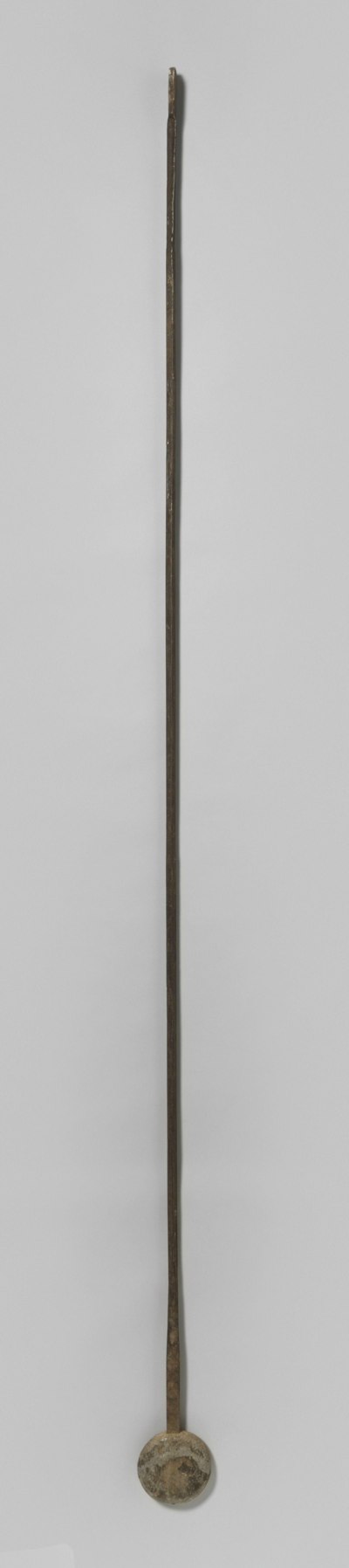
This object is a forged iron pendulum originating from a tower clock that was housed in the Waterpoort in Gorinchem. The pendulum is currently preserved in the collection of the Rijksmuseum in Amsterdam under accession number BK-NM-11197-3. It is dated by the institution to the period between circa 1585 and circa 1615. The component measures 265 cm in length and was constructed using iron metal through a forging process. The pendulum was recovered following the demolition of the Waterpoort, a fortified gatehouse, in 1893. While the specific maker of the pendulum is not recorded, it survives as a component associated with the historic tower clock mechanism from that gatehouse. The documentation provides physical dimensions and material data but notes an absence of specific visual or decorative details within the museum catalogue.

Forged iron pendulum of the tower clock, measuring 265 cm in length.
Forged iron pendulum of the tower clock, measuring 265 cm in length. — Rijksmuseum, Amsterdam. Rights pending — permission not yet requested. Original source

Catalogue identity

Source
orbiscollectibles.com
Category
Component · Tower clock pendulum
Maker / attribution
Not established
Reference
Not recorded
Catalogue / lot identifier
BK-NM-11197-3
Source-reported date
c. 1585 - c. 1615
Source-reported place
Netherlands

Source-reported attribution and specifications are not independent authentication. A listing does not establish present ownership, current display, availability or permission to reproduce.

Object description

Object Provenance and History

The pendulum is documented as having originated from the Waterpoort in Gorinchem, a fortified gatehouse that previously formed part of the town fortifications in the province of South Holland. Positioned near a landing stage on the river Merwede, the gatehouse contained a tower clock until its demolition in 1893.

Following the destruction of the structure, the clock mechanism and various architectural fragments were salvaged and preserved. The pendulum is currently part of the Rijksmuseum collection in Amsterdam, catalogued as part of the material history of the gatehouse clock.

Evidence for this section
  • “originally came from the demolished Waterpoort in Gorinchem”
  • “Until its demolition in 1893, the gatehouse housed a tower clock, whose historic movement was preserved alongside architectural fragments of the demolished gate.”

Physical Construction

The component is manufactured from iron using a forging technique, resulting in a single vertical rod with an integrated weight at the bottom. The total length of the piece is recorded as 265 cm.

The museum documentation acknowledges that there are no specific details regarding potential decorative elements or inscriptions that might appear on the metal surface. It is identified within the museum classification as a component for a tower clock.

Evidence for this section
  • “physical material of the piece is documented as iron (metal), and its technique is recorded as forging.”
  • “The object has a recorded measurement of 265 cm in length.”
  • “The museum catalogue provides no specific details regarding its visual design, decorative elements, inscriptions, or legends.”

Institutional Documentation

The object is held and registered by the Rijksmuseum, Amsterdam, under the museum object number BK-NM-11197-3. The piece is dated by the institution to the interval between approximately 1585 and 1615.

The record status is defined as an individual type, and it is explicitly noted that the maker of the pendulum remains unrecorded in current documentation.

Evidence for this section
  • “It is preserved in the collection of the holding institution, the Rijksmuseum, Amsterdam, where it is registered under the museum object number BK-NM-11197-3.”
  • “The pendulum is dated to circa 1585 – circa 1615”
  • “the maker remains unrecorded.”

Open research questions

  • Confirm the connection of this pendulum to specific escapement types utilized in late 16th-century Dutch tower clocks.
  • Investigate whether any surviving components of the movement from the Waterpoort in Gorinchem are held in other collections to verify the clock's original mechanism.

Source evidence

Recorded claims and source quotations for Tower clock pendulum
FieldSource-reported valueSource quotation
Materialiron (metal)“iron (metal)”
Techniqueforging“forging”
Length265 cm“lengte 265 cm”
Accession NumberBK-NM-11197-3“BK-NM-11197-3”
OriginWaterpoort in Gorinchem“originally came from the demolished Waterpoort in Gorinchem”
Datingc. 1585 - c. 1615“c. 1585 - c. 1615”

Visible details

  • The object has a long, slender rod structure.
  • A circular or disc-shaped weight is visible at the lower end.

Research qualifications

  • The exact horological function and mechanism configuration remain unverified beyond its classification as a tower clock component.
  • Attribution of the specific construction period is based on institutional dating that may require further comparative research.

Photograph identity and source facts were screened before import; rights clearance remains pending.

Consulted source

Pendulum of the tower clock

Reviewed 2026-11-02 · Record e9ed7bf716

Terms in this record

Glossary explanations for terms named in this object’s record.