
Skip to content
The Encyclopedia of Horology

Clock · Table clock

Tower clock on a gilded wooden base

Partially verified

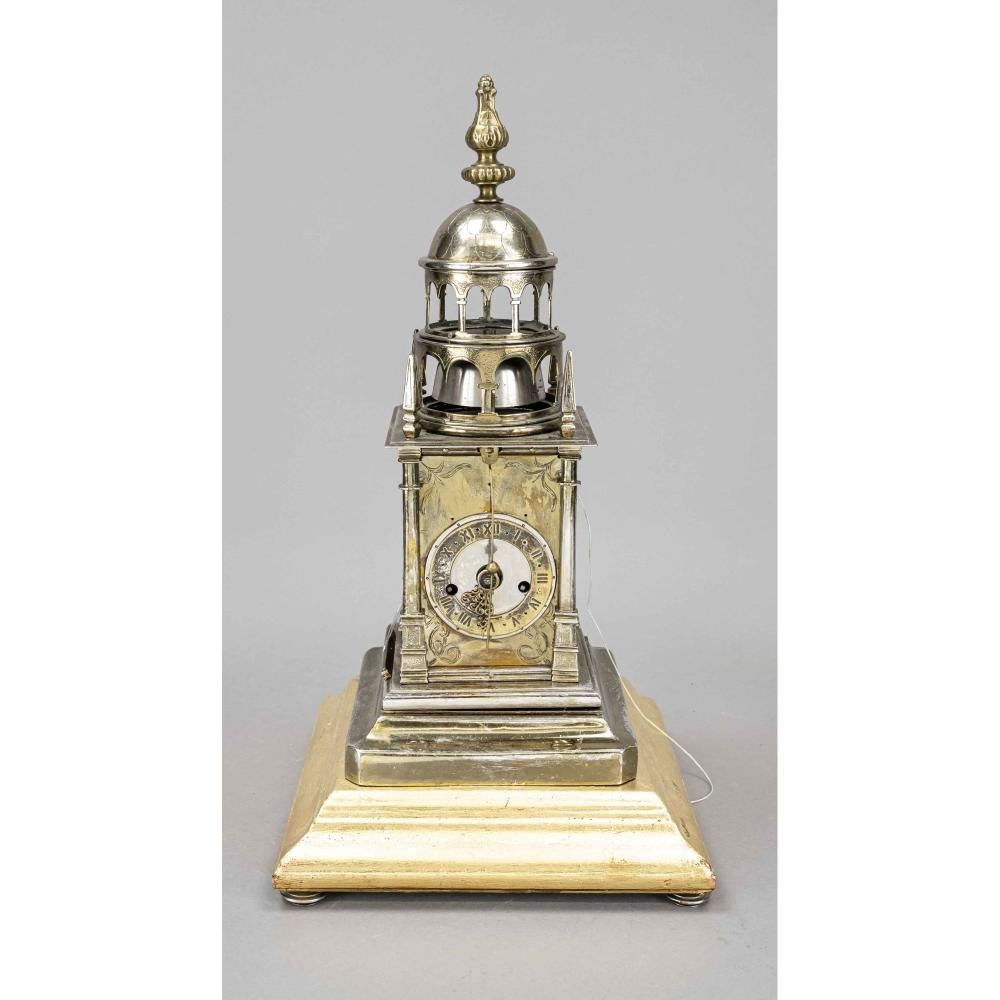
According to auction catalog documentation, this clock is styled as an 18th-century tower clock mounted upon a gilded wooden base. The case is constructed from silver-plated brass, featuring an engraved facade and openwork windows along the sides. The architectural body rises to an arcaded upper superstructure holding an exposed bell for striking. The movement incorporates front-striking with hour strike on the upper bell, though the auctioneer notes it starts only briefly, needs servicing, and has parts missing from the face.

Front view of the silver-plated brass tower clock on a gilded wooden base
Front view of the silver-plated brass tower clock on a gilded wooden base — Historia Auctionata. Rights pending — permission not yet requested. Original source

Catalogue identity

Source
www.invaluable.com
Category
Clock · Table clock
Maker / attribution
Not established
Reference
Not recorded
Catalogue / lot identifier
6806
Source-reported date
18th century
Country
Not established

Source-reported attribution and specifications are not independent authentication. A listing does not establish present ownership, current display, availability or permission to reproduce.

Object description

Architectural Form and Materials

The lot is cataloged as a tower clock measuring 48 x 25 x 25 cm, constructed from silver-plated brass and mounted upon a gilded wooden base. Visible observation notes a tiered architectural body set on a stepped rectangular plinth with low feet.

The body features openwork windows along its sides, rising to an arcaded upper superstructure that encloses an exposed bell. The structure is capped by a domed top surmounted by a decorative finial.

Evidence for this section
  • “Tower clock on a gilded wooden base”
  • “silver-plated brass”
  • “with openwork windows on the sides”
  • “48 x 25 x 25 cm”
  • “Mounted on a stepped rectangular gilded wooden plinth with low feet”
  • “Openwork arcaded windows on the superstructure enclosing an exposed bell”
  • “Domed top surmounted by a decorative finial”

Dial and Visible Facade

The front plate of the case is engraved with scrollwork framing a dial indicated with Roman numerals. A single openwork decorative hand is visible at the dial center.

The auction catalog expressly notes that some parts are missing from the face. The specific identity of the absent elements is not identified in the lot description.

Evidence for this section
  • “dial with Roman numerals”
  • “some parts missing from the face”
  • “Front plate engraved with scrollwork around a dial with Roman numerals”
  • “Single decorative openwork hand visible at the dial center”

Reported Striking Mechanism and Operating Status

According to the catalog text, the clock incorporates front-striking, with the movement sounding the hour strike on an upper bell. The maker, movement layout, train configuration, and escapement type are not recorded in the source.

In terms of functional condition, the auctioneer reports that the movement starts only briefly and needs servicing. Full mechanical integrity and running order remain unverified.

Evidence for this section
  • “front-striking”
  • “movement with hour strike on an upper bell”
  • “starts briefly, needs servicing”

Dating and Catalog Attribution

The auction catalog assigns the clock to the 18th century, but does not cite any maker's signatures, foundry stamps, or hallmarks to substantiate this period.

The auction house's terms of sale stipulate that datings, descriptions of materials, and attribution indications represent the opinion of the house and statements of consignors rather than guaranteed statements of condition or authenticity.

Evidence for this section
  • “18th century”
  • “These artist's indications, datings as well as indications of processed materials are based on the opinion of Historia and indications of the consignors”

Open research questions

  • What specific dial components (such as an alarm disc, setting arbor, or secondary hand) are absent from the clock face?
  • Does the movement plate bear any maker marks, serial stamps, or regional characteristics when removed from the case?
  • Does metallurgical inspection confirm 18th-century brass fabrication, or does the piece represent a later historicist production?

Source evidence

Recorded claims and source quotations for Tower clock on a gilded wooden base
FieldSource-reported valueSource quotation
Era18th century“18th century”
MaterialSilver-plated brass“silver-plated brass”
BaseGilded wooden base“gilded wooden base”
Striking MechanismHour strike on an upper bell“movement with hour strike on an upper bell”
Dimensions48 x 25 x 25 cm“48 x 25 x 25 cm”
Striking OrientationFront-striking“front-striking”
Operating StatusStarts briefly, needs servicing“starts briefly, needs servicing”
Face ConditionSome parts missing from the face“some parts missing from the face”

Visible details

  • Silver-plated brass architectural body styled as a tiered tower
  • Openwork arcaded windows on the superstructure enclosing an exposed bell
  • Domed top surmounted by a decorative finial
  • Front plate engraved with scrollwork around a dial with Roman numerals
  • Single decorative openwork hand visible at the dial center
  • Mounted on a stepped rectangular gilded wooden plinth with low feet

Research qualifications

  • Source notes some parts are missing from the face
  • Source reports movement only starts briefly and needs servicing
  • Dating to the 18th century is source-reported without independent verification

Photograph identity and source facts were screened before import; rights clearance remains pending.

Consulted source

Sold at Auction: Watches, TOWER CLOCK ON A GILDED WOODEN B

Reviewed 2026-10-21 · Record 1817de6e2e

Terms in this record

Glossary explanations for terms named in this object’s record.