
Skip to content
The Encyclopedia of Horology

Clock · Banjo clock

Timepiece

Partially verified

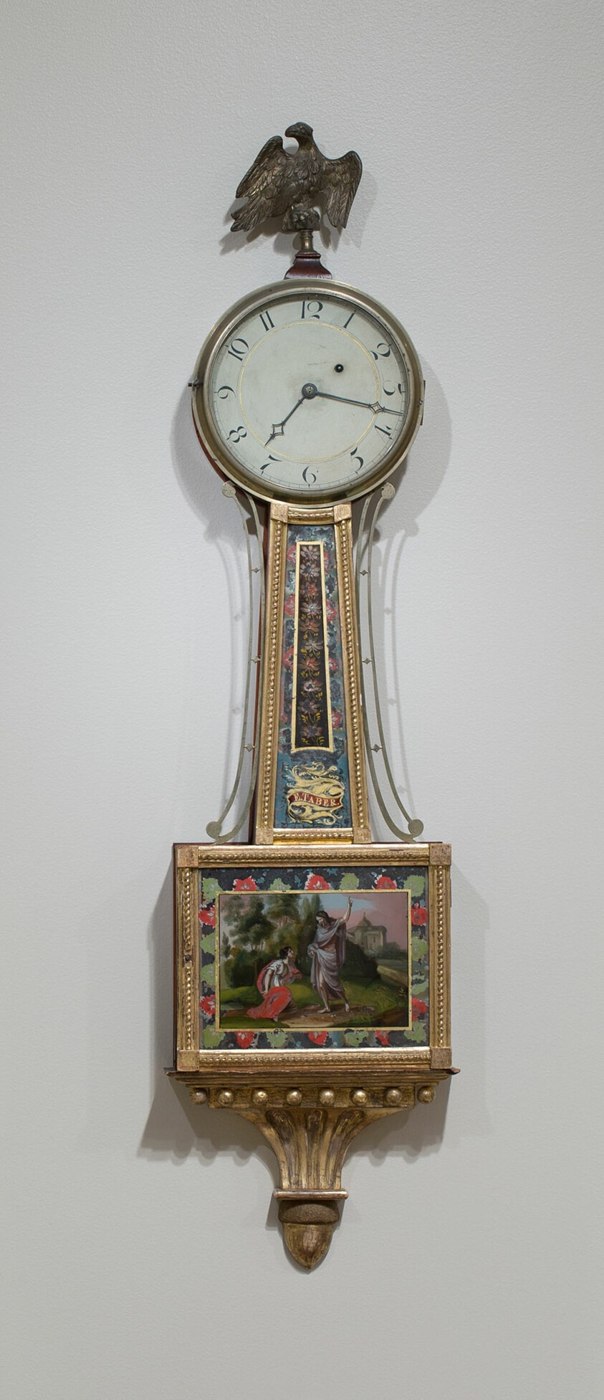
This timepiece, held in the collection of the Art Institute of Chicago, is attributed to the maker Elnathan Taber of Roxbury, Massachusetts. Produced between 1802 and 1805, the object stands 109.2 cm tall. Its construction incorporates a mixture of wood, glass, and metal elements, specifically utilizing gilt mahogany, white pine, painted glass, gesso, iron, steel, and brass. The signature 'E. Taber' appears prominently within the central painted panel of the waist section. The object remains documented in the Art Institute of Chicago's register, which serves as the primary source for the technical and provenance information presented here.

Full view of the wall-mounted timepiece showing the eagle finial, circular dial, and decorative painted glass panels.
Full view of the wall-mounted timepiece showing the eagle finial, circular dial, and decorative painted glass panels. — Art Institute of Chicago. Rights pending — permission not yet requested. Original source

Catalogue identity

Source
orbiscollectibles.com
Category
Clock · Banjo clock
Maker / attribution
Elnathan Taber
Reference
Not recorded
Catalogue / lot identifier
144345
Source-reported date
1802–5
Source-reported place
United States

Source-reported attribution and specifications are not independent authentication. A listing does not establish present ownership, current display, availability or permission to reproduce.

Object description

Construction and Design

The timepiece is constructed primarily from mahogany and white pine, with significant surfaces finished in gesso and gilding. The overall silhouette is vertical, designed to be mounted on a wall, featuring a circular housing for the dial surmounted by an eagle-form finial. Below the dial, the case narrows into a central trunk decorated with floral motifs painted on glass, which also bears the maker's signature.

The lower section of the case forms a rectangular box, which is similarly ornamented with a reverse-painted glass panel displaying a scene with two figures. Structural supports are provided by brass side elements that bridge the transition between the upper dial housing and the narrower waist, providing both aesthetic detail and structural reinforcement to the upper assembly.

Evidence for this section
  • “Gilt mahogany and white pine, painted glass, gesso, iron, steel, and brass”
  • “H.: 109.2 cm (43 in.)”

Signature and Attribution

The clock is identified by the Art Institute of Chicago as a product of the workshops associated with Elnathan Taber. The specific piece is dated by the institution to the early nineteenth century, specifically the window of 1802 to 1805.

The signature 'E. TABER' is visible on the painted glass of the central trunk, identifying the maker or the workshop responsible for the piece. While these details are held within the museum's catalogue, the documentation notes that these associations are based on the museum's institutional record, and all information is extracted from their specific entry.

Evidence for this section
  • “Works by Elnathan Taber (American, 1768–1854) Roxbury, Massachusetts, made in Roxbury”
  • “The museum record attributes this piece to Works by Elnathan Taber”

Documentation and Provenance

The timepiece is currently held in the collection of the Art Institute of Chicago under the accession number 144345. The museum serves as the primary source for the physical descriptions and dating of this object, cataloguing it under the category of a furniture accessory.

The documentation provided indicates that the museum's record is the source for all data points, and no outside, independently verified catalogue references are associated with the piece. The record status is listed as partial, acknowledging the nature of the information available in the institution's collection API.

Evidence for this section
  • “Held by Art Institute of Chicago (object no. 144345)”
  • “All details come from the object's own museum catalogue record”

Open research questions

  • What specific type of movement is housed within the casing?
  • Are there any surviving records or receipts relating to the initial commission of this timepiece in Roxbury?

Source evidence

Recorded claims and source quotations for Timepiece
FieldSource-reported valueSource quotation
MakerElnathan Taber“Works by Elnathan Taber (American, 1768–1854)”
Date1802–5“dated 1802–5”
Dimensions109.2 cm“H.: 109.2 cm (43 in.)”
MaterialsGilt mahogany, white pine, glass, gesso, iron, steel, brass“Gilt mahogany and white pine, painted glass, gesso, iron, steel, and brass”
LocationRoxbury, Massachusetts“Roxbury, Massachusetts, made in Roxbury”
Museum Number144345“object no. 144345”

Visible details

  • Eagle finial perched atop the circular clock dial
  • Painted glass panel in the lower box section depicting a figurative scene
  • Tapered waist section with floral ornamentation and signature
  • Brass side scrolling brackets connecting the dial housing to the trunk

Research qualifications

  • The exact provenance history beyond its inclusion in the Art Institute of Chicago is not detailed.
  • Details regarding the internal movement mechanism are not provided in the source documentation.

Photograph identity and source facts were screened before import; rights clearance remains pending.

Consulted source

Timepiece

Reviewed 2026-11-02 · Record ff5257e298

Terms in this record

Glossary explanations for terms named in this object’s record.