
Skip to content
The Encyclopedia of Horology

Clock · Mantel clock

The Astronomy Lesson French Empire Mantel Clock

Partially verified

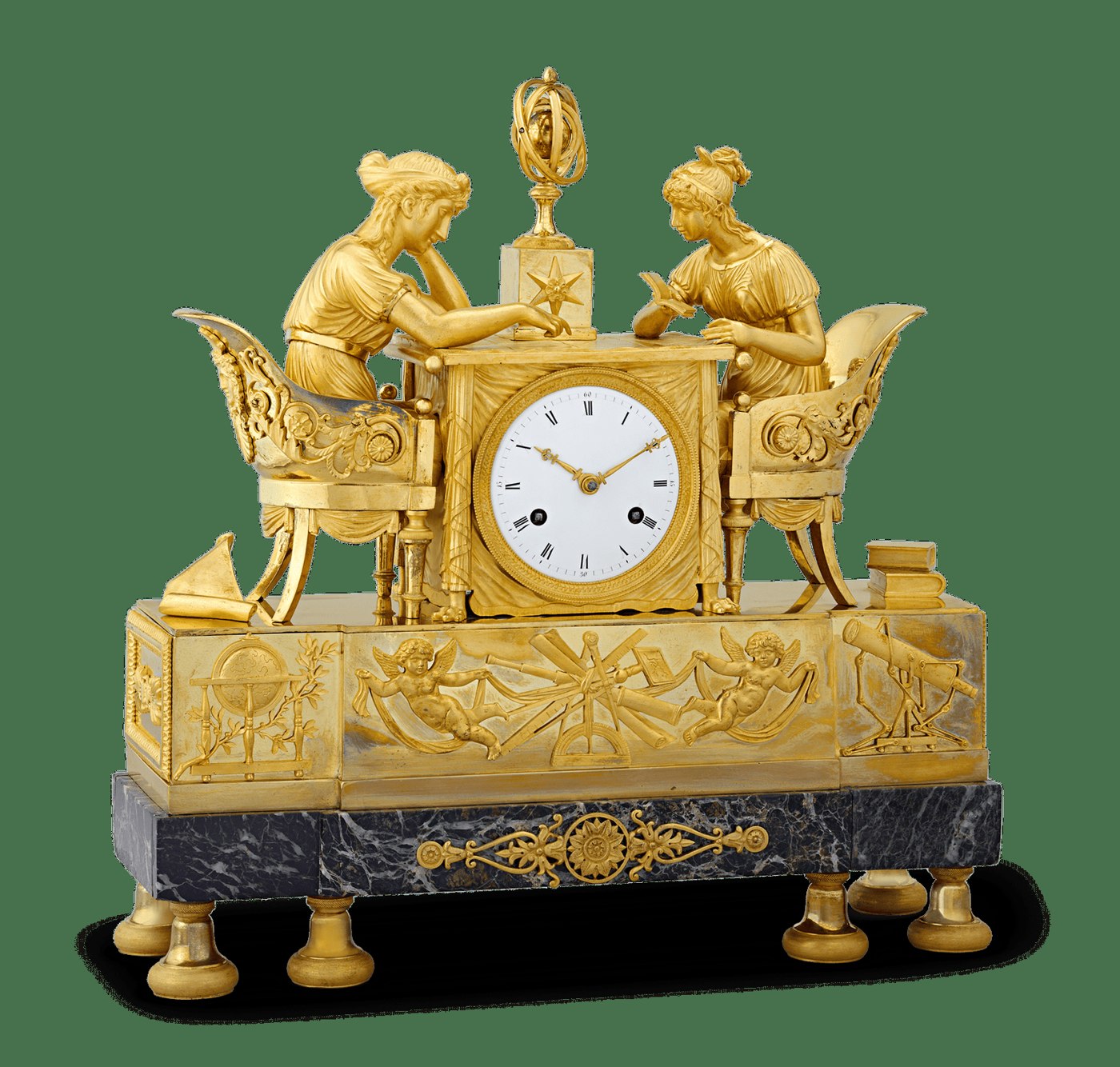
This mantel clock is executed in ormolu and features a central plinth supporting an armillary sphere, flanked by two figures of women seated in chairs during an astronomy lesson. The clock dial is white enamel with Roman numerals, set into the front of the table-form case. The base is constructed of verde antico marble and incorporates ormolu decorative mounts, including central putti, scientific instruments, a terrestrial globe, and a telescope. The composition features a governess and a pupil, with books placed on the floor surface. The clock measures approximately 16 inches high by 15.5 inches wide by 5 inches deep. Attributed to the French Empire period, the design depicts a scene recognized as "The Astronomy Lesson," featuring figures in period dress seated on Empire-style chairs.

The Astronomy Lesson French Empire mantel clock, showing the armillary sphere, seated figures, and detailed base ornamentation.
The Astronomy Lesson French Empire mantel clock, showing the armillary sphere, seated figures, and detailed base ornamentation. — M.S. Rau. Rights pending — permission not yet requested. Original source

Catalogue identity

Source
rauantiques.com
Category
Clock · Mantel clock
Maker / attribution
Not established
Reference
Not recorded
Catalogue / lot identifier
Source URL identifies the listing
Source-reported date
Circa 1810
Source-reported place
France

Source-reported attribution and specifications are not independent authentication. A listing does not establish present ownership, current display, availability or permission to reproduce.

Object description

Case and Figurative Composition

The clock is configured as a narrative scene, featuring two female figures seated in ornate chairs, positioned on opposite sides of a central rectangular plinth. The figures are dressed in attire described as period clothing and are depicted in a scholarly setting. Between the figures, atop the plinth, rests an armillary sphere. Additional details on the base platform include a stack of books and a singular volume, contributing to the theme of an astronomy lesson.

The rectangular housing for the clock movement is designed to resemble a table, integrated between the two chairs. The primary base consists of a slab of verde antico marble, elevated on ormolu feet. The front of this base is adorned with a relief frieze featuring two putti flanking a central arrangement of various scientific instruments, while a terrestrial globe and a telescope are positioned at the far ends of the base decoration.

Evidence for this section
  • “This clock features a governess and her young pupil during an astronomy lesson.”
  • “The pair sit on luxurious Empire-style chairs, highly decorated with elaborate scrollwork”
  • “the base features fitting motifs such as a pair of putti presenting an array of scientific instruments, a table globe and an impressive astronomical telescope.”

Dial and Movement

The clock movement is housed within the central plinth structure. The dial is composed of white enamel and features Roman numerals for the hours. The hands are visible against the face of the dial.

The rear of the movement housing is open, revealing a cylindrical bell and parts of the movement assembly, including the hammer and motion work. The layout allows for access to the mechanical components of the clock, which remain mounted within the gilded bronze table housing.

Evidence for this section
  • “the clock's white enamel dial and verde antico marble base perfectly complete an overall symphony of opulence.”

Historical Context and Comparisons

The listing identifies the scene as "The Astronomy Lesson," noting it as a recognizable motif from the early 19th century. The source compares the composition to a clock owned by Emperor Napoleon, which was produced by the bronzier Jean-André Reiche in 1807.

The clock is characterized as an object intended to represent luxury within the Empire period.

Evidence for this section
  • “Emperor Napoleon owned a similar clock made by master bronzier Jean-André Reiche in 1807”
  • “Women were often used as the subject in clocks where learning or technology was involved during this period, indicating the feeling of emancipation for women in the new France after the revolution.”

Open research questions

  • What specific movement manufacturer's marks, if any, are present on the backplate of the movement?
  • Does the ormolu casting bear any foundry stamps or signatures indicating the specific production date or maker?

Source evidence

Recorded claims and source quotations for The Astronomy Lesson French Empire Mantel Clock
FieldSource-reported valueSource quotation
DateCirca 1810“Circa 1810”
MaterialsOrmolu, white enamel, verde antico marble“white enamel dial and verde antico marble base”
Dimensions16" high x 15 1/2" wide x 5" deep“16" high x 15 1/2" wide x 5" deep”
SubjectAn astronomy lesson with a governess and pupil“This clock features a governess and her young pupil during an astronomy lesson.”
MountsPutti, table globe, astronomical telescope“the base features fitting motifs such as a pair of putti presenting an array of scientific instruments, a table globe and an impressive astronomical telescope.”

Visible details

  • Armillary sphere mounted on central plinth
  • White enamel dial with Roman numerals
  • Verde antico marble base
  • Ormolu decorative elements depicting scientific tools

Research qualifications

  • The source attributes the design to Jean-André Reiche by comparison but does not state this specific clock is by that maker.
  • The source provides a general date of circa 1810 without specific provenance or manufacturing records.

Photograph identity and source facts were screened before import; rights clearance remains pending.

Consulted source

ساعت شومینه‌ای درس نجوم؛ امپراتوری فرانسه

Reviewed 2026-11-02 · Record 5c65424495

Terms in this record

Glossary explanations for terms named in this object’s record.