
Skip to content
The Encyclopedia of Horology

Clock · Globe clock

Terrestrial Globe Clock

Partially verified

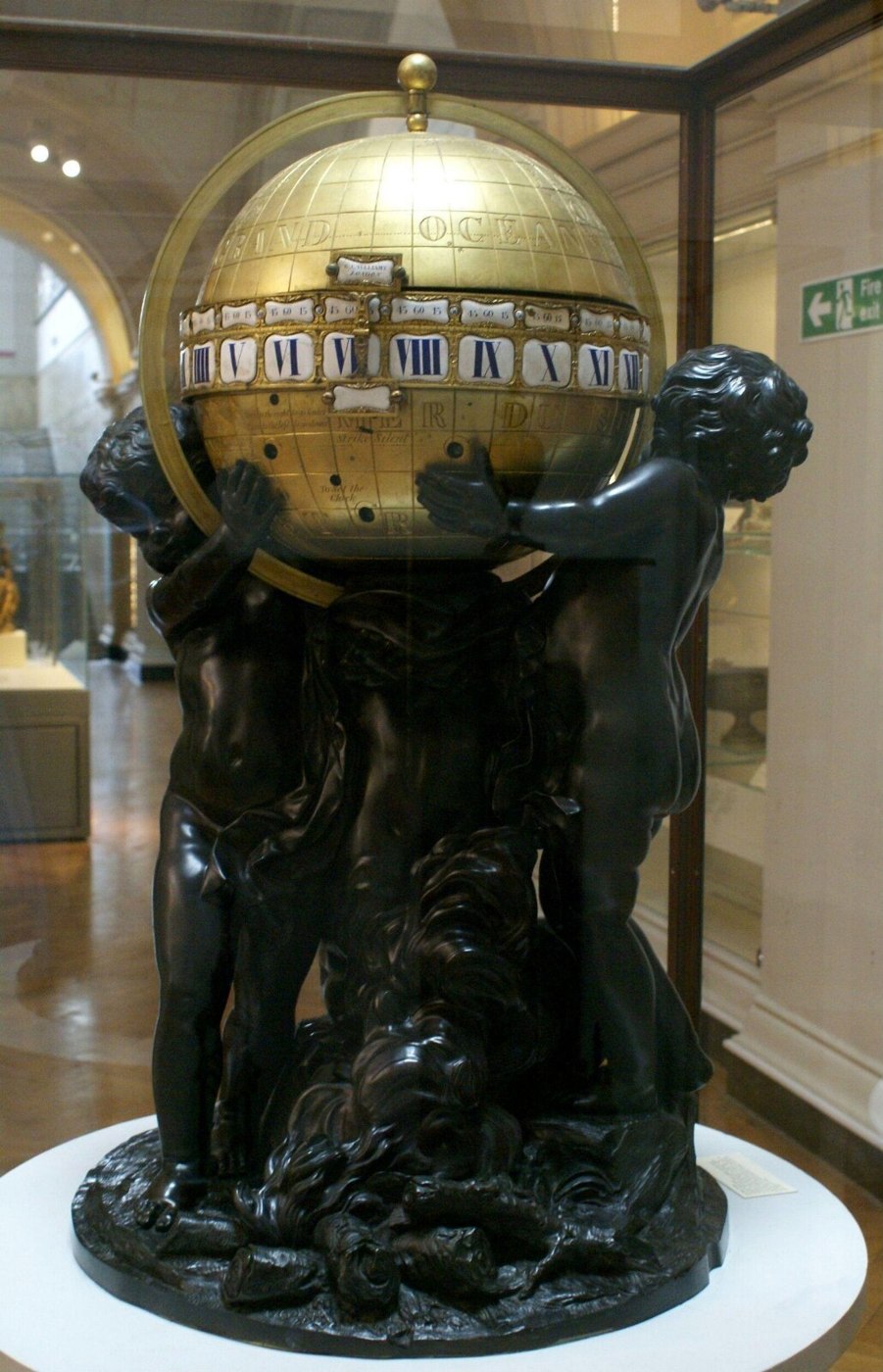
This terrestrial globe clock stands 1175 mm high with a diameter of 503 mm. The dial is formed by a concentric enamel ring fixed around the globe's equator, indicated by a snake's head pointer. The case is attributed to French production, dating to approximately 1783-1785. The original internal movement by the Parisian clockmaker Jean Romilly was replaced between 1805 and 1810 by a balance clock movement created by the London maker Benjamin Lewis Vulliamy. The movement plate bears the inscription 'VULLIAMY LONDON 155'. The entire sculptural assembly is mounted on friction rollers, allowing it to revolve. The piece was acquired by the South Kensington Museum in 1857 from the executors of Benjamin Lewis Vulliamy.

Terrestrial globe clock supported by three putti, with a snake-head pointer at the equator.
Terrestrial globe clock supported by three putti, with a snake-head pointer at the equator. — Victoria and Albert Museum. Rights pending — permission not yet requested. Original source

Catalogue identity

Source
collections.vam.ac.uk
Category
Clock · Globe clock
Maker / attribution
Jean Romilly (case/original); Benjamin Lewis Vulliamy (movement)
Reference
Not recorded
Catalogue / lot identifier
4311-1857
Source-reported date
1783-1785 (case); 1805-1810 (movement)
Source-reported place
France; United Kingdom
Source-reported serial
155

Source-reported attribution and specifications are not independent authentication. A listing does not establish present ownership, current display, availability or permission to reproduce.

Object description

Construction and Design

The clock is designed as a terrestrial globe, supported by a grouping of three cast bronze putti figures. Two of these figures are identified by the auction records as representations of Earth and Fire. The globe itself is fashioned from gilt brass, with geographical features engraved onto the surface.

The time-telling mechanism is integrated into the equator of the globe, which features a concentric ring holding enamel plaques inscribed with Roman numerals. Time is read via a pointer designed in the shape of a snake's head. The entire sculptural group is mounted on friction rollers, which allows the user to rotate the assembly to view the figures from different angles without disrupting the clock's operation.

Evidence for this section
  • “The clock is in the form of a terrestial globe which is supported by three putti, two representing the elements of Earth and Fire.”
  • “The dial is in the form of a concentric ring situated as an equator with a snake's head pointer to indicate the time.”
  • “The entire group can, if required, for the convenience of seeing the figures all round, be very easily made to revolve on friction rollers, without fear of stopping the clock.”

Movement and Attribution

The clock incorporates a movement by the London maker Benjamin Lewis Vulliamy, produced between 1805 and 1810. This movement replaced an earlier mechanism originally supplied by the Parisian clockmaker Jean Romilly, which was reported as worn out by time. The Vulliamy movement is a balance clock capable of striking the hours and quarters.

The movement plate is inscribed with 'VULLIAMY LONDON 155'. Historical correspondence from Vulliamy suggests that the casing, while paired with the Romilly movement in the 18th century, may be of an earlier period or different origin than the movement itself, reflecting common 19th-century practices of updating antique French cases with contemporary movements.

Evidence for this section
  • “now with a later movement by Benjamin Lewis Vulliamy, London, 1805-10.”
  • “The movement originally placed in the Globe was made by ROMILLY”
  • “The inscription is on the plate of the lever movement.”

Provenance and History

The clock was in the possession of Benjamin Lewis Vulliamy before being lent to the Museum of Ornamental Art at Marlborough House in 1853. It was purchased by the museum from Vulliamy's executors in 1857. An 1856 watercolour by William Linnaeus Casey documents the clock as part of the Marlborough House displays, an early precursor to the Victoria and Albert Museum collection.

The clock has been the subject of varied historical speculation regarding its casting. While some early 19th-century commentary attributed the bronze work to a Florentine origin, others suggested it was 18th-century work associated with the Romilly clock. The piece is also cited in historical records from the Society of Antiquaries and compared to similar globe clocks owned by the Duke of Sutherland.

Evidence for this section
  • “The clock was originally made in France during the 18th century and contained a movement by Jean Romilly which was later removed and replaced by Benjamin Lewis Vulliamy”
  • “It was purchased from Vulliamy's executors by the Museum in 1854”
  • “In the Utensils and Furniture album of drawings in the Library of the Society of Antiquaries is an engraving of the clock with the legend.”

Open research questions

  • What is the definitive metallurgical composition of the bronze figures?
  • Can the specific casting techniques used for the putti be reconciled with documented 18th-century French manufacturing methods versus the 19th-century copies mentioned in Vulliamy's notes?

Source evidence

Recorded claims and source quotations for Terrestrial Globe Clock
FieldSource-reported valueSource quotation
Object TypeGlobe clock“Object type: Globe clock”
Original MakerJean Romilly“originally by Jean Romilly, Paris, 1783-5”
Restoring MakerBenjamin Lewis Vulliamy“now with a later movement by Benjamin Lewis Vulliamy, London, 1805-10.”
MaterialsBronze, brass, steel, enamel“bronze, brass, steel and enamel”
InscriptionVULLIAMY LONDON 155“VULLIAMY LONDON 155”
MechanismRevolving base on friction rollers“The entire group can, if required, for the convenience of seeing the figures all round, be very easily made to revolve on friction rollers, without fear of stopping the clock.”

Visible details

  • Three bronze putti figures support the central globe.
  • A metal snake's head functions as the time indicator.
  • The central globe is engraved with geographical details including 'GRAND OCEAN'.

Research qualifications

  • The exact casting date and origin of the bronze figures remain unverified, with sources debating between a mid-18th-century French origin and an earlier Florentine attribution.
  • The representation of the four elements by the putti is an interpretation suggested by Vulliamy rather than a confirmed sculptural fact.

Photograph identity and source facts were screened before import; rights clearance remains pending.

Consulted source

Globe clock

Reviewed 2026-11-02 · Record 6fb2015dae

Terms in this record

Glossary explanations for terms named in this object’s record.