
Skip to content
The Encyclopedia of Horology

Clock · Tall case clock

Tall-Case Clock

Partially verified

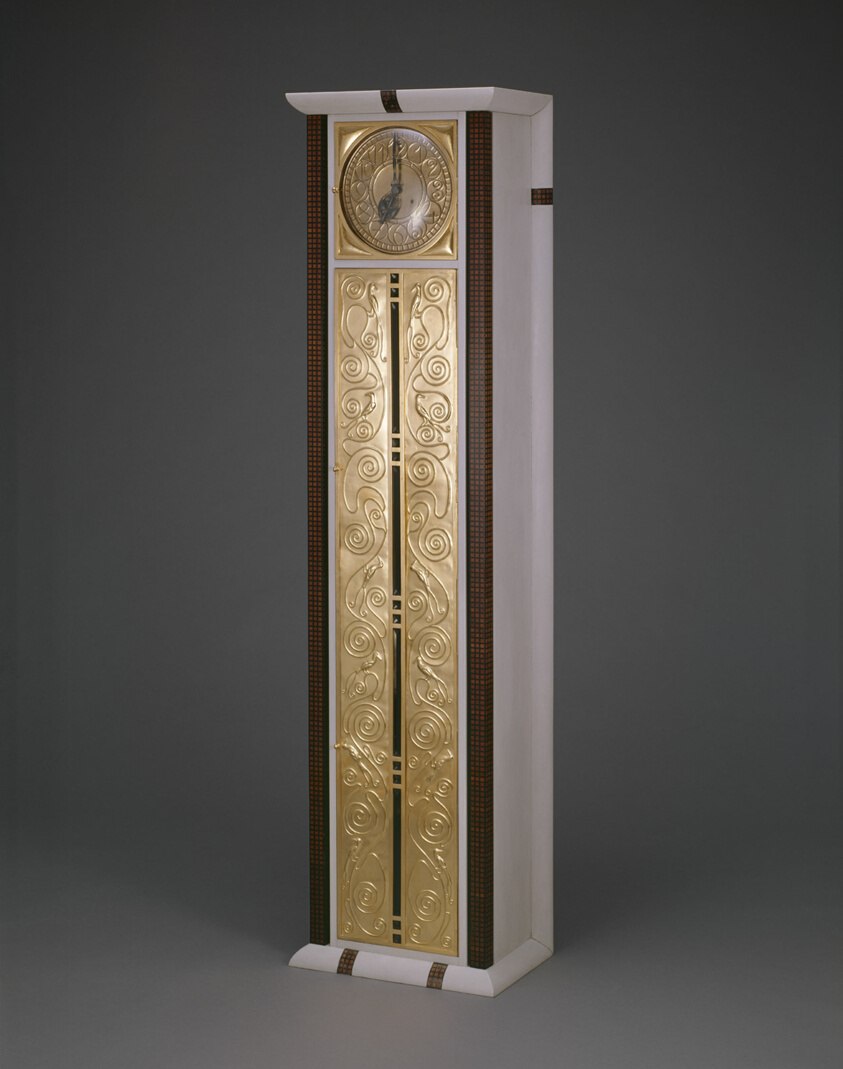
This tall-case clock, produced in Vienna, Austria, around 1906, was manufactured by the Wiener Werkstätte. The timepiece features a case designed by Josef Hoffmann and metalwork components created by Carl Otto Czeschka. Constructed from a mixture of materials including white-painted maple, ebony, mahogany, gilt brass, glass, silver-plated copper, and patinated bronze, the clock stands 179.5 cm high. The design utilizes rectilinear forms in the white-painted maple structure, which is accented by an inlaid checkered pattern. The door incorporates hand-embossed gilt brass with cut-glass prisms, featuring a stylized tree of life motif. Positioned above this ornamental door is a square clock face framed in gilt brass. The clock remains in the collection of the Art Institute of Chicago.

A full-length view of the tall-case clock, displaying its white-painted maple case with checkered inlay and the embossed gilt brass door.
A full-length view of the tall-case clock, displaying its white-painted maple case with checkered inlay and the embossed gilt brass door. — Art Institute of Chicago. Rights pending — permission not yet requested. Original source

Catalogue identity

Source
orbiscollectibles.com
Category
Clock · Tall case clock
Maker / attribution
Wiener Werkstätte
Reference
Not recorded
Catalogue / lot identifier
1983.37a-b
Source-reported date
circa 1906
Source-reported place
Austria

Source-reported attribution and specifications are not independent authentication. A listing does not establish present ownership, current display, availability or permission to reproduce.

Object description

Case Construction and Design

The tall-case clock is constructed using an architectural approach, characterized by a white-painted maple frame defined by rectilinear geometry. This structure is distinguished by specific decorative detailing, including an inlaid checkered pattern that runs along the vertical sides of the main case body.

The primary visual focus is the door, which utilizes hand-embossed gilt brass. This surface is inset with cut-glass prisms and features a stylized tree of life motif. The overall composition incorporates a variety of materials, including mahogany and ebony, to provide contrast against the painted maple finish.

Evidence for this section
  • “Hoffmann's case utilizes simple, rectilinear architectonic forms executed in white-painted maple accented by an inlaid checkered pattern.”
  • “The door is made of hand-embossed gilt brass inset with cut-glass prisms, presenting a richly textured surface depicting a stylized tree of life motif”

Collaborative Execution

This timepiece resulted from a collaboration between Josef Hoffmann and Carl Otto Czeschka, both prominent figures within the Vienna Secession. The Wiener Werkstätte, founded by Hoffmann and others, served as the workshop for the execution of the object's components.

The division of labor involved distinct roles: Hoffmann provided the architectural layout of the case, while Czeschka was responsible for the hand-wrought metalwork.

Evidence for this section
  • “This tall-case clock, made circa 1906 in Vienna, Austria, features a case designed by Josef Hoffmann and metalwork designed by Carl Otto Czeschka.”
  • “It was executed by specialist craftsmen of the Wiener Werkstätte.”

Collection and Attribution

The clock is held in the collection of the Art Institute of Chicago under the accession number 1983.37a-b. The documentation for this object is derived from the museum's own collection records.

The museum identifies the object as a collaborative project produced in Vienna. While the source details the materials and dimensions, the specific technical performance of the clockwork mechanism remains noted as a component without further mechanical description.

Evidence for this section
  • “Transcribed from the Art Institute of Chicago collection record for this single object”
  • “Museum object number 1983.37a-b”

Open research questions

  • What is the technical configuration of the internal clockwork mechanism housed within the case?
  • Were other examples of this specific tall-case clock design produced by the Wiener Werkstätte?

Source evidence

Recorded claims and source quotations for Tall-Case Clock
FieldSource-reported valueSource quotation
MakerWiener Werkstätte“Made by the Wiener Werkstätte”
Datecirca 1906“c. 1906”
Dimensions179.5 × 46.5 × 30.5 cm“179.5 × 46.5 × 30.5 cm (70 5/8 × 18 1/4 × 12 in.)”
MaterialsPainted maple, ebony, mahogany, gilt brass, glass, silver-plated copper, patinated bronze“painted maple, ebony, mahogany, gilt brass, glass, silver-plated copper, patinated bronze”
Case DesignerJosef Hoffmann“case designed by Josef Hoffmann”
Metalwork DesignerCarl Otto Czeschka“metalwork designed by Carl Otto Czeschka”
Museum Accession Number1983.37a-b“1983.37a-b”

Visible details

  • White-painted maple exterior case features dark checkered wood inlays
  • Gilt brass door panels display embossed curvilinear floral patterns
  • Square clock dial is positioned in the upper section of the case

Research qualifications

  • The extent to which this specific specimen represents a wider serial production remains unverified
  • The internal clockwork mechanism details are not fully documented in the source

Photograph identity and source facts were screened before import; rights clearance remains pending.

Consulted source

Tall-Case Clock

Reviewed 2026-11-02 · Record a4e15ae08a

Terms in this record

Glossary explanations for terms named in this object’s record.