
Skip to content
The Encyclopedia of Horology

Clock · Table watch

Table watch of Willem van Outhoorn

Partially verified

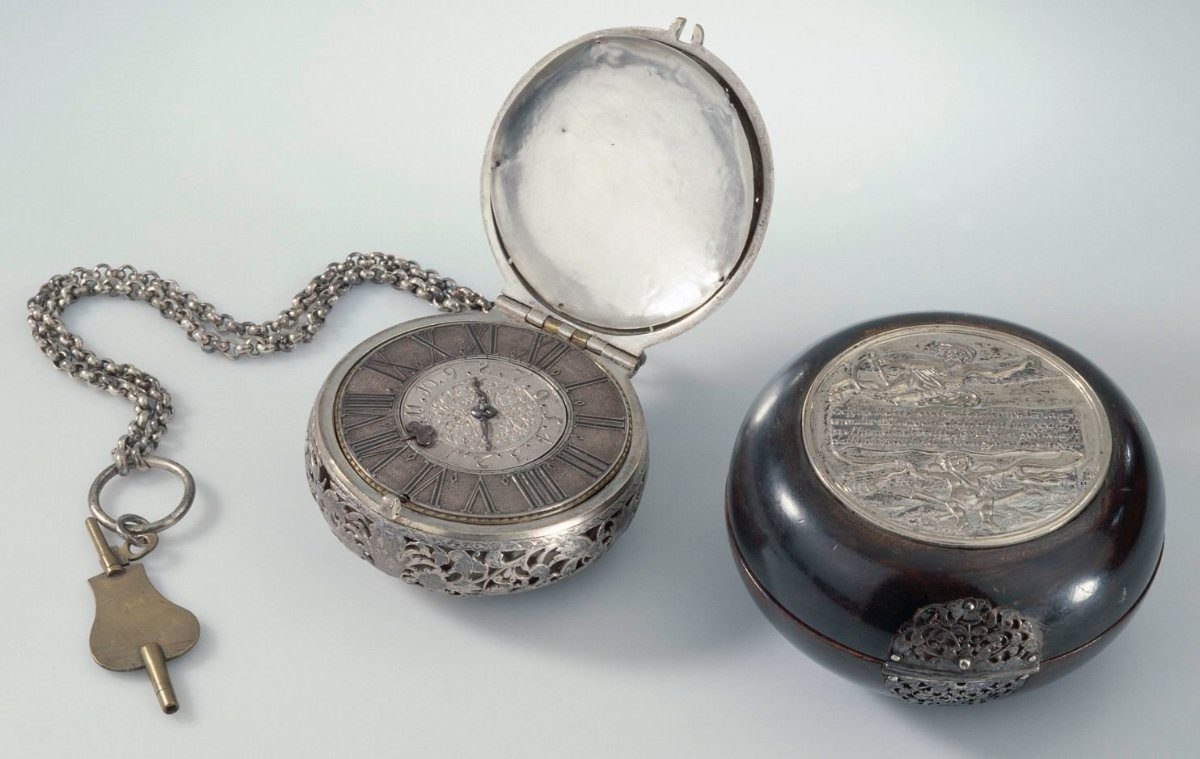
This table watch is a silver timepiece housed within a wooden case, dating to 1670-1685. The movement and the silver case, which is ajour-worked with floral and leaf motifs, are believed to be of European origin. A silver plate depicting Time and an inscription is embedded in the wooden cover. The watch includes a double link chain terminating in a ring with a copper key. A lid decorated in relief with a putto among scrollwork was reportedly added in Batavia in 1694. The movement bears a signature reading 'Batavia 1694 Noel Pol'. Records suggest that Noel Pol acted as the donor or vendor rather than the maker. The watch is linked to Governor-General Willem van Outhoorn (1635-1720), having passed through his family line to Jan Trip and Petronella Willemina van Hoorn. The object measures 11 cm in diameter and 6 cm in height.

Table watch of silver in a wooden case, with chain and key, inscribed Batavia 1694 Noel Pol.
Table watch of silver in a wooden case, with chain and key, inscribed Batavia 1694 Noel Pol. — Rijksmuseum. Rights pending — permission not yet requested. Original source

Catalogue identity

Source
www.rijksmuseum.nl
Category
Clock · Table watch
Maker / attribution
Anonymous (possibly French or English)
Reference
Not recorded
Catalogue / lot identifier
AK-RAK-2017-24-1
Source-reported date
1670 - 1685
Source-reported place
Europe

Source-reported attribution and specifications are not independent authentication. A listing does not establish present ownership, current display, availability or permission to reproduce.

Object description

Construction and Decoration

The watch is constructed from silver and housed in an outer wooden case. The primary watch casing is finished with ajour-worked floral and leaf patterns, which are attributed to a European maker. The watch itself features a dial with both Roman and Arabic numerals, paired with a double-link chain and a copper key.

The wooden case provides a protective housing and is enhanced by silver elements, including ornate latch plates and hinge pieces. Notably, an embossed silver plate showing a representation of Time is fitted into the lid of the wooden case. A separate lid, also decorated with a putto amidst scrollwork in relief, is associated with the 1694 modifications made in Batavia.

Evidence for this section
  • “Tafelhorloge van zilver in een houten kast.”
  • “Het uurwerk en de kast, ajour gewerkt met bloem- en bladranken, zijn waarschijnlijk Europees.”
  • “Het deksel versierd met een putto tussen ranken in reliëf, zal in Batavia in 1694 zijn bijgemaakt.”
  • “Rijk versierde zilveren slotplaten en scharnierstukken.”

Signatures and Attribution

The watch movement is inscribed with the signature 'Batavia 1694 Noel Pol'. While this inscription is present, historical analysis suggests that Noel Pol is not the original maker of the timepiece.

The original manufacturing origin remains anonymous, with the Rijksmuseum indicating that a French or English origin is possible. The dating of 1670-1685 covers the period of the watch's original production, distinguishing it from the modifications made in 1694.

Evidence for this section
  • “Het uurwerk is gesigneerd: Batavia 1694 Noel Pol.”
  • “Pol zal de schenker of verkoper zijn geweest, niet de vervaardiger.”
  • “vervaardiger: anoniem, Frankrijk (mogelijk)”
  • “vervaardiger: anoniem, Engeland (mogelijk)”

Provenance and History

The object is recorded as having belonged to the Governor-General of the Dutch East Indies, Willem van Outhoorn (1635-1720). Following his death, the timepiece was bequeathed to Jan Trip, the husband of Van Outhoorn's granddaughter, Petronella Willemina van Hoorn. The watch subsequently passed into her possession after the death of her husband.

The item was acquired by the Rijksmuseum in August 2017 through a purchase supported by a contribution from the B.J. Peiser bequest. The documentation reflects the known path of ownership through these specific Dutch historical figures.

Evidence for this section
  • “Afkomstig van Gouverneur Generaal Willem van Outhoorn (1635-1720), die het naliet aan Jan Trip, de echtgenoot van zijn kleindochter Petronella Willemina van Hoorn.”
  • “Na Trips overlijden kwam het in haar bezit.”
  • “Aankoop dankzij een bijdrage uit het legaat B.J. Peiser”

Open research questions

  • Can stylistic analysis of the ajour work definitively confirm or exclude English or French origin?
  • Is the identity of Noel Pol and his specific role in the Batavia watch trade documented in colonial archives?

Source evidence

Recorded claims and source quotations for Table watch of Willem van Outhoorn
FieldSource-reported valueSource quotation
Object numberAK-RAK-2017-24-1“AK-RAK-2017-24-1”
Dimensions11 cm diameter x 6 cm height“diameter 11 cm x hoogte 6 cm”
Date range1670-1685“1670 - 1685”
SignatureBatavia 1694 Noel Pol“Batavia 1694 Noel Pol”
ProvenanceWillem van Outhoorn“Afkomstig van Gouverneur Generaal Willem van Outhoorn (1635-1720)”
DecorationSilver plate of Time in wooden cover“In het deksel van de houten kast is een zilveren plaat met een voorstelling van de Tijd en een spreuk ingelaten.”

Visible details

  • Silver casing features ajour-work with leaf and floral motifs
  • Wooden outer case features a silver lid with embossed putto and scrollwork
  • Double link chain includes a copper winding key
  • Dial displays Roman numerals for hours and Arabic numerals for inner tracking

Research qualifications

  • European origin of the movement and case is suggested but not verified
  • The lid decorated with a putto is presumed to have been added specifically in Batavia in 1694

Photograph identity and source facts were screened before import; rights clearance remains pending.

Consulted source

Table watch from Governor-General Willem van Outhoorn

Reviewed 2026-11-02 · Record 155677e96f

Terms in this record

Glossary explanations for terms named in this object’s record.