
Skip to content
The Encyclopedia of Horology

Clock · Table clock

Table clock by Nicolaas Weylandt

Partially verified

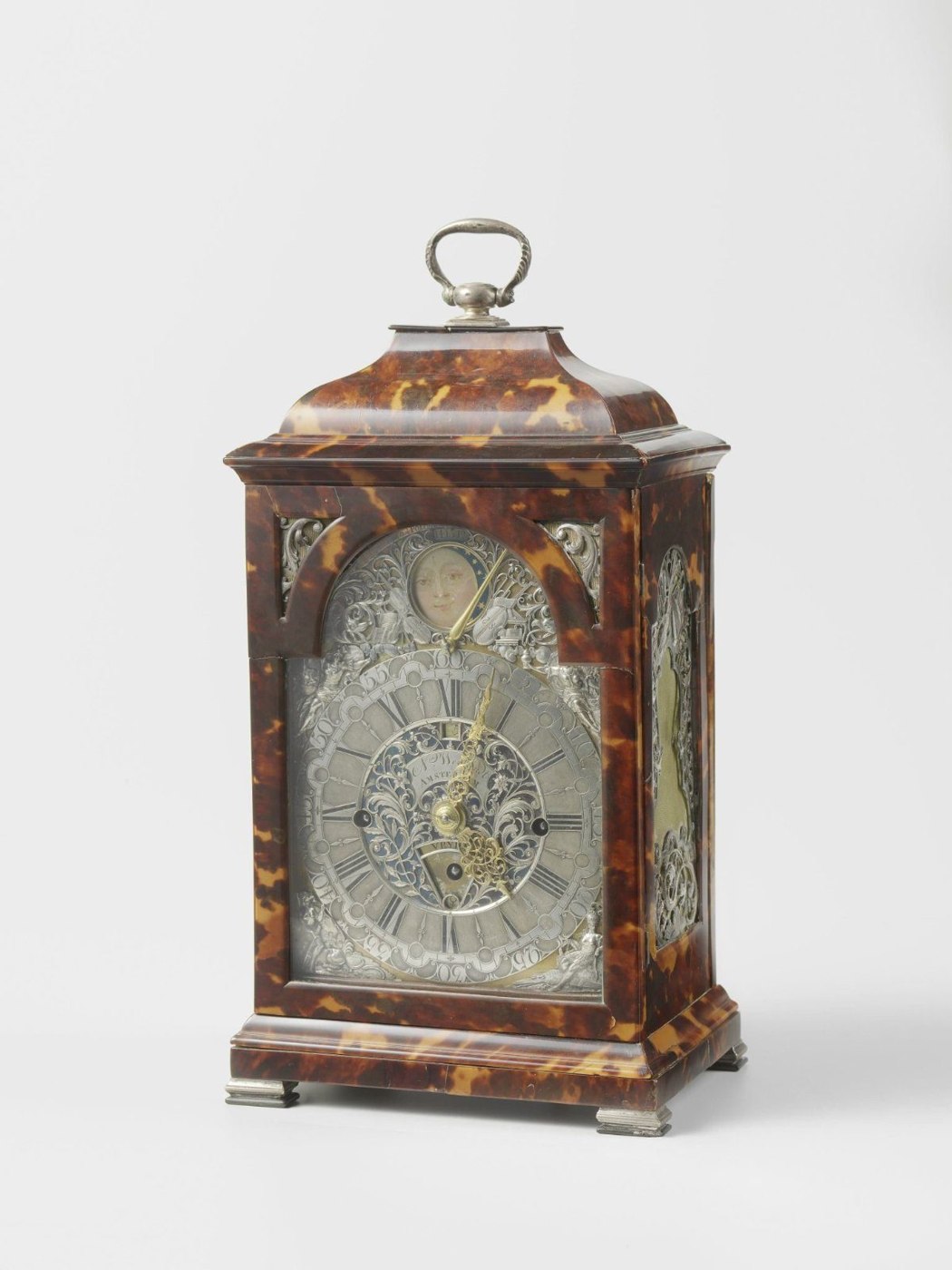
This table clock, created by the Amsterdam maker Nicolaas Weylandt between circa 1730 and 1750, is a mechanical timepiece housed in a case constructed of oak and pear wood veneered with tortoiseshell. The clock measures 30.1 cm in height, 14.1 cm in width, and 9.3 cm in depth, with a weight of 3338 grams. It features a silver dial decorated with figures representing the four continents in the corners and acanthus foliage in the arch surrounding a sun and moon phase indicator. The clock possesses openwork, gilded copper hands. A musical mechanism allows the clock to play various melodies, represented by silver ornaments on the sides depicting a lute, violin, and trumpets. The clock stands on flat silver feet and includes a cushion-shaped top with a silver handle. The rear of the case features a door providing access to the movement and a signed backplate.

Table clock with tortoiseshell veneer and silver decorations by Nicolaas Weylandt, circa 1730-1750.
Table clock with tortoiseshell veneer and silver decorations by Nicolaas Weylandt, circa 1730-1750. — Rijksmuseum. Rights pending — permission not yet requested. Original source

Catalogue identity

Source
www.rijksmuseum.nl
Category
Clock · Table clock
Maker / attribution
Nicolaas Weylandt
Reference
Not recorded
Catalogue / lot identifier
BK-KOG-1670
Source-reported date
ca. 1730 - ca. 1750
Source-reported place
Netherlands

Source-reported attribution and specifications are not independent authentication. A listing does not establish present ownership, current display, availability or permission to reproduce.

Object description

Case Construction

The clock is built upon a walnut core, which is veneered with tortoiseshell. The structure stands on flat silver feet and is topped with a cushion-shaped crown fitted with a silver handle. The front door includes a scalloped, arched top.

The sides of the clock house the musical components, indicated by ornate silver appliques. These decorative elements include acanthus foliage, a dolphin, and musical instruments, specifically a lute, a violin, and trumpets, set against a background of green fabric. A similar door is positioned on the rear to allow for access to the internal movement and the engraved backplate.

Evidence for this section
  • “Tafelklok belijmd met schildpad op noten kern.”
  • “De zijkanten hebben aan de bovenzijde boogvormige uitgezaagde openingen, die op een grond van groene stof opengewerkte, zilveren vullingen met acanthusranken, een dolfijn en trofeeën van muziekinstrumenten vertonen.”

Dial and Timekeeping

The silver dial is intricately decorated with figures in the corners representing the four continents. The arch contains acanthus ranken with instruments situated on either side of a sun and moon phase indicator. The clock uses openwork, gilded copper hands to indicate the time.

In addition to the main time display, the dial features a central display for the day and date. The maker's signature, N. Weylandt Amsterdam, is engraved on a cartouche surrounded by openwork acanthus foliage in the center of the dial.

Evidence for this section
  • “De zilveren wijzerplaat heeft in de hoeken vrouwenfiguren, de vier werelddelen symboliserend, en in de boog acanthusranken met instrumenten ter weerszijden van een zonne- en maandstand aanduiding.”
  • “en verguld. In het midden een aanduiding van dag en datum en op een cartouche, omgeven door opengewerkte acanthusranken, de signatuur N. Weylandt Amsterdam.”

Provenance and Identification

Nicolaas Weylandt, noted by the source as a prominent Amsterdam clockmaker, is the identified creator of this timepiece. The object is catalogued with the inventory number BK-KOG-1670 and currently resides in the Rijksmuseum collection as a loan from the Koninklijk Oudheidkundig Genootschap.

The date of the object is established as approximately 1730 to 1750.

Evidence for this section
  • “Nicolaas Weylandt was een van de bekendste horloge-makers van Amsterdam.”
  • “Bruikleen van het Koninklijk Oudheidkundig Genootschap”
  • “De kostbaar uitgevoerde kast geeft blijk van de grote waarde die verzamelaars en liefhebbers toekenden aan vernuftig gemaakte uurwerken.”

Open research questions

  • What specific musical repertoire is encoded in the movement?
  • Are there secondary marks on the silver components that clarify the manufacturing date of the dial and ornaments?

Source evidence

Recorded claims and source quotations for Table clock by Nicolaas Weylandt
FieldSource-reported valueSource quotation
MakerNicolaas Weylandt“Nicolaas Weylandt was een van de bekendste horloge-makers van Amsterdam.”
MaterialsOak, pear wood, tortoiseshell, silver, brass“eiken- en perenhout, belijmd met schildpad, zilver, messing”
Dimensions30.1 x 14.1 x 9.3 cm“hoogte 30,1 cm x breedte 14,1 cm x diepte 9,3 cm”
SignaturesN. Weylandt Amsterdam“In het midden een aanduiding van dag en datum en op een cartouche, omgeven door opengewerkte acanthusranken, de signatuur N. Weylandt Amsterdam.”
Musical featuresSilver instruments on sides“De zilveren muziek instrumenten in de zijkanten van de klokkenkast - een luit, een viool, trompetten - verwijzen naar de verschillende melodieën die het uurwerk kan spelen.”
Dial decorationFigures representing four continents“De zilveren wijzerplaat heeft in de hoeken vrouwenfiguren, de vier werelddelen symboliserend”

Visible details

  • Silver dial features sun and moon phase indicator
  • Case veneered with tortoiseshell on walnut core
  • Musical mechanism indicated by side trophies
  • Openwork gilded copper hands

Research qualifications

  • Specific melodies played by the clock are not listed
  • Internal movement mechanism details remain largely obscured by the housing

Photograph identity and source facts were screened before import; rights clearance remains pending.

Consulted source

Table clock, c. 1730 - c. 1750

Reviewed 2026-11-02 · Record 1b517bcc95

Terms in this record

Glossary explanations for terms named in this object’s record.