
Skip to content
The Encyclopedia of Horology

Tool · Mandrel-frame lathe

Swiss brass and steel watchmaker's 6mm mandrel-frame lathe

Partially verified

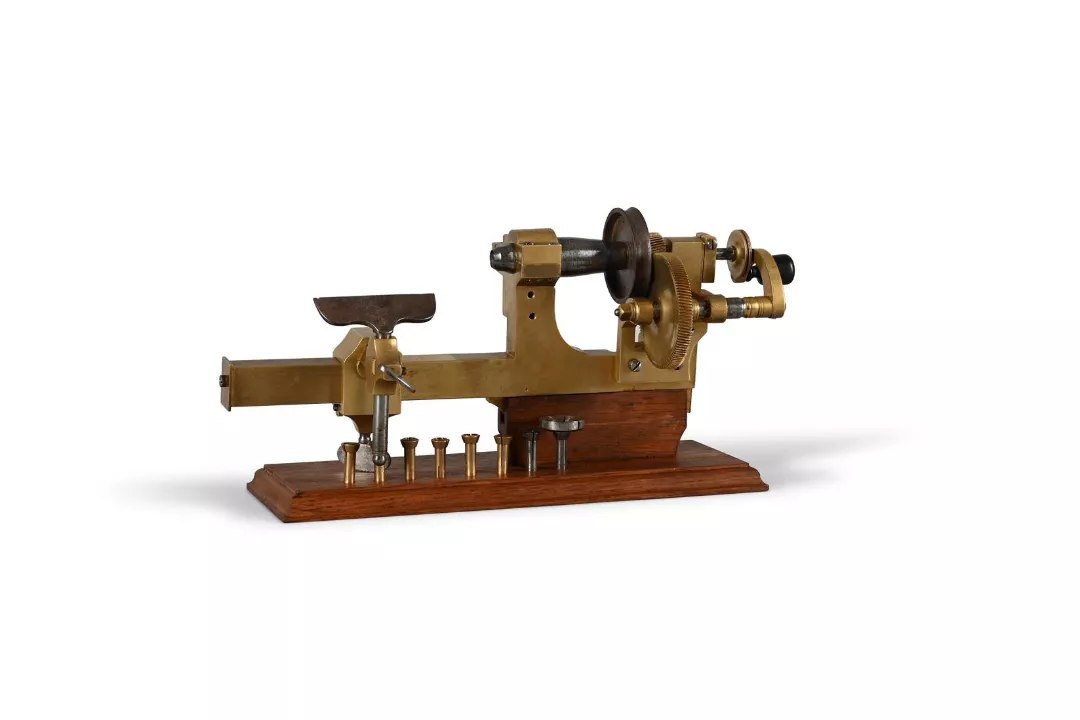
According to the auctioneer, this unsigned Swiss brass and steel watchmaker's mandrel-frame lathe dates to circa 1900 and is probably from Geneva. It features a U-shaped brass frame fitted with a brass handwheel and bevel gears driving an arbor designed to take 6mm split collets at the headstock. An integral rectangular-section bed carries an adjustable toolrest mounted on a slider. The lathe is secured by a base tongue to a wooden display plinth with drilled holes holding a selection of eight collets.

Front oblique view of the mandrel-frame lathe mounted on a wooden plinth with collets
Front oblique view of the mandrel-frame lathe mounted on a wooden plinth with collets — Dreweatts 1759. Rights pending — permission not yet requested. Original source

Catalogue identity

Source
www.the-saleroom.com
Category
Tool · Mandrel-frame lathe
Maker / attribution
Not established
Reference
Not recorded
Catalogue / lot identifier
724
Source-reported date
circa 1900
Country
Switzerland

Source-reported attribution and specifications are not independent authentication. A listing does not establish present ownership, current display, availability or permission to reproduce.

Object description

Frame Architecture and Mechanical Drive

The instrument features a U-shaped brass frame fitted with a brass handwheel and bevel gears that drive an arbor designed to hold 6mm split collets at the headstock.

Observation of the lathe shows the gearing and hand crank positioned at the right end of the assembly driving the central arbor, with the frame elevated on a wooden plinth structure.

Evidence for this section
  • “With U-shaped brass frame fitted with brass handwheel and bevel gears driving arbor taking 6mm split collets to the headstock”
  • “Gearing and hand crank positioned at the right end driving the central arbor”

Bed, Toolrest, and Workholding

The lathe includes an integral rectangular-section bed fitted with an adjustable toolrest mounted onto a slider. Observations note the bed extending horizontally to the left, with the adjustable steel T-shaped rest secured by a clamping screw.

The arbor takes 6mm split collets at the headstock, and the lathe is mounted onto a wooden plinth drilled with sockets displaying a selection of eight upright collets.

Evidence for this section
  • “the integral rectangular section bed with adjustable toolrest fitted onto a slider”
  • “Horizontal rectangular bed extending to the left with an adjustable steel T-shaped rest secured by a clamping screw”
  • “Eight accessory collets arranged upright in drilled sockets along the front of the wooden base”
  • “now mounted via the tongue at the base onto a wooden plinth drilled with holes to display a selection of eight collets.”

Attribution, Mounting, and Dimensions

The cataloguing describes the lathe as unsigned, probably from Geneva, and dating to circa 1900. It is secured via a base tongue to a wooden display plinth with a rectangular wooden riser and stepped base.

The frame is recorded as 27.5 cm long, with overall measurements of approximately 34 cm in length, 11.5 cm (catalogued with parenthetical 4.5cm) in width, and 16 cm (6.25 ins) in height. The cataloguer also notes that a related mandrel set-up configured as a lathe is illustrated in Theodore R. Crom's Horological Shop Tools 1700-1900, page 535 (Figure 1058).

Evidence for this section
  • “UNSIGNED, PROBABLY GENEVA, CIRCA 1900”
  • “The frame 27.5cm long; 34cm approx. long overall, 11.5cm (4.5cm) wide, 16cm (6.25ins) high.”
  • “U-shaped brass body supported over a rectangular wooden riser and stepped wooden base”
  • “A related mandrel set-up as a lathe is illustrated in Crom, Theodore R. Horological Shop Tools 1700-1900 page 535 (Figure 1058).”

Open research questions

  • Are there any batch numbers, punch marks, or maker stamps visible on the undersides of the frame or the mounting tongue?
  • Do all eight supplied 6mm collets match the lathe spindle thread and taper, or are they from mixed manufacturers?
  • Does the wooden plinth incorporate an original bench mounting clamp tongue, or was the timber stand constructed modernly for display?

Source evidence

Recorded claims and source quotations for Swiss brass and steel watchmaker's 6mm mandrel-frame lathe
FieldSource-reported valueSource quotation
AttributionUnsigned, probably Geneva, circa 1900“UNSIGNED, PROBABLY GENEVA, CIRCA 1900”
Frame ConstructionU-shaped brass frame with handwheel and bevel gears“With U-shaped brass frame fitted with brass handwheel and bevel gears driving arbor taking 6mm split collets to the headstock”
Bed and ToolrestIntegral rectangular section bed with adjustable toolrest“the integral rectangular section bed with adjustable toolrest fitted onto a slider”
MountingWooden plinth drilled with holes for eight collets“now mounted via the tongue at the base onto a wooden plinth drilled with holes to display a selection of eight collets.”
DimensionsFrame 27.5 cm long; overall approx. 34 cm long, 11.5 cm wide, 16 cm high“The frame 27.5cm long; 34cm approx. long overall, 11.5cm (4.5cm) wide, 16cm (6.25ins) high.”
Literature ComparisonIllustrated in Crom, Theodore R., Horological Shop Tools 1700-1900, p. 535 (Fig. 1058)“A related mandrel set-up as a lathe is illustrated in Crom, Theodore R. Horological Shop Tools 1700-1900 page 535 (Figure 1058).”

Visible details

  • U-shaped brass body supported over a rectangular wooden riser and stepped wooden base
  • Horizontal rectangular bed extending to the left with an adjustable steel T-shaped rest secured by a clamping screw
  • Gearing and hand crank positioned at the right end driving the central arbor
  • Eight accessory collets arranged upright in drilled sockets along the front of the wooden base

Research qualifications

  • Origin in Geneva is qualified as probable by the auction house
  • Wooden base and display mounting are noted as later additions ('now mounted')

Photograph identity and source facts were screened before import; rights clearance remains pending.

Terms in this record

Glossary explanations for terms named in this object’s record.