
Skip to content
The Encyclopedia of Horology

Tool · German sun and moon dial

Sun And Moon Dial

Partially verified

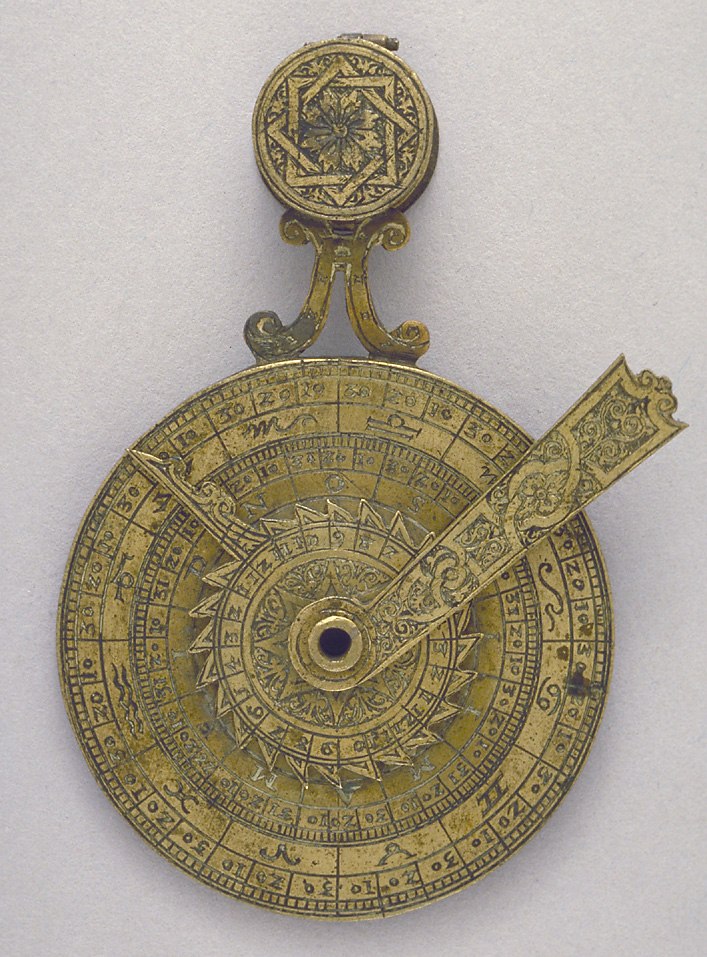
This brass sun and moon dial measures 44 mm in diameter and is attributed to German manufacture circa 1580. The instrument features a circular horizontal dial on one side and a nocturnal on the other, connected to a handle with an integrated compass box. The compass is covered by mica and a brass lid decorated with strapwork. One side of the dial includes a hinged, decorated gnomon set for a latitude of approximately 48 degrees and a pierced volvelle used for lunar time calculations, inscribed with the phrase 'OMNIA CVM TEMPORE PRETEREVNT'. The reverse side incorporates a nocturnal with a degree scale, zodiac symbols, and a calendar scale, alongside a rotating arm. The instrument was donated by A.W. Franks in 1871. It is currently held in the British Museum collection, where it has been noted that some doubts exist regarding its authenticity.

The obverse of the brass dial showing the nocturnal arm, the calendar/zodiac scales, and the compass housing.
The obverse of the brass dial showing the nocturnal arm, the calendar/zodiac scales, and the compass housing. — British Museum, London. Rights pending — permission not yet requested. Original source

Catalogue identity

Source
www.mhs.ox.ac.uk
Category
Tool · German sun and moon dial
Maker / attribution
Not established
Reference
Not recorded
Catalogue / lot identifier
MLA 1871, 11-15.10
Source-reported date
circa 1580
Source-reported place
Germany

Source-reported attribution and specifications are not independent authentication. A listing does not establish present ownership, current display, availability or permission to reproduce.

Object description

Dial and Nocturnal Configuration

The instrument serves as a multi-functional device featuring two distinct functional faces. One side functions as a circular horizontal sun and moon dial, utilizing a folding gnomon calculated for a latitude of approximately 48 degrees. This component is integrated with a pierced volvelle that allows the user to adjust for the moon's age. When set to zero, the instrument displays solar time; when adjusted for the lunar cycle, it provides a measurement for lunar time.

The reverse side of the device houses a nocturnal, which is used to tell time by the stars. This face is organized with a degree scale, zodiac symbols, and a calendar scale divided to ten days. A rotating arm is positioned centrally, decorated with strapwork, and indicates the hours from 1 to 12 twice. The handle, which connects the main circular body to the compass, is also decorated with strapwork on its exterior side.

Evidence for this section
  • “One of the faces is engraved on the limb with hours from 4 to 12 to 8, divided to the half hours.”
  • “A folding and decorated gnomon for latitude c. 48? is hinged on the lunar volvelle.”
  • “The other side of the dial has a nocturnal with handle at 15 October.”

Compass and Construction

The dial is constructed from brass and measures 44 mm in diameter. A small compass is situated within a box hinged to the handle, which facilitates the proper orientation of the instrument during use. The compass is protected by a cover made of mica, topped with a hinged brass lid. The exterior of the lid and the handle display decorative strapwork, maintaining a consistent aesthetic across the physical structure of the tool.

The lunar volvelle is pierced with two specific apertures: one smaller opening displays the moon's age in numerical form, while the larger aperture provides a visual representation of the current moon phase. The central area of this volvelle is also embellished with engraved strapwork, similar to the detailing on the nocturnal arm and the handle. The accuracy of the lunar time measurement is constrained, as the gnomon orientation does not remain parallel to the earth's axis during use.

Evidence for this section
  • “This sun and moon dial has a small compass , covered with mica, hinged to one end of the handle.”
  • “The volvelle is pierced twice, with a small aperture indicating the moon's age in figures and a bigger one showing the phase visually.”
  • “This measure is, however, not very precise, since the gnomon will no longer be parallel to the earth's axis.”

Provenance and Authenticity

The instrument is part of the collection at the British Museum in London, identified by the registration number MLA 1871, 11-15.10. It was originally donated to the museum by A.W. Franks in 1871. The object is documented in the 1981 publication by F. A. B. Ward, 'A Catalogue of European Scientific Instruments in the Department of Medieval and Later Antiquities of the British Museum'.

Despite its inclusion in museum collections, the instrument has been subjected to scrutiny regarding its history. Observations recorded in the research documentation explicitly state that doubts have been raised concerning the authenticity of this particular item. The piece remains unsigned, and its origin is attributed to Germany based on historical classification within the collection records.

Evidence for this section
  • “The instrument was presented by A.W. Franks in 1871”
  • “Some doubts have been raised about the authenticity of this instrument.”

Open research questions

  • What specific physical characteristics or stylistic anomalies prompted the doubts regarding the instrument's authenticity?
  • Does the lack of a maker's signature align with other known German scientific instruments from circa 1580?

Source evidence

Recorded claims and source quotations for Sun And Moon Dial
FieldSource-reported valueSource quotation
Dimensions44 mm in diameter“44 mm in diameter”
Datingcirca 1580“circa 1580”
OriginGerman“German”
InscriptionOMNIA CVM TEMPORE PRETEREVNT“This is engraved 'OMNIA ? CVM ? TEMPORE ? PRETEREVNT'”
ProvenancePresented by A.W. Franks in 1871“The instrument was presented by A.W. Franks in 1871”
Accession NumberMLA 1871, 11-15.10“MLA 1871, 11-15.10”

Visible details

  • Pierced volvelle with apertures for moon phase and age
  • Folding gnomon decorated with engraving
  • Handle featuring a compass with mica cover
  • Inscribed Latin text on the lunar volvelle

Research qualifications

  • Authenticity of the instrument has been questioned
  • Precision of the lunar time calculation is limited

Photograph identity and source facts were screened before import; rights clearance remains pending.

Consulted source

Sun And Moon Dial

Reviewed 2026-10-26 · Record 4a2208a6d5

Terms in this record

Glossary explanations for terms named in this object’s record.