
Skip to content
The Encyclopedia of Horology

Clock · Stoelklok

Stoelklok wall clock

Partially verified

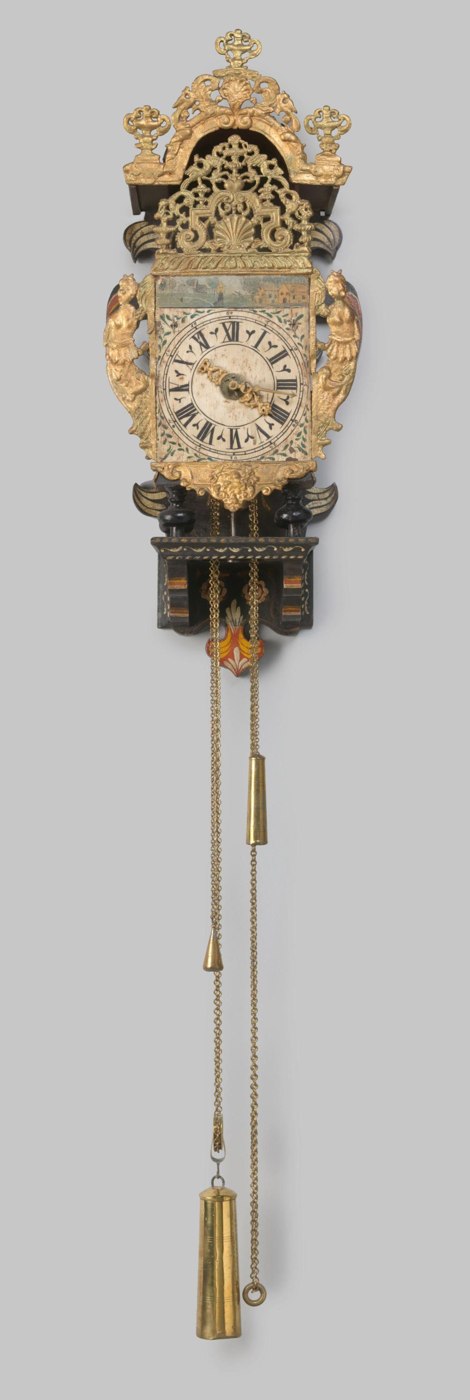
The Stoelklok (stool clock), identified as object BK-18835 in the Rijksmuseum, Amsterdam, is a Dutch hanging wall clock dating to approximately 1785–1800. The clock features an iron movement case fitted with two side doors containing glass panes. It is mounted upon a painted oak bracket or 'stool,' which is finished in dark green with colored floral and leaf motifs and includes a console base with turned legs. The clock face comprises a copper dial decorated with green leaves and a painted landscape featuring houses. The dial is surrounded by gilded lead plates incorporating diverse decorative elements such as shells, strapwork, vases, and bird motifs, with mermaids appearing on the sides against a checkered background. The clock is constructed from materials including lead, iron, cardboard, wood, glass, and oak, utilizing painting and gilding techniques to achieve its final appearance.

Stoelklok with oak bracket and gilded lead decoration.
Stoelklok with oak bracket and gilded lead decoration. — Rijksmuseum, Amsterdam. Rights pending — permission not yet requested. Original source

Catalogue identity

Source
orbiscollectibles.com
Category
Clock · Stoelklok
Maker / attribution
Not established
Reference
Not recorded
Catalogue / lot identifier
BK-18835
Source-reported date
c. 1785–1800
Source-reported place
Netherlands

Source-reported attribution and specifications are not independent authentication. A listing does not establish present ownership, current display, availability or permission to reproduce.

Object description

Structural Design and Mounting

The object is categorized as a stoelklok, a specific form of Dutch wall clock defined by its movement resting upon a distinct supporting bracket or stool. The assembly is secured to an oak wall mount, which is painted dark green and adorned with colored motifs of leaves and flowers. The structural base of this support consists of a console that incorporates turned wooden legs to provide stability for the clock housing above.

The mechanical movement is contained within an iron casing, which includes two side doors that feature glass panels. These windows allow for visibility into the inner workings of the movement. The overall height of the combined assembly is 64 cm, with a width of 31 cm and a depth of 25.5 cm, reflecting the compact scale intended for wall-mounted usage within domestic interiors.

Evidence for this section
  • “Stoelklok, with an oak stool (bracket), painted dark green with colored leaf and flower motifs.”
  • “The iron movement case has two doors with glass panes on the sides.”
  • “height 64 cm x width 31 cm x depth 25.5 cm”

Dial and Decorative Elements

The clock dial is crafted from copper and features painted ornamentation, specifically green leaf motifs and a detailed landscape illustration containing depictions of houses. Surrounding this central dial is a complex array of gilded lead plates, which provide the primary decorative impact of the clock's facade. These plates are molded with a variety of motifs, including shell patterns, strapwork, vases, and representations of birds.

Further flanking the dial are additional lead castings featuring mermaid figures set against a checkered background, accompanied by foliage designs. The use of various materials, such as cardboard and metal, confirms the mixed-media nature of the clock's construction during the late eighteenth century.

Evidence for this section
  • “Green leaf motifs and a landscape with houses are painted on the copper dial.”
  • “decorated gilded lead plates with shell, strapwork, vases, bird motifs, and on the sides mermaids with foliage against a checkered background.”
  • “The Rijksmuseum, Amsterdam, holds this object as BK-18835; its record gives material recorded as lead (metal), iron (metal), cardboard, wood (plant material), glass, oak (wood)”

Provenance and Documentation

This clock is officially catalogued as object number BK-18835 in the permanent collection of the Rijksmuseum, Amsterdam. The institutional record serves as the primary source for the technical and physical specifications of the piece, including its dating range of 1785 to 1800. The museum classification identifies the object as a mechanical clock while also acknowledging its status as a piece of furniture, consistent with the substantial nature of the mounting stool.

Current documentation is based on the museum's internal records, with the description being a translation of the original Dutch catalogue text. As this is a single institutional specimen, further research is required to definitively link this object to a specific workshop or to ascertain the broader manufacturing trends for this class of clock beyond the provided museum data.

Evidence for this section
  • “The Rijksmuseum, Amsterdam, holds this object as BK-18835”
  • “Stoelklok (stool clock) with a painted oak bracket, c. 1785–1800”
  • “Description translated from the museum's Dutch catalogue text”

Open research questions

  • Can the movement type be further classified beyond the general description?
  • Are there similar pieces with identical gilded lead motifs that might suggest a shared workshop origin?

Source evidence

Recorded claims and source quotations for Stoelklok wall clock
FieldSource-reported valueSource quotation
Materiallead (metal), iron (metal), cardboard, wood (plant material), glass, oak (wood)“lead (metal), iron (metal), cardboard, wood (plant material), glass, oak (wood)”
Datec. 1785–1800“c. 1785–1800”
Museum Object NumberBK-18835“BK-18835”
Dimensionsheight 64 cm x width 31 cm x depth 25.5 cm“height 64 cm x width 31 cm x depth 25.5 cm”
DecorationGreen leaf motifs and a landscape with houses are painted on the copper dial.“Green leaf motifs and a landscape with houses are painted on the copper dial.”
Supporting StructureStoelklok, with an oak stool (bracket), painted dark green with colored leaf and flower motifs.“Stoelklok, with an oak stool (bracket), painted dark green with colored leaf and flower motifs.”

Visible details

  • Painted oak bracket with turned legs
  • Gilded lead decorative plates featuring mermaids and strapwork
  • Copper dial depicting a landscape with houses

Research qualifications

  • Maker attribution remains unverified in current records
  • Precise origin and manufacture details are based on institutional catalogue notes

Photograph identity and source facts were screened before import; rights clearance remains pending.

Consulted source

Stoelklok (stool clock) with a painted oak bracket, c. 1785–1800

Reviewed 2026-11-02 · Record f048286e70

Terms in this record

Glossary explanations for terms named in this object’s record.