
Skip to content
The Encyclopedia of Horology

Tool · Stationary horizontal sundial

Stationary horizontal sundial

Partially verified

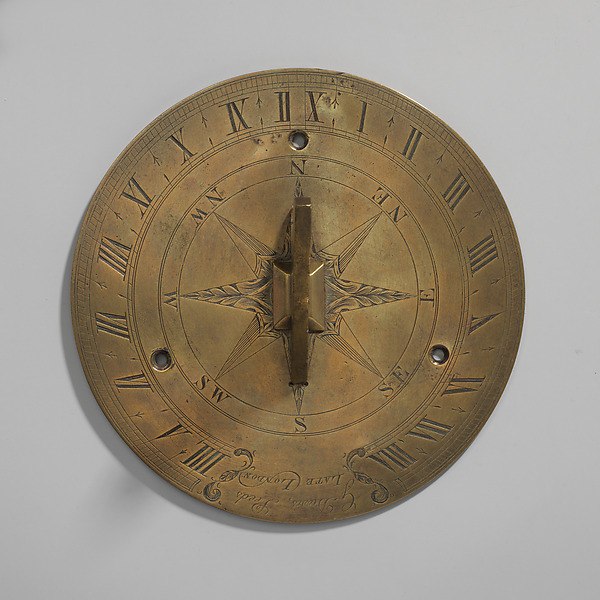
This stationary horizontal sundial is crafted from brass and measures approximately 3 3/4 by 7 inches. The object, which belongs to the collection of The Metropolitan Museum of Art (accession number 03.21.3), is attributed to George Davis, who was active around 1720. The dial is engraved with Roman numerals for timekeeping, a compass rose with directional indicators, and an inscription reading "G. Davis, Leeds, LATE LONDON." The piece is part of the museum's European Sculpture and Decorative Arts collection, entering the institutional records as a gift from Mrs. Stephen D. Tucker in 1903. It serves as an instrument for measuring time through the projection of solar shadows on the marked plate.

Top-down view of the stationary horizontal sundial, showing the compass rose, gnomon, and inscription.
Top-down view of the stationary horizontal sundial, showing the compass rose, gnomon, and inscription. — The Metropolitan Museum of Art, Gift of Mrs. Stephen D. Tucker, 1903. Rights pending — permission not yet requested. Original source

Catalogue identity

Source
orbiscollectibles.com
Category
Tool · Stationary horizontal sundial
Maker / attribution
George (?) Davis
Reference
Not recorded
Catalogue / lot identifier
03.21.3
Source-reported date
ca. 1720
Source-reported place
British

Source-reported attribution and specifications are not independent authentication. A listing does not establish present ownership, current display, availability or permission to reproduce.

Object description

Physical Construction

The sundial consists of a circular brass plate and an integral gnomon designed to cast a shadow across the face. The dial is calibrated with an outer ring of Roman numerals representing the hours. The surface is heavily decorated with an internal compass rose, featuring stylized directional markers for North, South, East, and West, along with intermediate points.

The base plate includes three small perforations arranged in a triangular formation near the perimeter. These apertures indicate that the instrument was meant to be fixed to a plinth or stone surface.

Evidence for this section
  • “Overall: 3 3/4 × 7 in. (9.5 × 17.8 cm)”

Inscriptions and Provenance

The dial plate features an engraved signature located near the southern edge, reading "G. Davis, Leeds, LATE LONDON," enclosed in decorative script flourishes. This inscription provides a geographical and professional link for the maker.

The object entered the institutional record in 1903. It is currently held by The Metropolitan Museum of Art as part of their European Sculpture and Decorative Arts department, having been presented by Mrs. Stephen D. Tucker.

Evidence for this section
  • “Gift of Mrs. Stephen D. Tucker, 1903”
  • “Department: European Sculpture and Decorative Arts.”

Documentation and Attribution

The records for this object are held by The Metropolitan Museum of Art. The documentation classifies the maker as George (?) Davis, noting his period of activity as circa 1720. The museum designates the material as brass.

The source notes that this specific attribution and the details regarding the maker's history reflect institutional records. No independent catalogue reference is currently assigned to this specific item.

Evidence for this section
  • “George (?) Davis (working 1720)”
  • “The Metropolitan Museum of Art's own record of this object”

Open research questions

  • What specific stylistic features connect George Davis to the London and Leeds clockmaking trades of the early 18th century?
  • Do surviving records for the estate of Mrs. Stephen D. Tucker provide any additional context regarding the acquisition of this sundial?

Source evidence

Recorded claims and source quotations for Stationary horizontal sundial
FieldSource-reported valueSource quotation
MakerGeorge (?) Davis“George (?) Davis (working 1720)”
Dateca. 1720“ca. 1720”
Dimensions3 3/4 × 7 in. (9.5 × 17.8 cm)“Overall: 3 3/4 × 7 in. (9.5 × 17.8 cm)”
Museum Number03.21.3“The Metropolitan Museum of Art holds this object as 03.21.3.”
Credit LineGift of Mrs. Stephen D. Tucker, 1903“Gift of Mrs. Stephen D. Tucker, 1903”

Visible details

  • Engraved compass rose with cardinal directions
  • Roman numerals indicating time
  • Central gnomon component
  • Three circular mounting holes on the base plate

Research qualifications

  • Maker attribution is queried by the source as George (?) Davis
  • Independence of the manufacturing origin from London versus Leeds requires further historical verification

Photograph identity and source facts were screened before import; rights clearance remains pending.

Consulted source

Stationary horizontal sundial

Reviewed 2026-11-02 · Record e53479bf58

Terms in this record

Glossary explanations for terms named in this object’s record.