
Skip to content
The Encyclopedia of Horology

Clock · Skeleton clock

Skeleton clock and key

Partially verified

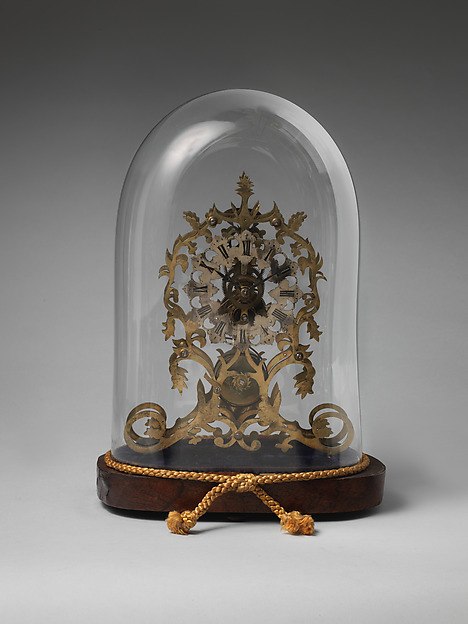
This skeleton clock and associated key, accessioned by The Metropolitan Museum of Art under number 1978.98a, b, is dated to circa 1850–1865. The timepiece is constructed from an assembly of brass, with elements that are partly silvered and painted. The clock mechanism is mounted on a base featuring rosewood veneer and velvet, and the entire assembly is housed under a protective glass dome. With the dome in place, the object measures approximately 18 inches in height, 12 3/8 inches in width, and 6 3/8 inches in depth. The height of the clock mechanism alone is 14 3/8 inches. The base is decorated with a cord trim. The provenance and historical context of this specific specimen are maintained within the museum's European Sculpture and Decorative Arts department records.

Museum photograph of the skeleton clock and key (accession 1978.98a, b)
Museum photograph of the skeleton clock and key (accession 1978.98a, b) — The Metropolitan Museum of Art. Rights pending — permission not yet requested. Original source

Catalogue identity

Source
orbiscollectibles.com
Category
Clock · Skeleton clock
Maker / attribution
Not established
Reference
Not recorded
Catalogue / lot identifier
1978.98a, b
Source-reported date
ca. 1850–65
Source-reported place
Not established

Source-reported attribution and specifications are not independent authentication. A listing does not establish present ownership, current display, availability or permission to reproduce.

Object description

Construction and Materials

The object is identified as a skeleton clock, a classification characterized by the intentional exposure of the movement components within a delicate, skeletal framework. The primary material utilized for the frame is brass, which has been worked into an intricate, pierced design that incorporates ornamental foliate patterns.

The movement is secured to a base that integrates different textures and materials, specifically a foundation of rosewood veneer accented with velvet. This assembly is designed to sit beneath a clear glass dome, which serves to protect the clock from environmental factors while maintaining the visibility of the internal components. A decorative cord or braid is positioned around the lower perimeter of the base, adding a final stylistic element to the ensemble. The inclusion of an associated key completes the object record.

Evidence for this section
  • “Brass, partly silvered and painted, velvet, rosewood veneer, glass”
  • “Skeleton clock and key”

Dimensions and Scale

The physical proportions of the clock reflect its design as a tabletop display piece. The entire unit, including the protective glass dome, stands 18 inches tall, with a width of 12 3/8 inches and a depth of 6 3/8 inches. These external dimensions ensure the clock occupies a significant presence while remaining suitable for placement on furniture surfaces.

When removed from the dome, the clock itself measures 14 3/8 inches in height. This specific dimension accounts for the verticality of the brass frame and the visual weight of the movement architecture. The distinction between the overall dimensions and the height of the clock alone provides a clear understanding of the clearance required for the dome housing.

Evidence for this section
  • “Overall (with glass dome): 18 × 12 3/8 × 6 3/8 in. (45.7 × 31.4 × 16.2 cm)”
  • “Height (clock): 14 3/8 in. (36.5 cm).”

Institutional Documentation

The object is held within the collection of The Metropolitan Museum of Art in New York. It is officially recorded under the accession number 1978.98a, b, which links the clock and its key as a single entry. The piece has been catalogued by the institution's European Sculpture and Decorative Arts department, which provides the dating of circa 1850–1865 for the work.

The entry is further assigned the museum internal identification number 206716. Documentation relies on the museum's open-access records, which serve as the primary source for technical specifications and material description. No specific maker or workshop is currently attributed within the provided registry, indicating that further research is required to determine the precise origins of the movement.

Evidence for this section
  • “catalogued by the museum's European Sculpture and Decorative Arts department.”
  • “Met object 1978.98a, b (ID 206716)”
  • “The museum dates it ca. 1850–65.”

Open research questions

  • What is the specific maker or workshop responsible for this clock's movement?
  • Are there similar period examples that confirm the original intent of the brass finish?

Source evidence

Recorded claims and source quotations for Skeleton clock and key
FieldSource-reported valueSource quotation
Accession number1978.98a, b“1978.98a, b”
Datingca. 1850–65“ca. 1850–65”
MaterialsBrass, partly silvered and painted, velvet, rosewood veneer, glass“Brass, partly silvered and painted, velvet, rosewood veneer, glass”
Overall height18 inches“Overall (with glass dome): 18 × 12 3/8 × 6 3/8 in.”
Clock height14 3/8 inches“Height (clock): 14 3/8 in. (36.5 cm).”
DepartmentEuropean Sculpture and Decorative Arts“catalogued by the museum's European Sculpture and Decorative Arts department.”

Visible details

  • Openwork brass frame with foliage motifs
  • Clock mechanism mounted on a wooden base
  • Protective glass dome enclosure
  • Decorative braided cord trim on base

Research qualifications

  • Maker identity remains unverified
  • Specific workshop or geographical origin not established

Photograph identity and source facts were screened before import; rights clearance remains pending.

Consulted source

Skeleton clock and key, ca. 1850–65

Reviewed 2026-11-02 · Record adaa6d548b

Terms in this record

Glossary explanations for terms named in this object’s record.