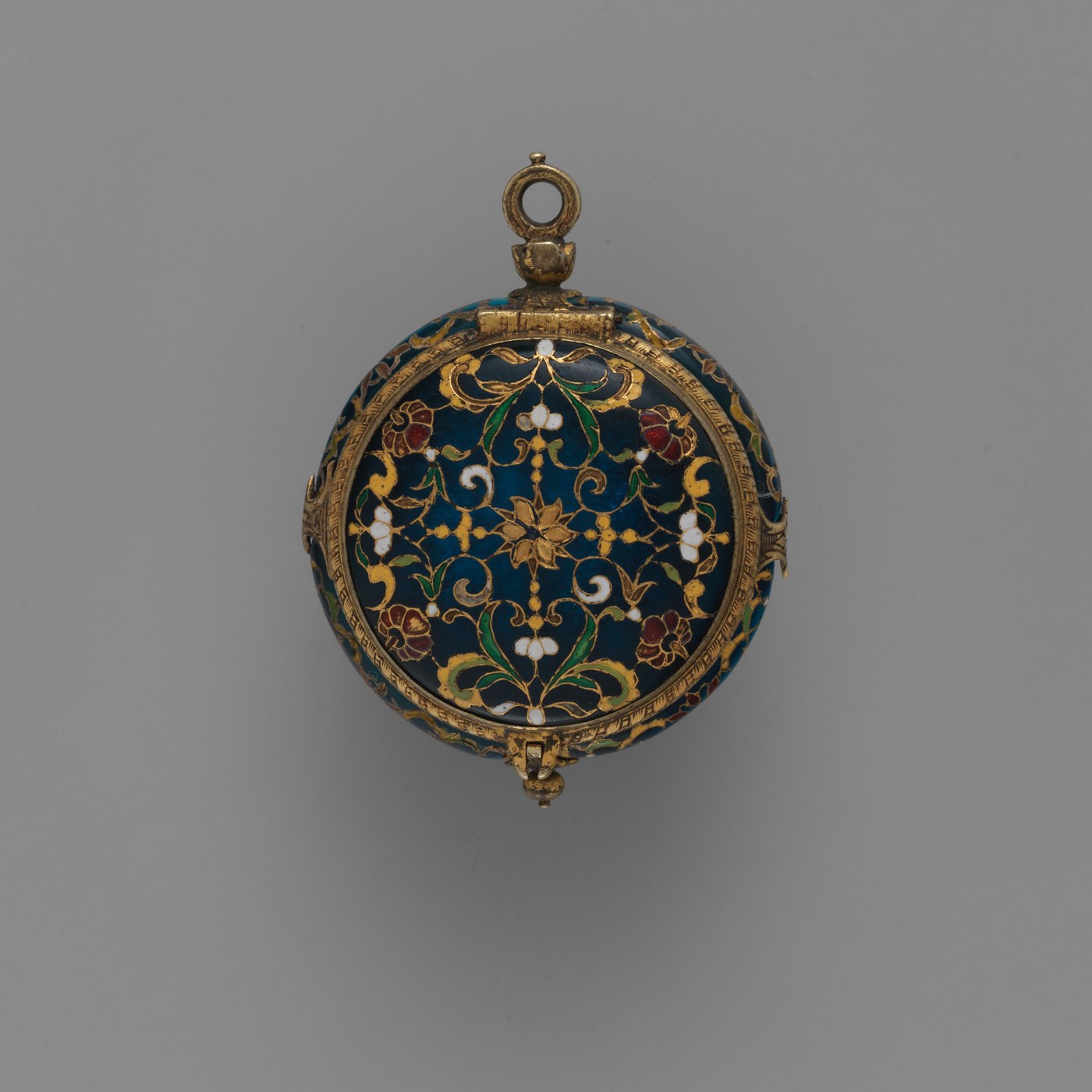
Case Construction
The case of this watch is constructed from a combination of gold, gilded brass, glass, and enamel. The exterior surface is ornamented with decorative enamel work featuring stylized floral and foliate motifs. These designs are executed in various colors, providing a contrast against the metallic base of the case. The structure incorporates a suspension loop at the apex and a decorative pendant knob at the bottom, both integrated into the overall casing design.
The combination of materials reflects the integration of base metals and precious finishes consistent with the period of manufacture. The case is designed to protect the internal movement while serving an ornamental purpose, secured by a hinge mechanism situated near the suspension ring.
The construction details have been formally recorded by the Metropolitan Museum of Art, which classifies the watch as a horological object. The dimensions provided for the case are a uniform 1.5 inches in diameter, placing it within the size range for portable timepieces of the era.
Evidence for this section
- “Case: enamel, glass, gold, and gilded brass”
- “Diameter: 1 1/2 in. (3.8 cm)”
Movement and Mechanism
The movement is constructed from gilded brass and steel components. The internal plates and bridges are finished in gilded brass, while the functional mechanical parts are primarily formed from steel.
The technical specifications of the movement are noted by the museum, which identifies the piece as a horological instrument. As the movement is contained within the ornamental casing, its construction aligns with the practices associated with the watchmaking output attributed to Simon Hackett.
Although the specific escapement type is not documented in the provided source, the material selection—specifically the combination of gilded brass and steel—is consistent with the recorded production period. The movement remains a fixed component of the object as catalogued under its current museum accession number, ensuring that the integrity of the watch as an individual horological specimen is maintained within the collection.
Evidence for this section
- “Movement: gilded brass and steel, partly blued”
Documentation and Attribution
This watch is documented in the collection of The Metropolitan Museum of Art under the accession number 17.190.1477. The record identifies Simon Hackett as the maker, with a dating attribution of circa 1632–40. This information originates from the museum's internal collection database, which serves as the primary source for the physical description and historical context of the object.
The record provides a clear attribution to the maker and a defined chronological window for the watch's creation. As an item within the museum’s holdings, it has been catalogued with specific attention to its material composition and physical dimensions. The museum also notes that the object was a gift of J. Pierpont Morgan, providing a formal record of its provenance.
The documentation provided by the institution confirms the object’s status as a specific horological specimen rather than a generalized type. The classification of the watch as a single object is supported by the unique accession number, and its details remain subject to the museum's ongoing curatorial review. The information regarding its provenance and maker remains consistent with the museum's current collection records, providing a basis for this horological entry.
Evidence for this section
- “Museum object number
17.190.1477”
- “maker recorded: Simon Hackett.”
- “Gift of J. Pierpont Morgan, 1917”