
Skip to content
The Encyclopedia of Horology

Pocket watch · Pocket watch

Silver Pocket Watch by Pieter Morijn

Partially verified

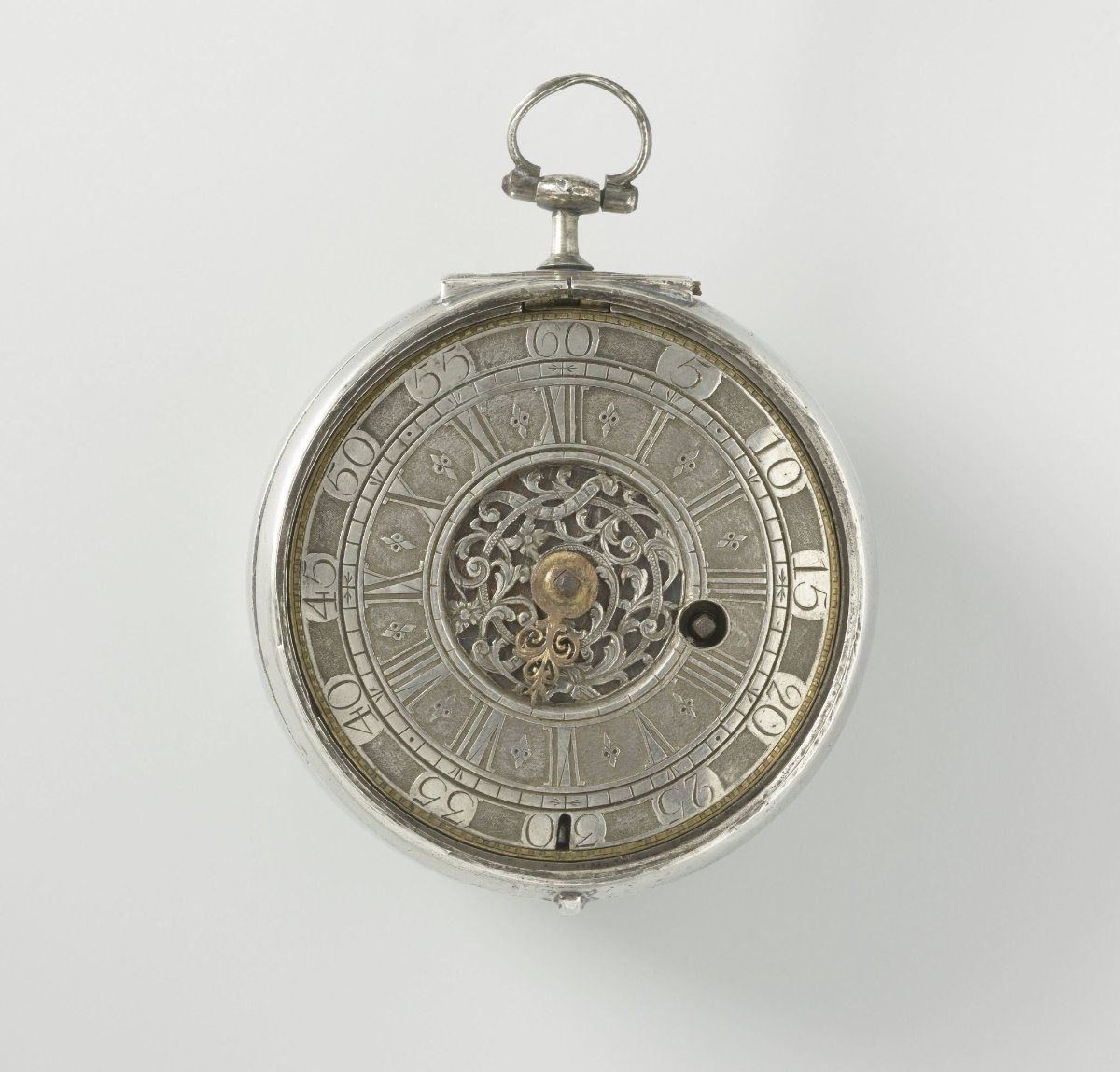
This silver pocket watch, documented as object BK-15006, is attributed to the Amsterdam watchmaker Pieter Morijn and dates to approximately 1742. The timepiece features a silver dial with raised Roman hour numerals and Arabic numerals for the minutes. The central portion of the dial is decorated with an ornate floral or foliate motif. The rear of the watch casing incorporates an enamelled representation depicting Antony and Cleopatra, with a landscape scene rendered as counter-enamel on the interior. The signature of the maker, "Pierre Morin, Amsterdam," appears on the dial, accompanied by a monogram of his crowned initials on the watch bridge. Part of the Maurits Elzas Collection, the watch was bequeathed to the Rijksmuseum in 1937.

Silver pocket watch with dial showing Roman and Arabic numerals and foliate center.
Silver pocket watch with dial showing Roman and Arabic numerals and foliate center. — Rijksmuseum. Rights pending — permission not yet requested. Original source

Catalogue identity

Source
www.rijksmuseum.nl
Category
Pocket watch · Pocket watch
Maker / attribution
Pieter Morijn
Reference
Not recorded
Catalogue / lot identifier
BK-15006
Source-reported date
ca. 1742
Source-reported place
Netherlands

Source-reported attribution and specifications are not independent authentication. A listing does not establish present ownership, current display, availability or permission to reproduce.

Object description

Dial and Exterior

The pocket watch is constructed with a silver dial, which displays a dual-numeral system. It includes raised Roman hour numerals positioned in a circular band, complemented by Arabic minute numerals at the periphery. The center of the dial is finished with a detailed rondel featuring a scrolling vine or foliate ornament, providing a decorative contrast to the numerical markers.

The exterior of the watch case displays a specific narrative scene executed in enamel. This representation, depicting Antony and Cleopatra, is located on the back cover. Additionally, the interior side of this back cover contains a landscape scene executed as a counter-enamel, demonstrating an emphasis on both the decorative and internal finishing of the watch casing.

Evidence for this section
  • “De zilveren wijzerplaat met verhoogde Romeinse uurcijfers en Arabische minuutcijfers heeft in het midden een rondsel met rankenornament”
  • “Zilveren horloge met geëmailleerd rondsel in de achterbodem voorstellende Antonius en Cleopatra, als contra-émail aan de binnenkant een landschap”

Signatures and Marks

The identity of the maker is confirmed through signatures found on the watch components. The dial bears the inscription "Pierre Morin, Amsterdam," clearly identifying the watch as a product of the maker's workshop in Amsterdam. This signature is integrated into the dial layout.

Internal mechanical features also corroborate the attribution. The watch bridge is marked with a distinctive monogram composed of the maker's crowned initials. This combination of dial-side inscription and bridge-side monogram provides a consistent identification for the object within the context of 18th-century Dutch horology.

Evidence for this section
  • “waarvan twee randen zijn gemerkt: Pierre Morin, Amsterdam”
  • “terwijl de kloof gevormd wordt door een monogram van zijn gekroonde initialen”

Provenance and Acquisition

The history of the object is traced through various collections in Arnhem. It was previously held in the Van Balveren collection and was possibly owned by Walraven Elias Johan baron van Balveren. In 1921, the watch was acquired by Maurits Elzas.

The watch eventually entered the Rijksmuseum collection in 1937 as part of the Maurits Elzas Collection. This acquisition included a large number of other watches, specifically 106 additional items, all of which were bequeathed by Maurits Elzas to the museum.

Evidence for this section
  • “collection Van Balveren, possibly Walraven Elias Johan baron van Balveren (1858-1920), Arnhem”
  • “by whom bequeathed with 106 other watches, as part of the 'Maurits Elzas Collection', to the museum, 1937”

Open research questions

  • What is the internal mechanism configuration behind the ornate central dial rondel?
  • Are there archival records linking the Antony and Cleopatra motif to a specific enamel workshop in 18th-century Amsterdam?

Source evidence

Recorded claims and source quotations for Silver Pocket Watch by Pieter Morijn
FieldSource-reported valueSource quotation
MakerPieter Morijn“Pieter Morijn, ca. 1742”
Dateca. 1742“ca. 1742”
Object NumberBK-15006“Objectnummer BK-15006”
Case MaterialSilver“Zilveren horloge”
DecorationEnamelled scene of Antony and Cleopatra“geëmailleerd rondsel in de achterbodem voorstellende Antonius en Cleopatra”
SignaturePierre Morin, Amsterdam“signatuur, wijzerplaat: ‘Pierre Morin, Amsterdam’”

Visible details

  • Silver dial with raised Roman numerals and Arabic minute markers
  • Central dial features an intricate pierced or engraved foliate design
  • Single winding hole visible on the dial surface
  • Suspension bow mounted on a pendant at the top of the case

Research qualifications

  • Attribution to Pieter Morijn is based on signatures and archival records but remains subject to historical confirmation
  • The exact extent of the restoration or condition is not detailed in the provided source text

Photograph identity and source facts were screened before import; rights clearance remains pending.

Consulted source

Pocket watch with enamelled representation of Antony and Cleopatra

Reviewed 2026-11-02 · Record 4ba5deb2c8

Terms in this record

Glossary explanations for terms named in this object’s record.