
Skip to content
The Encyclopedia of Horology

Tool · Nuremberg scaphe dial

Scaphe Dial by Georg Hartmann

Partially verified

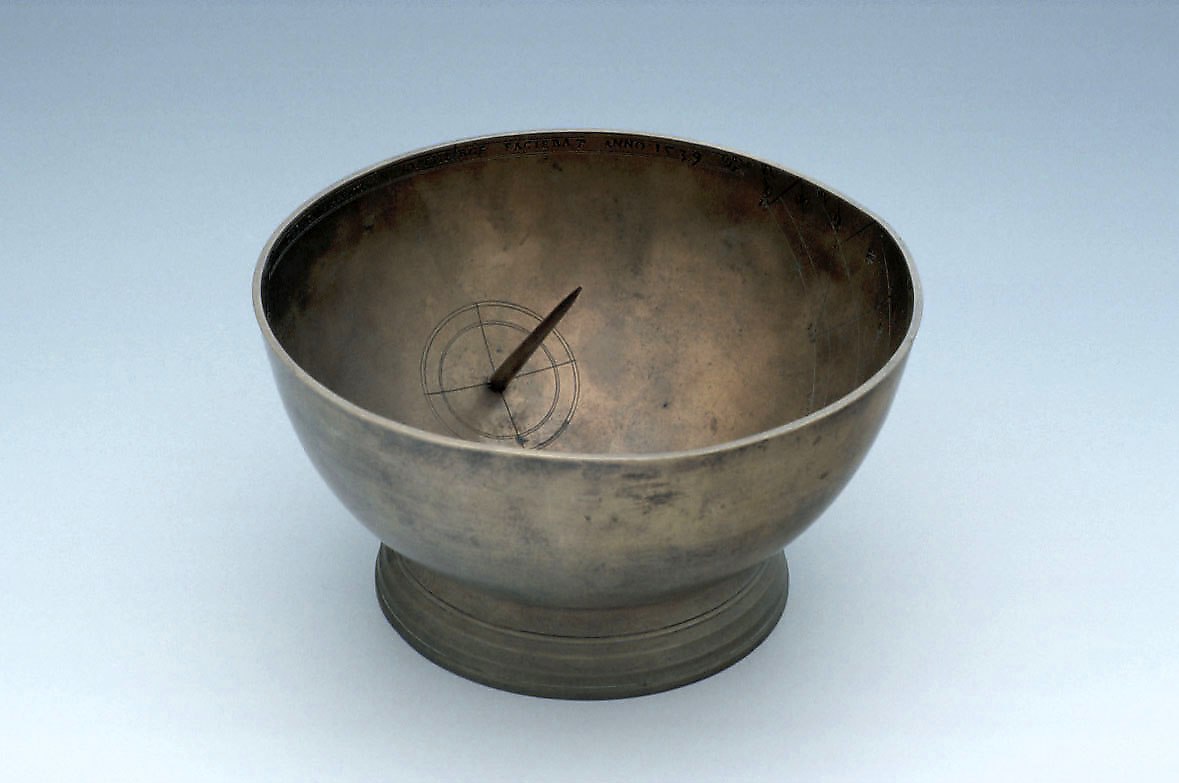
This scaphe dial, fashioned as a bowl, was created in 1539 by the instrument maker Georg Hartmann in Nuremberg. Measuring 151 mm in diameter, the instrument is constructed from brass, showing residual signs of original gilding upon its interior surface. The dial features a bowl-shaped body designed to track time through the projection of solar shadows. While it formerly contained an integrated compass at its base—evidenced by engraved cardinal directions—this component is currently missing. The instrument includes a gnomon, though this is noted as a modern replacement, configured for a latitude of 48 degrees as verified by an inscription on the dial's rim. It serves as an complex timekeeping device capable of indicating both common and Italian hours, alongside zodiacal references for solar declination, representing an example of mid-16th-century instrument design maintained in the Museum of the History of Science, Oxford.

The scaphe dial viewed from the front, showing the internal bowl markings and the gnomon.
The scaphe dial viewed from the front, showing the internal bowl markings and the gnomon. — Museum of the History of Science, Oxford. Rights pending — permission not yet requested. Original source

Catalogue identity

Source
www.mhs.ox.ac.uk
Category
Tool · Nuremberg scaphe dial
Maker / attribution
Georg Hartmann
Reference
Not recorded
Catalogue / lot identifier
46540
Source-reported date
1539
Source-reported place
Nuremberg

Source-reported attribution and specifications are not independent authentication. A listing does not establish present ownership, current display, availability or permission to reproduce.

Object description

Construction and Design

The scaphe dial is structured as a large bowl, manufactured from brass with traces of gilding preserved on the interior surface. It measures 151 mm in diameter and rests on a circular pedestal base. The interior of the bowl contains markings for solar time, including common hours numbered IIII to XII to VIII, and Italian hours from 9 to 24. Additionally, symbols representing the zodiacal signs are engraved within the bowl to track solar declination.

The base of the bowl originally featured an integrated compass. Although this component is currently missing, the circular area where it resided remains, surrounded by engraved indicators for the cardinal points, specifically 'SEP:', 'OR:', 'ME:' and 'OCC:'.

Evidence for this section
  • “The instrument is in brass and has traces of gilding on the inner surface.”
  • “The scaphe had at the bottom a compass (missing) with the indication of the cardinal points 'SEP:', 'OR:', 'ME:' and 'OCC:' engraved on the brass in a circle around the compass.”

Signatures and Inscriptions

The instrument bears a signature on its border identifying the maker and the production year: 'GEORGIVS HARTMANN NOREMBERGE FACIEBAT ANNO 1539'. This inscription confirms the origin of the dial as Nuremberg.

Further inscriptions on the border provide technical information regarding the intended use of the dial. Specifically, the text 'POLVS GRA: 48' is engraved, indicating the instrument was calibrated for a latitude of 48 degrees.

Evidence for this section
  • “On the border of the scaphe is also the signature 'GEORGIVS HARTMANN NOREMBERGE FACIEBAT ANNO 1539'.”
  • “the inscription on the border of the scaphe 'POLVS GRA: 48'”

Condition and Components

The instrument is maintained by the Museum of the History of Science in Oxford, designated by inventory number 46540. The current physical state of the object reflects the loss of the original compass at the bottom of the bowl.

The gnomon, which serves as the shadow-casting element of the sundial, is present but is not original. The auction description reports that this component appears to be a modern replacement.

Evidence for this section
  • “The gnomon, which appears to be a modern replacement, is inclined for 48? latitude”
  • “The scaphe had at the bottom a compass (missing)”

Open research questions

  • What material and form would the original compass at the base have taken?
  • Can the specific 16th-century owners or provenance of this dial be traced beyond the museum's acquisition?

Source evidence

Recorded claims and source quotations for Scaphe Dial by Georg Hartmann
FieldSource-reported valueSource quotation
MakerGeorg Hartmann“Signed by Georg Hartmann”
Date1539“Dated 1539”
Diameter151 mm“151 mm in diameter”
MaterialGilt brass“Gilt brass”
LocationNuremberg“Nuremberg”
Inventory number46540“Inventory number 46540”
InscriptionGEORGIVS HARTMANN NOREMBERGE FACIEBAT ANNO 1539“GEORGIVS HARTMANN NOREMBERGE FACIEBAT ANNO 1539”

Visible details

  • Bowl-shaped dial body with pedestal base
  • Engraved cardinal point markers on the bottom interior
  • Signature and date inscribed along the upper rim
  • Visible graduation markings for time and zodiac signs

Research qualifications

  • The gnomon is reported to be a modern replacement
  • The compass originally housed at the base is missing

Photograph identity and source facts were screened before import; rights clearance remains pending.

Consulted source

Scaphe Dial

Reviewed 2026-10-26 · Record eabe694c58

Terms in this record

Glossary explanations for terms named in this object’s record.