
Skip to content
The Encyclopedia of Horology

Tool · English ring dial

Ring Dial by Humfrey Cole

Partially verified

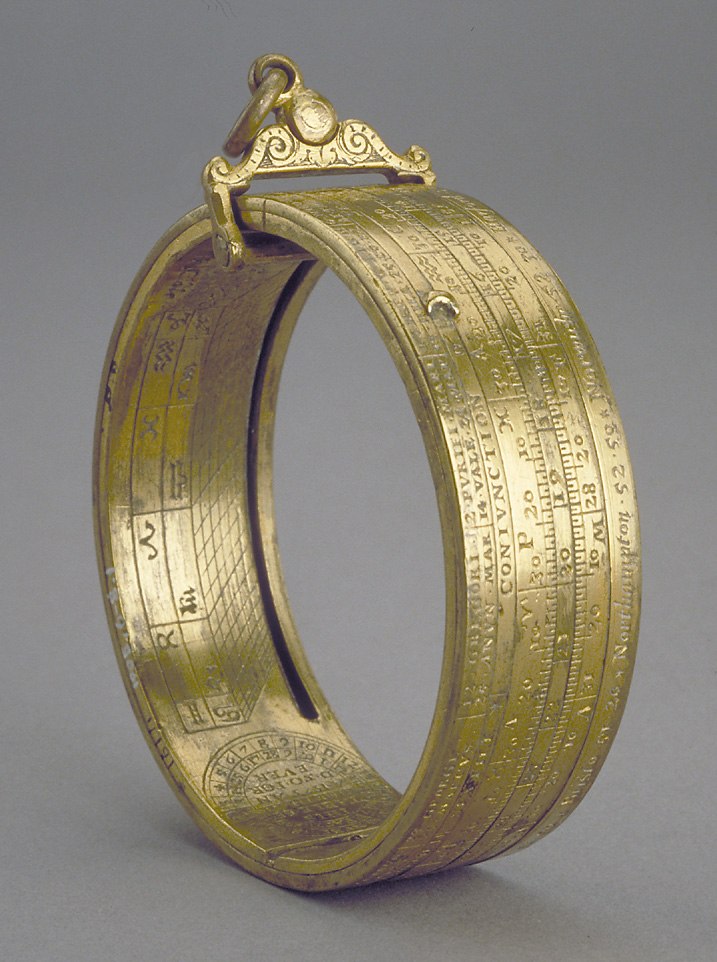
This gilt brass ring dial, measuring 74 mm in diameter, is attributed to the English maker Humfrey Cole and dates to circa 1575. The instrument comprises a ring with multiple movable bands, each featuring pinholes for setting the device according to the time of year and specific latitude. The interior surface contains markings for a ring dial covering latitudes between 50 and 56 degrees, tables for the sun's entry into zodiacal signs, and a perpetual calendar. The exterior is densely engraved with a table of Saints' days and Christian feasts, planetary aspects, zodiacal and calendrical scales, and a comprehensive list of cities with their corresponding latitudes. A lunar crescent-shaped boss facilitates the rotation of the movable bands. The signature 'H C?le' is engraved at the base of the zodiacal and latitude scales on the interior. This is the sole surviving ring dial by Cole.

The gilt brass ring dial by Humfrey Cole, displaying the external engraved scales and suspension mechanism.
The gilt brass ring dial by Humfrey Cole, displaying the external engraved scales and suspension mechanism. — British Museum, London. Rights pending — permission not yet requested. Original source

Catalogue identity

Source
www.mhs.ox.ac.uk
Category
Tool · English ring dial
Maker / attribution
Humfrey Cole
Reference
Not recorded
Catalogue / lot identifier
MLA 1905,6-8.1
Source-reported date
circa 1575
Source-reported place
London

Source-reported attribution and specifications are not independent authentication. A listing does not establish present ownership, current display, availability or permission to reproduce.

Object description

Construction and Exterior Markings

The ring dial is constructed of gilt brass and features a diameter of 74 mm. It is designed with a series of movable bands and a movable suspension apparatus. The exterior surface of the ring is engraved with an extensive array of astronomical and calendrical information. This includes a table of Saints' days and Christian feasts, planetary aspects, zodiacal scales, and a list of cities with their associated latitudes. The exterior markings are laid out anticlockwise, beginning with a list of feast days spanning January through December.

Additional features on the exterior include bands for planetary aspects and the age of the moon, both equipped with bosses to assist in manual rotation. A fixed band displays a Julian calendar scale with Latin month names and corresponding date scales. The list of cities with latitudes starts on the ring surface and continues along the outside edge, including locations such as London, Oxford, and Bristol.

Evidence for this section
  • “This instrument consists of a ring with movable bands with pin holes and a movable suspension apparatus.”
  • “The outside of the ring is marked anticlockwise with several scales”
  • “A boss in the shape of a lunar crescent aids manual rotation.”
  • “list of cities with their latitudes (anticlockwise starting at the pinhole)”

Interior Markings and Calendrical Data

The interior of the ring dial is engraved with a perpetual calendar that indicates it begins in 1575 and is intended for permanent use. This section provides lists for Dominical Letters, Golden Numbers, and Epacts. Adjacent to the calendar is a scale detailing the zodiacal signs and latitude lines ranging from 50 to 56 degrees. The signature 'H C?le' is positioned at the base of this scale.

Also included on the interior is a table for the entry of the sun into specific zodiacal signs, with columns marked for months, dates, the sun, and the signs. Oblique lines for common hours are present, which are numbered from 4 to 12 to 9, corresponding to the required latitude settings for the user. These components enable the instrument to function as a portable sundial across various geographic locations.

Evidence for this section
  • “On the inside of the ring are two circular perpetual calendars consisting of two circles each.”
  • “The signature 'H C?le' appears at the bottom of this scale.”
  • “Next to this table are oblique lines for the common hours numbered 4 to 12 to 9, and the lines for the latitudes between 50 and 56 .”

Provenance and Documentation

The instrument is identified by the British Museum, London, under the registration number MLA 1905,6-8.1. It was presented to the museum by C. J. Wertheimer in 1905. The object is recognized as the only known surviving example of a ring dial produced by the maker Humfrey Cole.

The dial has been the subject of academic research and is documented in several publications, including R. T. Gunther's 1927 study of Cole's instruments in Archaeologia and F. A. B. Ward's 1981 catalogue of the British Museum's European scientific instruments. Further analysis was conducted by Silke Ackermann in her 1998 work regarding Cole's output in Elizabethan England.

Evidence for this section
  • “This is the only surviving ring dial by the renowned English maker Humfrey Cole”
  • “The instrument was presented by C. J. Wertheimer in 1905”
  • “described and illustrated in R. T. Gunther, "The Great Astrolabe and other Scientific Instruments of Humphrey Cole", Archaeologia , 76 (1927)”

Open research questions

  • What is the exact interpretation of the character in the signature 'H C?le'?
  • Does the deviation in the date for the sun's entry into Cancer suggest a specific error or an adjustment to a known astronomical formula used by Cole?

Source evidence

Recorded claims and source quotations for Ring Dial by Humfrey Cole
FieldSource-reported valueSource quotation
MakerHumfrey Cole“Signed by Humfrey Cole”
Datecirca 1575“circa 1575”
LocationLondon“London”
MaterialGilt brass“Gilt brass”
Diameter74 mm“74 mm in diameter”
Inventory NumberMLA 1905,6-8.1“MLA 1905,6-8.1”
Latitude Range50° to 56°“latitudes between 50? and 56?”

Visible details

  • Gilt brass construction with a suspension apparatus
  • Signature 'H C?le' engraved on the inner surface
  • Multiple movable bands with pinholes for latitude and calendrical settings
  • Engraved list of city latitudes and planetary symbols on the exterior

Research qualifications

  • The source notes that the date given for the sun's entry into Cancer deviates from Cole's usual date
  • The source indicates a possible transcription or reading uncertainty in the signature ('H C?le')

Photograph identity and source facts were screened before import; rights clearance remains pending.

Consulted source

Ring Dial

Reviewed 2026-10-26 · Record 78b141be0f

Terms in this record

Glossary explanations for terms named in this object’s record.