
Skip to content
The Encyclopedia of Horology

Pocket watch · Repeating pocket watch

Repetitiehorloge met sourdine

Partially verified

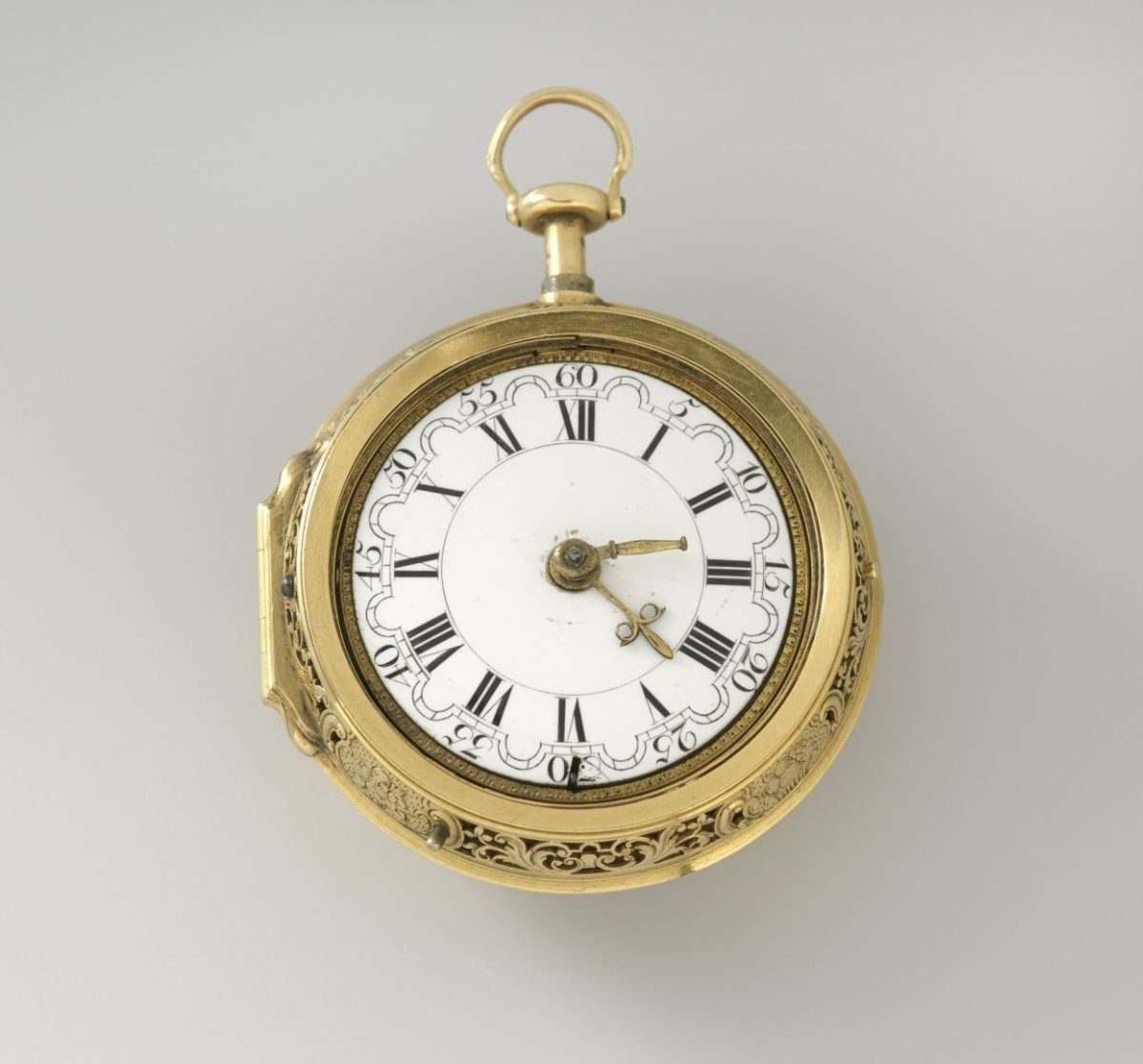
This repeating pocket watch with a silent mechanism, or 'sourdine', was produced in Amsterdam in 1728 by clockmaker Andries Vermeulen. The watch features a gold case that is both engraved and partially open-worked, reflecting techniques attributed to the goldsmith Pierre Daniël Bellanger. The dial displays Roman numerals for hours, with a secondary outer track for minutes. The movement, numbered 673, is signed by Vermeulen on both the main plate and the dust cover. The watch contains various marks including an Amsterdam town mark, a Dutch lion quality mark, and a date letter 'S' corresponding to 1728. It also bears a wolf's head tax stamp associated with the mid-19th century. The watch was acquired by the Rijksmuseum in 1878 through a bequest from F.G.S. baron van Brakell tot den Brakell of Arnhem.

Front view of the 1728 Andries Vermeulen gold repeating pocket watch.
Front view of the 1728 Andries Vermeulen gold repeating pocket watch. — Rijksmuseum. Rights pending — permission not yet requested. Original source

Catalogue identity

Source
www.rijksmuseum.nl
Category
Pocket watch · Repeating pocket watch
Maker / attribution
Andries Vermeulen
Reference
Not recorded
Catalogue / lot identifier
BK-VBR-356
Source-reported date
1728
Source-reported place
Netherlands
Source-reported serial
673

Source-reported attribution and specifications are not independent authentication. A listing does not establish present ownership, current display, availability or permission to reproduce.

Object description

Case Construction and Decoration

The watch is housed in a gold case characterized by intricate decorative techniques. The surface is adorned with engravings and sections of open-work, which contribute to the aesthetic presentation of the object. This work is attributed to the Amsterdam-based goldsmith Pierre Daniël Bellanger, identified by a maker's mark 'PB' in a rectangle located on the inside of the case.

The case includes multiple assay and tax marks providing context for its history. These include the standard Amsterdam city mark and the Dutch lion quality mark. A wolf's head stamp, applied to the hinge, indicates that the watch was subject to specific tax regulations in the Netherlands between 1831 and 1853, long after its original manufacture.

Evidence for this section
  • “Horloge van goud met een gegraveerde, gedeeltelijk opengewerkte kast.”
  • “meesterteken, binnenzijde kast, afgeslagen: PB in rechthoek ( Citroen 1975, nr. 725). (Pierre Daniël Bellanger.)”
  • “belastingteken, scharnier, afgeslagen: wolvenkopje (1831-1853)”

Movement and Signatures

The internal mechanism is an Andries Vermeulen creation, specifically identified as a repeating watch equipped with a 'sourdine' or mute mechanism. The movement is serialised with the number 673. The maker's signature is prominent, found on both the main plate of the movement and the internal dust cover, ensuring the attribution to the Amsterdam workshop.

The dating of the piece to 1728 is supported by an 'S' year letter found among the markings inside the case.

Evidence for this section
  • “signatuur, platine van het uurwerk: ‘ANDRIES VERMEULEN AMSTERDAM // 673’”
  • “signatuur, beschermkap: ‘ANDRIES // VERMEULEN // AMSTERDAM’”
  • “jaarletter, binnenzijde kast, afgeslagen: ‘S’ (1728)”

Provenance and History

The object was brought into the Rijksmuseum collection in 1878. It was part of a legacy donation from F.G.S. baron van Brakell tot den Brakell, a resident of Arnhem. This provenance establishes the long-term preservation of the object within a Dutch private collection before its institutional acquisition.

The watch remains in the public domain and is catalogued under the object number BK-VBR-356.

Evidence for this section
  • “Legaat van F.G.S. baron van Brakell tot den Brakell, Arnhem”
  • “legaat 1878”
  • “Objectnummer BK-VBR-356”

Open research questions

  • What is the specific mechanical design of the 'sourdine' mechanism used by Vermeulen in this model?
  • Are there records detailing the specific date of manufacture for the case versus the movement, given the dual attribution to Vermeulen and Bellanger?

Source evidence

Recorded claims and source quotations for Repetitiehorloge met sourdine
FieldSource-reported valueSource quotation
MakerAndries Vermeulen“Andries Vermeulen (uurwerkmaker)”
Case MaterialGold“Horloge van goud”
GoldsmithPierre Daniël Bellanger“edelsmid: Pierre Daniel Bellanger, Amsterdam”
Movement SignatureANDRIES VERMEULEN AMSTERDAM“signatuur, platine van het uurwerk: ‘ANDRIES VERMEULEN AMSTERDAM // 673’”
Tax MarkWolf's head“belastingteken, scharnier, afgeslagen: wolvenkopje (1831-1853)”

Visible details

  • Case features extensive engraved open-work decoration
  • White enamel or metal dial with Roman hour numerals and Arabic minute markers
  • Presence of a winding aperture visible near the bottom of the dial track

Research qualifications

  • The wolf's head tax stamp indicates later handling or taxation between 1831 and 1853, not 1728
  • The connection to Pierre Daniël Bellanger as the specific goldsmith for the case is attributed by the source based on a maker's mark

Photograph identity and source facts were screened before import; rights clearance remains pending.

Consulted source

Dumb Repeating Watch

Reviewed 2026-11-02 · Record 3a5cf03dd2

Terms in this record

Glossary explanations for terms named in this object’s record.