
Skip to content
The Encyclopedia of Horology

Clock · Tall case clock

Renaissance Revival Carved Oak Tall Case Clock

Partially verified

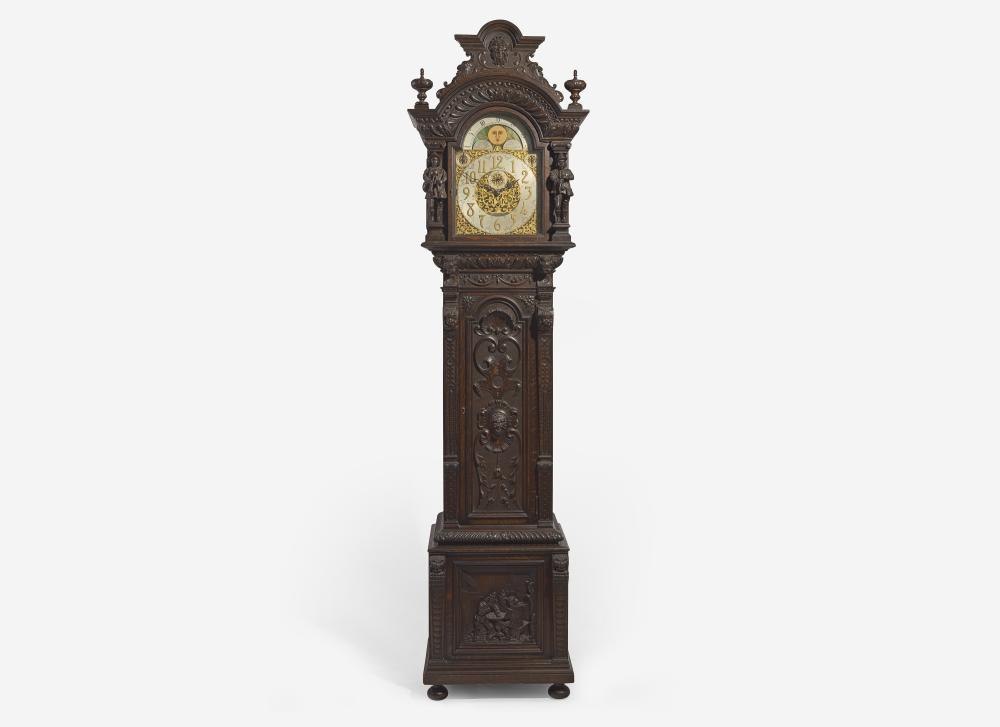
This Renaissance Revival tall case clock features an elaborately carved oak case, attributed to R.J. Horner & Co. of New York. The hood is crowned with an arched superstructure featuring leafage, a grotesque masque, and flanking finials, with gadrooning and egg-and-dart molding. The hood door is framed by two musician columnettes playing a bagpipe and horn. The case includes pilasters adorned with lion and putti heads, while the door displays carved shells, scrolls, and foliate motifs centering a masque. The base rests on bun feet and features pilasters with lion capitals flanking a townscape panel with three revelers. The brass dial includes a moon phase display and an Arabic numeral chapter ring, signed by the retailer Tilden Thurber Co. The movement is marked "Elite A1/ W&H/ Sch/ Germany," indicating manufacture by Winterhalder & Hofmeier of the Black Forest.

Full view of the Renaissance Revival carved oak tall case clock
Full view of the Renaissance Revival carved oak tall case clock — Freeman's (via Invaluable). Rights pending — permission not yet requested. Original source

Catalogue identity

Source
www.invaluable.com
Category
Clock · Tall case clock
Maker / attribution
Winterhalder & Hofmeier
Reference
Not recorded
Catalogue / lot identifier
170
Source-reported date
late 19th-early 20th century
Source-reported place
Germany
Source-reported serial
Elite A1

Source-reported attribution and specifications are not independent authentication. A listing does not establish present ownership, current display, availability or permission to reproduce.

Object description

Case Construction and Ornamentation

The clock is housed in an elaborately carved oak tall case, characterized by Renaissance Revival decorative elements. The arched hood features a superstructure adorned with leafage and a central grotesque masque, accented by decorative finials. Further detailing in the hood includes gadrooning and egg-and-dart molding. The hood door is flanked by two distinct columnettes carved as musicians, one depicted with a bagpipe and the other with a horn.

The central trunk of the clock continues the ornate theme, featuring gadrooning and egg-and-dart molding. The door is flanked by pilasters decorated with lion and putti heads, while the door panel itself contains carved shells, scrolls, and foliate motifs centered on a masque. The base includes pilasters with lion-head capitals and a recessed panel illustrating a townscape with three revelers, all supported on bun feet.

Evidence for this section
  • “the arched hood with superstructure carved with leafage and grotesque masque”
  • “the hood door flanked by two columnettes in the form of musicians, one playing bagpipe, and the other playing horn”
  • “the case door flanked by pilasters with carved lion and putti heads”
  • “the case base with pilasters with capitals in the form of lions, flanking a recessed panel depicting a townscape, with three revelers”

Dial and Movement

The clock utilizes a brass dial fitted with a moon phase mechanism and a raised chapter ring displaying Arabic numerals. The dial is inscribed with the name of the Providence, Rhode Island-based retailer, Tilden Thurber Co. The horological mechanism is attributed to the Black Forest firm of Winterhalder & Hofmeier, as confirmed by markings on the rear of the movement.

The identified markings on the movement provide specific technical identification, specifically reading "Elite A1" in addition to the maker's abbreviation and origin. These details confirm the German origin of the clockwork assembly within the American-attributed case.

Evidence for this section
  • “the brass face with moon phase dial and raised Arabic numeral chapter ring, and inscribed, “Tilden-Thurber Co./ Providence R.I.,””
  • “the back of works marked, “Elite A1/ W&H/ Sch/ Germany.””

Provenance and History

The clock was historically held in the collection of Henry Pearce (1838-1909) and his wife, Elizabeth (Leonard Bourne) Pearce, residing in Providence, Rhode Island. The object remained within the family descent to the current consignor.

The Pearce residence, known as the Henry and Elizabeth Pearce Estate, was an architectural landmark designed in the Richardson Romanesque style. Following its period as a private residence, the property transitioned to serve as a convent for the Roman Catholic Diocese of Providence between 1923 and 1952. Since 1953, the site has served as the Division of Applied Mathematics for Brown University.

Evidence for this section
  • “This clock was originally owned by Henry Pearce (1838-1909) and his wife Elizabeth (Leonard Bourne) Pearce of Providence, Rhode Island.”
  • “In 1953, it became the site of the Division of Applied Mathematics for Brown University, which remains today.”

Open research questions

  • What is the specific production date range for the "Elite A1" movement series by Winterhalder & Hofmeier?
  • Can additional documentation verify the R.J. Horner & Co. attribution for this specific clock model?

Source evidence

Recorded claims and source quotations for Renaissance Revival Carved Oak Tall Case Clock
FieldSource-reported valueSource quotation
Case makerR.J. Horner & Co.“case attributed to R.J. Horner & Co., NY, NY”
Movement makerWinterhalder & Hofmeier“works by Winterhalder & Hofmeier, Schwaerzenbach, Black Forest, Germany”
RetailerTilden Thurber Co.“retailed by Tilden Thurber Co., Providence, RI”
Movement markingElite A1 / W&H / Sch / Germany“the back of works marked, “Elite A1/ W&H/ Sch/ Germany.””
Dimensions101 1/4 in. H x 22 5/8 in. W x 16 1/2 in. D“H: 101 ¼ in. W: 22 5/8 in. D: 16 ½ in.”
ProvenanceHenry and Elizabeth Pearce“originally owned by Henry Pearce (1838-1909) and his wife Elizabeth (Leonard Bourne) Pearce”

Visible details

  • Case decorated with carved lion and putti motifs
  • Dial features moon phase indicator and raised Arabic numerals
  • Movement backplate marks verify origin and model
  • Finials present on arched hood

Research qualifications

  • Case attribution to R.J. Horner & Co. is stated as an attribution
  • Exact date remains a broad range between late 19th and early 20th century

Photograph identity and source facts were screened before import; rights clearance remains pending.

Terms in this record

Glossary explanations for terms named in this object’s record.