
Skip to content
The Encyclopedia of Horology

Tool · Portable cube sundial

Portable Cube Sundial

Partially verified

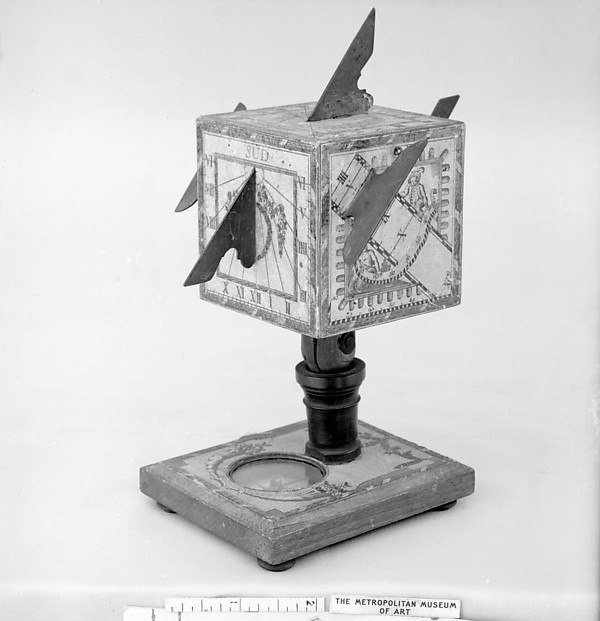
This portable cube sundial is attributed to the maker David Beringer (1756–1821) and originates from Nuremberg, Germany. Held by The Metropolitan Museum of Art under accession number 03.21.8, the device dates to approximately 1780–1821. It is constructed primarily from fruitwood and paper. The object features a multi-faceted cubic head mounted on a pedestal, which is supported by a square base. The base contains an integrated compass, facilitating the orientation of the instrument to true north for accurate timekeeping. Each face of the cube displays calibrated markings and metal gnomons of varying configurations, designed to measure time based on the solar position. The overall dimensions are 7 1/8 by 5 1/8 by 3 7/8 inches (18.1 by 13 by 9.8 cm). It remains a documented example within the museum's European Sculpture and Decorative Arts department, representing a specific form of eighteenth-century portable time-measuring instrument.

A side-profile view of the portable cube sundial, showing the wooden construction, the cubic head with multiple gnomons, the central pedestal, and the integrated compass on the base.
A side-profile view of the portable cube sundial, showing the wooden construction, the cubic head with multiple gnomons, the central pedestal, and the integrated compass on the base. — The Metropolitan Museum of Art. Rights pending — permission not yet requested. Original source

Catalogue identity

Source
orbiscollectibles.com
Category
Tool · Portable cube sundial
Maker / attribution
David Beringer
Reference
03.21.8
Catalogue / lot identifier
03.21.8
Source-reported date
ca. 1780–1821
Source-reported place
Germany, Nuremberg

Source-reported attribution and specifications are not independent authentication. A listing does not establish present ownership, current display, availability or permission to reproduce.

Object description

Construction and Materials

The portable cube sundial is constructed using a combination of fruitwood and paper. The core structural elements, including the pedestal and the square base, are fashioned from fruitwood, providing a stable foundation for the instrument. The exterior surfaces of the cubic head are finished with applied paper elements that serve as the calibrated dials for timekeeping.

The design incorporates a central support pedestal which connects the cubic timekeeping component to the square base below. This arrangement allows for portability and functionality in various locations. The materials used, specifically the combination of wood and printed paper, are consistent with the period and the known manufacturing practices attributed to the Nuremberg region during the late 18th to early 19th centuries.

Evidence for this section
  • “Fruitwood and paper”
  • “German, Nuremberg”

Functional Design

The functionality of the sundial relies on the orientation of the device and the interaction of solar light with the gnomons. An integrated compass is set into the surface of the base, which allows the user to align the instrument accurately with the cardinal points, a necessary step for the device to measure time correctly.

The cubic head contains multiple faces, each featuring distinct markings and gnomons of varied designs. These elements enable the reading of time throughout the day as the sun passes across the different sides of the cube. The use of metal gnomons attached to the printed surfaces provides the shadow-casting mechanism required for solar time observation.

Evidence for this section
  • “Portable cube sundial”

Institutional Provenance and Identification

The object is part of the collection of The Metropolitan Museum of Art, assigned the accession number 03.21.8. It is held within the Department of European Sculpture and Decorative Arts. The record notes the object was acquired by the museum in 1903 as a gift from Mrs. Stephen D. Tucker.

The sundial is attributed to David Beringer, who was active between 1756 and 1821.

Evidence for this section
  • “The Metropolitan Museum of Art holds this object as 03.21.8”
  • “Gift of Mrs. Stephen D. Tucker, 1903”
  • “made by David Beringer (1756–1821)”

Open research questions

  • Confirm if David Beringer personally manufactured this specific unit or if it is a production of his workshop
  • Identify specific geographical latitudes for which the printed dial markings were calibrated

Source evidence

Recorded claims and source quotations for Portable Cube Sundial
FieldSource-reported valueSource quotation
MakerDavid Beringer (1756–1821)“made by David Beringer (1756–1821)”
Dateca. 1780–1821“ca. 1780–1821”
OriginNuremberg, Germany“German, Nuremberg”
MaterialsFruitwood and paper“Fruitwood and paper”
Dimensions7 1/8 x 5 1/8 x 3 7/8 in.“7 1/8 × 5 1/8 × 3 7/8 in. (18.1 × 13 × 9.8 cm)”
Accession Number03.21.8“03.21.8”

Visible details

  • Integrated compass situated on the center of the wooden base
  • Gnomons extending from multiple faces of the cube
  • Printed paper dial faces mounted on wooden surfaces
  • Pedestal support connecting the cubic head to the base

Research qualifications

  • Wider type and specifications for the maker's output remain under research
  • The attribution to David Beringer is based on museum records without cited archival signature confirmation

Photograph identity and source facts were screened before import; rights clearance remains pending.

Consulted source

Portable cube sundial

Reviewed 2026-11-02 · Record 1c7d28cda7

Terms in this record

Glossary explanations for terms named in this object’s record.