
Skip to content
The Encyclopedia of Horology

Tool · German polyhedral dial

Polyhedral Sundial

Partially verified

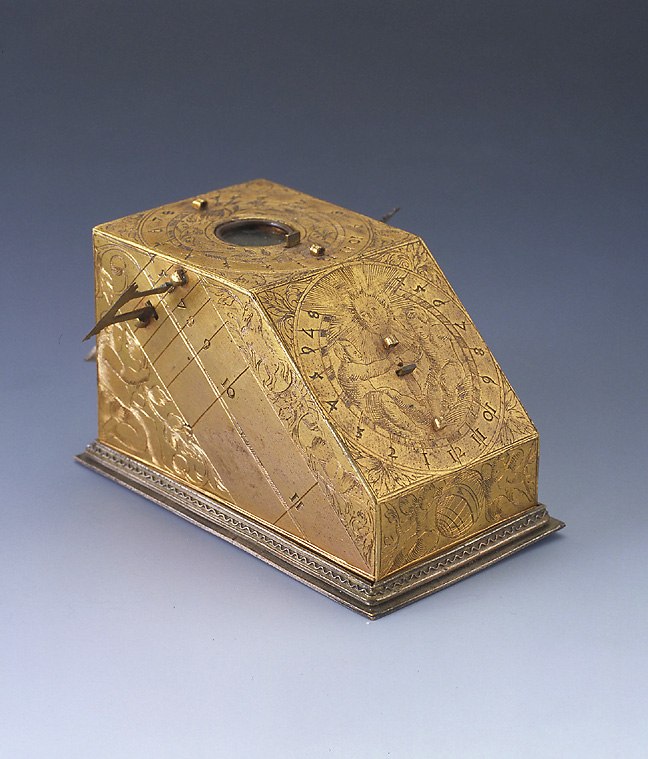
This portable polyhedral sundial is constructed as a hollow seven-sided trapezoidal solid measuring 50 x 50 x 87 mm, executed in gilt copper. The instrument is unsigned and is dated to the 16th century. It features dial diagrams engraved across five of its faces, including horizontal, vertical, and polar dials for morning and afternoon timekeeping. The top surface incorporates an inset compass, now missing its needle, alongside a circular hour scale divided to 30-minute intervals. The surfaces are decorated with foliate patterns, cherub heads, seated human figures, and a central scene on the south face depicting a sleeping cherub. The gnomons are designed to fold into the body of the instrument, secured by internal spring-loaded studs. The object sits on a detachable silvered base.

The polyhedral sundial showing the upper face with the compass recess and the side faces with engraved cherubim and dial markings.
The polyhedral sundial showing the upper face with the compass recess and the side faces with engraved cherubim and dial markings. — Istituto e Museo di Storia della Scienza, Firenze. Rights pending — permission not yet requested. Original source

Catalogue identity

Source
www.mhs.ox.ac.uk
Category
Tool · German polyhedral dial
Maker / attribution
Not established
Reference
Not recorded
Catalogue / lot identifier
2477
Source-reported date
16th century
Source-reported place
Germany

Source-reported attribution and specifications are not independent authentication. A listing does not establish present ownership, current display, availability or permission to reproduce.

Object description

Construction and Layout

The instrument is a seven-sided trapezoidal solid crafted from gilt copper. It functions as a portable timekeeping device, with dial diagrams distributed across five of its faces to provide readings through vertical, horizontal, and polar dials. The top surface serves as a horizontal dial, featuring an hour scale from 4 to 12 to 8, engraved around a central compass recess.

The gnomons for the various dials are designed to be folded down when not in use. They are maintained in an upright position by depressible studs connected to brass springs mounted on the interior wall of the casing. The overall assembly rests upon a detachable base finished in a silvered material, which includes a decorative cornice.

The instrument is heavily decorated with engraved motifs. The areas between the hour scales and the compass are filled with foliate patterns and bird figures. Corners are detailed with cherub heads, while individual faces display complex scenes, such as a satyr cart and a sleeping cherub near a sand-glass.

Evidence for this section
  • “Hollow seven-sided trapezoid carrying dial diagrams on five faces.”
  • “the gnomons may be folded down when not in use being steadied in position by depressible studs controlled by straight brass springs”
  • “There is a detachable silvered base with decorative cornice.”

Engraving and Numeral Details

The engraving style incorporates elaborate figurative elements. The east and west faces are distinct, with the east side featuring a crowned male head and prancing horses, and the west side depicting a satyr scene. The south face contains a circular vertical dial with a central scene of a sleeping winged cherub and a sun emblem. A north face, which is inclined, features two seated figures clasping hands.

Specific attention has been drawn to the numeral punches, which measure just over 2 mm in height. Notable characteristics include a numeral 5 formed by two arcs, a 2 with an exaggerated serif, and a 1 with unequal serifs.

Evidence for this section
  • “The numeral punches used on these two faces also appear to be the same.”
  • “It seems therefore not unjustifiable to ascribe the two instruments to the same workshop.”

Provenance and Comparisons

This object, held at the Istituto e Museo di Storia della Scienza in Florence, is frequently compared to another instrument in the collection, catalogued as Epact 85759. This comparison extends to both the decorative treatment and the specific physical construction methods, such as the use of identical numeral punches.

The similarities in style suggest that the instruments were produced in the same workshop during the 16th century.

Evidence for this section
  • “This instrument should be compared with Epact 85759.”
  • “If this be the case then the polyhedral dial may have been acquired at the same time as the compendium and figured in the Grand-Ducal collections.”

Open research questions

  • What was the intended location or purpose of the missing gnomons?
  • Can the specific workshop be identified beyond the attribution shared with compendium 85759?

Source evidence

Recorded claims and source quotations for Polyhedral Sundial
FieldSource-reported valueSource quotation
Inventory number2477“Inventory no. 2477”
MaterialGilt copper“Gilt copper”
Dimensions50 x 50 x 87 mm“50 x 50 x 87 mm”
Date16th century“16th century”
OriginGerman“German”
ConstructionHollow seven-sided trapezoid“Hollow seven-sided trapezoid”
Compass featureSmall compass“In the upper face is a small compass”
Gnomon mechanismSpring-loaded gnomon studs“being steadied in position by depressible studs controlled by straight brass springs”

Visible details

  • Gilt copper construction with detachable silvered base
  • Folding gnomons operated by internal brass springs
  • Engraved with various figurative motifs including cherubs and seated figures
  • Seven-sided trapezoidal form

Research qualifications

  • Missing compass needle
  • Some gnomons are missing

Photograph identity and source facts were screened before import; rights clearance remains pending.

Consulted source

Polyhedral Dial

Reviewed 2026-10-26 · Record eb00481f8f

Terms in this record

Glossary explanations for terms named in this object’s record.

Other german polyhedral dial records