
Skip to content
The Encyclopedia of Horology

Tool · German polyhedral dial

Polyhedral Dial

Partially verified

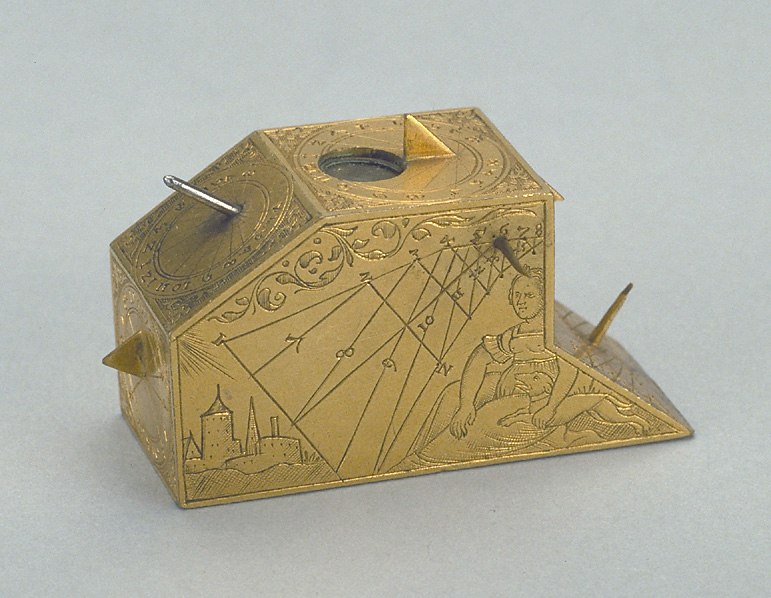
This German polyhedral dial, crafted from brass, measures 55 x 30 x 23 mm and is dated 1553. Signed with the initials 'WS', the instrument features seven differently inclined faces, each functioning as a sundial with various systems of timekeeping, including common, Italian, and Babylonian hours. The surfaces are decorated with extensive, detailed engraving consisting of foliage, landscape scenes, and human figures. The top face contains a small inset compass and a dial with a solid polar gnomon. Other faces utilize pin gnomons, one of which on the north reclining face is identified as a later steel replacement. The base of the instrument features a cartouche engraved with the name 'SIMON SCHMIDLKOFER DER IVNGER' and the date '1577', which is associated with the owner rather than the maker. It was bequeathed to the British Museum by Maurice Rosenheim in 1922.

A brass polyhedral sundial, dated 1553, showing the west and south faces with various gnomons and engraved figures.
A brass polyhedral sundial, dated 1553, showing the west and south faces with various gnomons and engraved figures. — British Museum, London. Rights pending — permission not yet requested. Original source

Catalogue identity

Source
www.mhs.ox.ac.uk
Category
Tool · German polyhedral dial
Maker / attribution
WS
Reference
MLA 1922, 7-5.22
Catalogue / lot identifier
MLA 1922, 7-5.22
Source-reported date
1553
Source-reported place
Germany

Source-reported attribution and specifications are not independent authentication. A listing does not establish present ownership, current display, availability or permission to reproduce.

Object description

Design and Configuration

The polyhedral dial is an irregular brass construction featuring seven distinct, inclined faces. Each face serves as an independent timekeeping surface, employing a variety of systems including common, Italian, and Babylonian hours. The top face includes a small, integrated compass with a card marked 'OR' and 'OC', alongside a dial fitted with a solid polar gnomon to indicate common hours from 4 to 12 to 8. The north face features a solid gnomon dial, while the north reclining face uses a pin gnomon, with the steel pin noted as a later replacement.

The south vertical face incorporates a solid polar gnomon for common hours, while the south reclining face is marked for both Italian and common hours, displaying symbols for the signs of the zodiac: Libra, Capricorn, Aries, and Cancer. The west face indicates common and Babylonian hours, while the east face provides readings for Babylonian and common morning hours.

Evidence for this section
  • “The polyhedral dial was a vehicle for makers to express their imagination and ingenuity in the design of different shapes and inclinations.”
  • “The north reclining face has a pin gnomon dial indicating common hours from 4 to 12 to 8, and decoration of foliage in the spandrel spaces. The steel pin is a later replacement.”

Engraving and Inscriptions

The instrument is densely decorated with fine engraving. The east and west faces feature detailed landscapes in the foreground, with the west face displaying a woman holding a dog and the east face showing a man with a dog. Foliage is used to fill the spandrel spaces across the dial faces. The initials 'WS' and the date '1553' are engraved on the north face, surrounded by star symbols.

A cartouche on the bottom face contains the inscription 'SIMON SCHMIDLKOFER DER IVNGER 1577'. While the maker is identified by the initials 'WS', historical research by E. Zinner suggests that the engraving on the bottom face refers to the later owner of the object, rather than the maker. This distinction clarifies the discrepancy between the date of the object's construction and the date recorded on the base.

Evidence for this section
  • “The finely engraved decoration is extensive and includes, on the east and west faces, figures and landscapes.”
  • “According to Zinner this refers to the owner, not to the maker.”

Provenance and Documentation

The dial is held in the collection of the British Museum, London, under registration number MLA 1922, 7-5.22. It entered the collection via a bequest from Maurice Rosenheim in 1922. The instrument is documented in the scholarly record, specifically appearing in F. A. B. Ward's catalogue of European scientific instruments held by the Department of Medieval and Later Antiquities.

Further analysis of the object was conducted by E. Zinner in his 1957 study of German and Dutch astronomical instruments. These academic sources provide the framework for the current attribution of the instrument's maker and the interpretation of the owner's inscription.

Evidence for this section
  • “The instrument was bequeathed by Maurice Rosenheim in 1922 and is described in F. A. B. Ward, A Catalogue of European Scientific Instruments in the Department of Medieval and Later Antiquities of the British Museum (London, 1981), p.32, no.64.”

Open research questions

  • What is the specific significance of the 'OR' and 'OC' markers on the compass card?
  • Are there similar extant works by the maker 'WS' that allow for a broader comparison of their engraving style?

Source evidence

Recorded claims and source quotations for Polyhedral Dial
FieldSource-reported valueSource quotation
Maker initialsWS“Signed 'WS'”
Date of manufacture1553“Dated 1553; German”
MaterialBrass“Brass; 55 x 30 x 23 mm”
Dimensions55 x 30 x 23 mm“55 x 30 x 23 mm”
Registration numberMLA 1922, 7-5.22“Registration no. MLA 1922, 7-5.22”
Owner inscriptionSimon Schmidlkofer der Ivnger, 1577“SIMON SCHMIDLKOFER DER IVNGER ?1 ? 5 ? 7 ? 7 ?”
ProvenanceMaurice Rosenheim“The instrument was bequeathed by Maurice Rosenheim in 1922”

Visible details

  • Seven differently inclined functional faces
  • Engraved figures of a man and woman with dogs
  • Integrated small compass on the top face
  • Later replacement of the north reclining face pin gnomon

Research qualifications

  • Distinction between maker initials 'WS' and owner name 'Simon Schmidlkofer' depends on E. Zinner's analysis
  • Identification of the pin gnomon as a later replacement

Photograph identity and source facts were screened before import; rights clearance remains pending.

Consulted source

Polyhedral Dial

Reviewed 2026-10-26 · Record 665f5258f9

Terms in this record

Glossary explanations for terms named in this object’s record.

Other german polyhedral dial records