
Skip to content
The Encyclopedia of Horology

Pocket watch · Alarm pocket watch

Pocket watch with alarm by Barent van der Cloesen

Partially verified

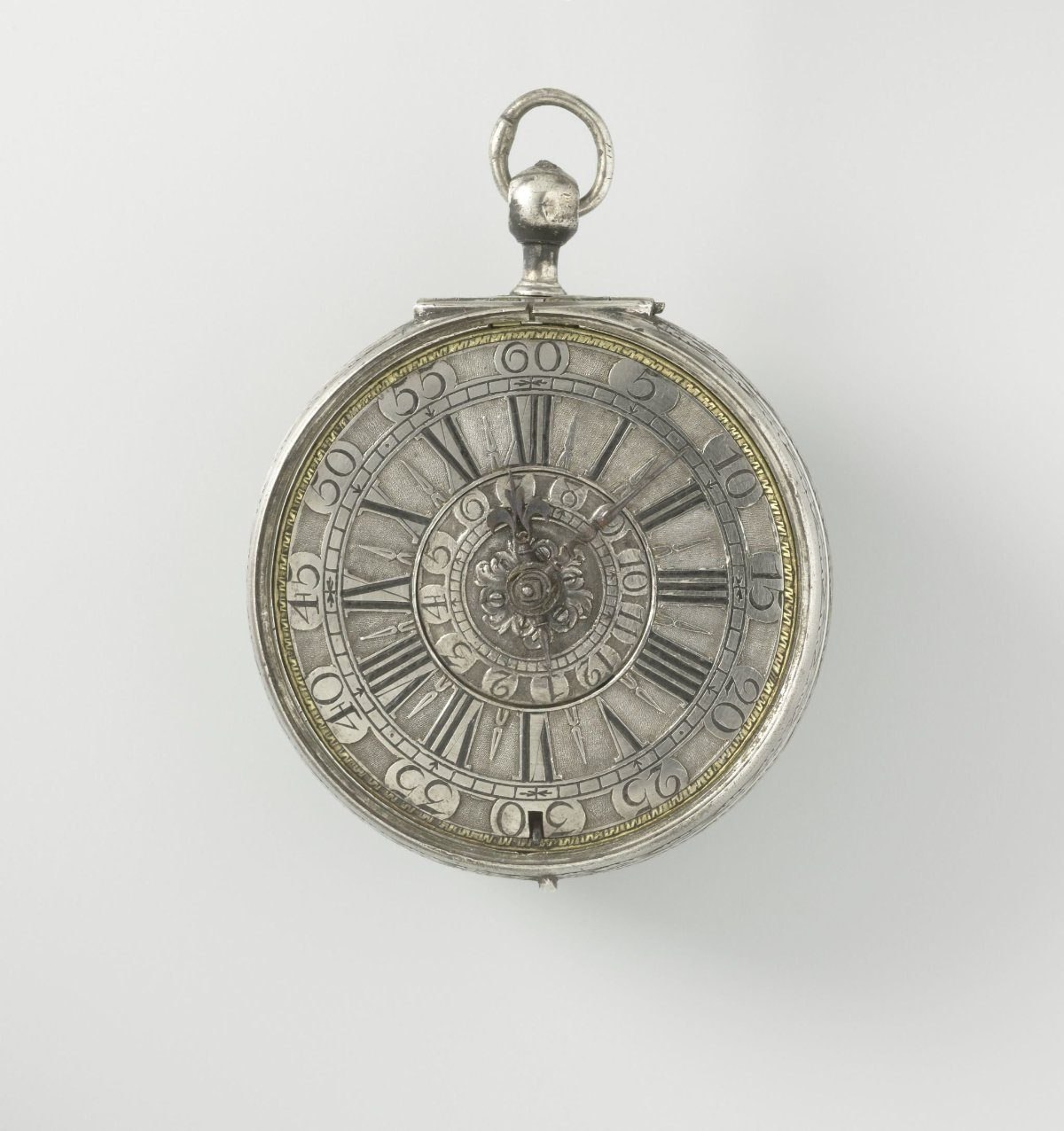
This silver verge pocket watch with an alarm function is attributed to the horologist Barent van der Cloesen, based in The Hague. Dating between circa 1680 and 1710, the watch features a bowl-shaped back cover decorated with ajour-worked edges, scroll ornaments, and two medallions depicting landscapes. The watch face is made of granulated silver with inlaid black Roman hour numerals and Arabic minute numerals, featuring a rotatable alarm disc and an alarm hand. The movement plate is engraved with the signature 'B. van der Cloesen, Hagae'. The watch was bequeathed to the Rijksmuseum in 1937 as part of the Maurits Elzas collection. Its construction includes an open-worked case design intended to allow the alarm sound to be audible, while the secondary layering of the casing provides protection for the internal movement against dirt and dust.

Front view of the silver pocket watch with alarm function, showing the inlaid numeral dial and rotatable alarm disc.
Front view of the silver pocket watch with alarm function, showing the inlaid numeral dial and rotatable alarm disc. — Rijksmuseum. Rights pending — permission not yet requested. Original source

Catalogue identity

Source
www.rijksmuseum.nl
Category
Pocket watch · Alarm pocket watch
Maker / attribution
Barent van der Cloesen
Reference
Not recorded
Catalogue / lot identifier
BK-15071
Source-reported date
ca. 1680 - ca. 1710
Source-reported place
Netherlands

Source-reported attribution and specifications are not independent authentication. A listing does not establish present ownership, current display, availability or permission to reproduce.

Object description

Case and Dial Design

The watch is housed in a silver case featuring a bowl-shaped back. The design incorporates an ajour-worked border decorated with scroll ornaments and two specific medallions depicting landscape scenes. The circular underside of the watch case is finished with finely chased scroll work, consistent with Dutch watchmaking practices of the late 17th century.

The dial is constructed from granulated silver and displays inlaid black Roman numerals for the hours and Arabic numerals for the minutes. A central, rotatable alarm disc is integrated into the dial, accompanied by an alarm hand for setting the alert function. The case design is specifically configured to allow sound transmission while protecting the mechanical movement.

Evidence for this section
  • “De komvormige achterbodem heeft een ajour bewerkte rand met rankornamenten, waartussen twee medaillons met landschappen”
  • “De zilveren wijzerplaat met ingelegde zwarte Romeinse uur- en Arabische minuutcijfers is gegranuleerd”
  • “De openingen van dit horloge zijn deel van een minutieus uitgewerkt patroon.”

Movement and Functionality

The object functions as a verge watch equipped with an alarm. The movement is protected by the case design, which includes multiple layers to guard against dust and environmental contaminants, an approach used in watches of this period to ensure durability.

The watchmaker Barent van der Cloesen, active in The Hague, is credited with the production of this timepiece. His signature is found on the movement plate, confirming the origin of the mechanical assembly.

Evidence for this section
  • “Zilveren spilhorloge met wekker”
  • “Door de gaten is de bel goed hoorbaar. Toch is het uurwerk goed beschermd tegen vuil en stof, doordat er meer dan één kast omheen zit.”
  • “De platine met kloof is gesigneerd: B. van der Cloese, Hagae.”

Provenance and History

The watch was formerly part of the Maurits Elzas collection in Arnhem. It was purchased from a dealer named Aalbers in 1929 for 12.50 guilders before becoming part of the collection held by Maurits Elzas (1868-1937).

Following the death of Maurits Elzas, the watch was bequeathed to the Rijksmuseum in 1937 as one of 107 watches within the larger collection.

Evidence for this section
  • “from the dealer Aalbers, Arnhem, fl. 12,50, to Maurits Elzas (1868-1937), Arnhem, 1929”
  • “by whom bequeathed with 106 other watches, as part of the 'Maurits Elzas Collection', to the museum, 1937”
  • “Linda Eversteijn, 'Schoone horlogien' : Nederlandse horloges in de Gouden Eeuw, 2014”

Open research questions

  • Can the specific anonymous silversmith be identified through stylistic comparisons with other Dutch silver watch cases from the 1690-1710 period?
  • Are there remaining internal records or inventories that detail the specific mechanical components of the movement beyond the signature and verge escapement?

Source evidence

Recorded claims and source quotations for Pocket watch with alarm by Barent van der Cloesen
FieldSource-reported valueSource quotation
MakerBarent van der Cloesen“Barent van der Cloesen, Den Haag”
SignatureB. van der Cloese, Hagae“B. van der Cloese, Hagae”
MaterialSilver“Zilveren spilhorloge met wekker”
ProvenanceMaurits Elzas Collection“Collectie Maurits Elzas, Arnhem”
AcquisitionLegatum 1937“legaat 1937”
Case featuresOpen-worked with landscape medallions“De komvormige achterbodem heeft een ajour bewerkte rand met rankornamenten, waartussen twee medaillons met landschappen”
Dial detailsGranulated silver with inlay“De zilveren wijzerplaat met ingelegde zwarte Romeinse uur- en Arabische minuutcijfers is gegranuleerd”

Visible details

  • Granulated silver dial with inlaid numerals
  • Ajour-worked case back with landscape medallions
  • Central rotatable alarm dial disc
  • Visible alarm setting hand

Research qualifications

  • The exact years of manufacture are provided as a range (1680-1710) without a more precise date
  • The silversmith responsible for the case remains anonymous

Photograph identity and source facts were screened before import; rights clearance remains pending.

Consulted source

Pocket watch, c. 1690 - c. 1710

Reviewed 2026-11-02 · Record 8467d8aab9

Terms in this record

Glossary explanations for terms named in this object’s record.