
Skip to content
The Encyclopedia of Horology

Clock · Mantel clock

Pendule Clio Mantel Clock

Partially verified

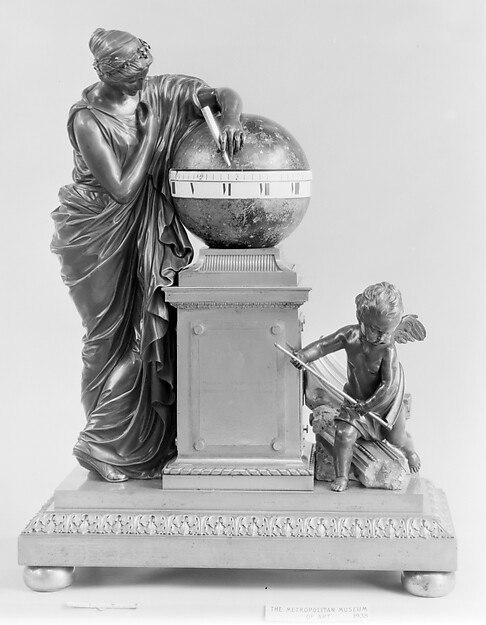
The Pendule Clio is a mantel clock held in the collection of The Metropolitan Museum of Art (accession 37.160.10). It is attributed to the French horologist Jean-André Lepaute and dated circa 1766–70. The clock incorporates complex metallic construction, with the case composed of patinated and gilded bronze, and potentially patinated copper. The timekeeping mechanism is housed within a spherical element supported by a pedestal, featuring a white enamel dial with Roman numerals. The iconography references the muse Clio from Greek mythology, accompanied by a putto figure. Measuring approximately 24 3/4 by 19 1/4 by 10 1/4 inches and weighing 105 pounds, the object is constructed from brass and steel movement components.

The Pendule Clio mantel clock, showing the muse Clio and accompanying putto.
The Pendule Clio mantel clock, showing the muse Clio and accompanying putto. — The Metropolitan Museum of Art, New York. Rights pending — permission not yet requested. Original source

Catalogue identity

Source
orbiscollectibles.com
Category
Clock · Mantel clock
Maker / attribution
Jean-André Lepaute
Reference
Not recorded
Catalogue / lot identifier
37.160.10
Source-reported date
ca. 1766–70
Source-reported place
France

Source-reported attribution and specifications are not independent authentication. A listing does not establish present ownership, current display, availability or permission to reproduce.

Object description

Design and Iconography

The Pendule Clio is designed with a mythological theme, featuring a central celestial-style sphere that functions as the clock dial. The primary figure, depicting Clio, the muse of history, stands beside the clock pedestal, gesturing toward the sphere. This sculptural arrangement integrates the horological function with fine arts casting.

A smaller putto figure is positioned on the base, providing additional narrative detail to the composition. The materials used for the exterior case include a combination of patinated and gilded bronze, with an additional potential inclusion of patinated copper.

Evidence for this section
  • “In Greek mythology, Clio is celebrated as the muse of history.”
  • “Subject tags assigned by the museum: Women, Putti.”
  • “Case: patinated and gilded bronze, and patinated copper (?)”

Technical Specifications

The internal movement is constructed primarily from brass and steel. The clock face itself uses white enamel to provide a clear background for the Roman numeral display, which is integrated into the spherical housing of the clock.

The structure is substantial, with an overall weight of 105 pounds. The dimensions are listed as 24 3/4 by 19 1/4 by 10 1/4 inches, indicating a scale suitable for a mantelpiece or significant display console.

Evidence for this section
  • “Movement: brass and steel”
  • “Overall (confirmed): 24 3/4 × 19 1/4 × 10 1/4 in., 105 lb.”

Provenance and Documentation

This object is part of the collection of The Metropolitan Museum of Art under accession number 37.160.10. It is catalogued under the European Sculpture and Decorative Arts department.

The piece is attributed to the clockmaker Jean-André Lepaute, who held the title of brevet horlogers du Roi and was a member of the Paris clockmakers' guild.

Evidence for this section
  • “Mantel clock in The Metropolitan Museum of Art, New York (accession 37.160.10)”
  • “Lepaute founded a prominent clockmaking dynasty alongside his brother Jean-Baptiste, holding the brevet horlogers du Roi”

Open research questions

  • Are there archival records confirming the specific commission or patron of the Pendule Clio?
  • Does the inclusion of patinated copper, as noted by the museum, distinguish this work from other known Lepaute mantel clocks?

Source evidence

Recorded claims and source quotations for Pendule Clio Mantel Clock
FieldSource-reported valueSource quotation
MakerJean-André Lepaute“attributed to Jean-André Lepaute (French, 1720–1789)”
Dateca. 1766–70“ca. 1766–70”
Dimensions24 3/4 x 19 1/4 x 10 1/4 in.“Overall (confirmed): 24 3/4 × 19 1/4 × 10 1/4 in.”
Weight105 lb.“105 lb.”
Case Materialspatinated and gilded bronze, and patinated copper“Case: patinated and gilded bronze, and patinated copper (?)”
Movement Materialsbrass and steel“Movement: brass and steel”
Object ID37.160.10“37.160.10”

Visible details

  • The clock features a central spherical housing with a white enamel band displaying Roman numerals.
  • A patinated bronze female figure representing Clio is positioned alongside the clock pedestal.
  • A small patinated bronze putto figure is depicted on the base, holding an instrument.
  • The entire assembly rests on a rectangular plinth supported by four feet.

Research qualifications

  • The use of patinated copper in the case construction is noted with uncertainty by the museum record.
  • The attribution to Jean-André Lepaute is documented by the museum but requires further verification against secondary specialist references.

Photograph identity and source facts were screened before import; rights clearance remains pending.

Consulted source

Mantel clock ("Pendule Clio"), ca. 1766–70

Reviewed 2026-11-02 · Record c18184bc71

Terms in this record

Glossary explanations for terms named in this object’s record.