
Skip to content
The Encyclopedia of Horology

Clock · Table clock

Pendule à cercles tournants table clock

Partially verified

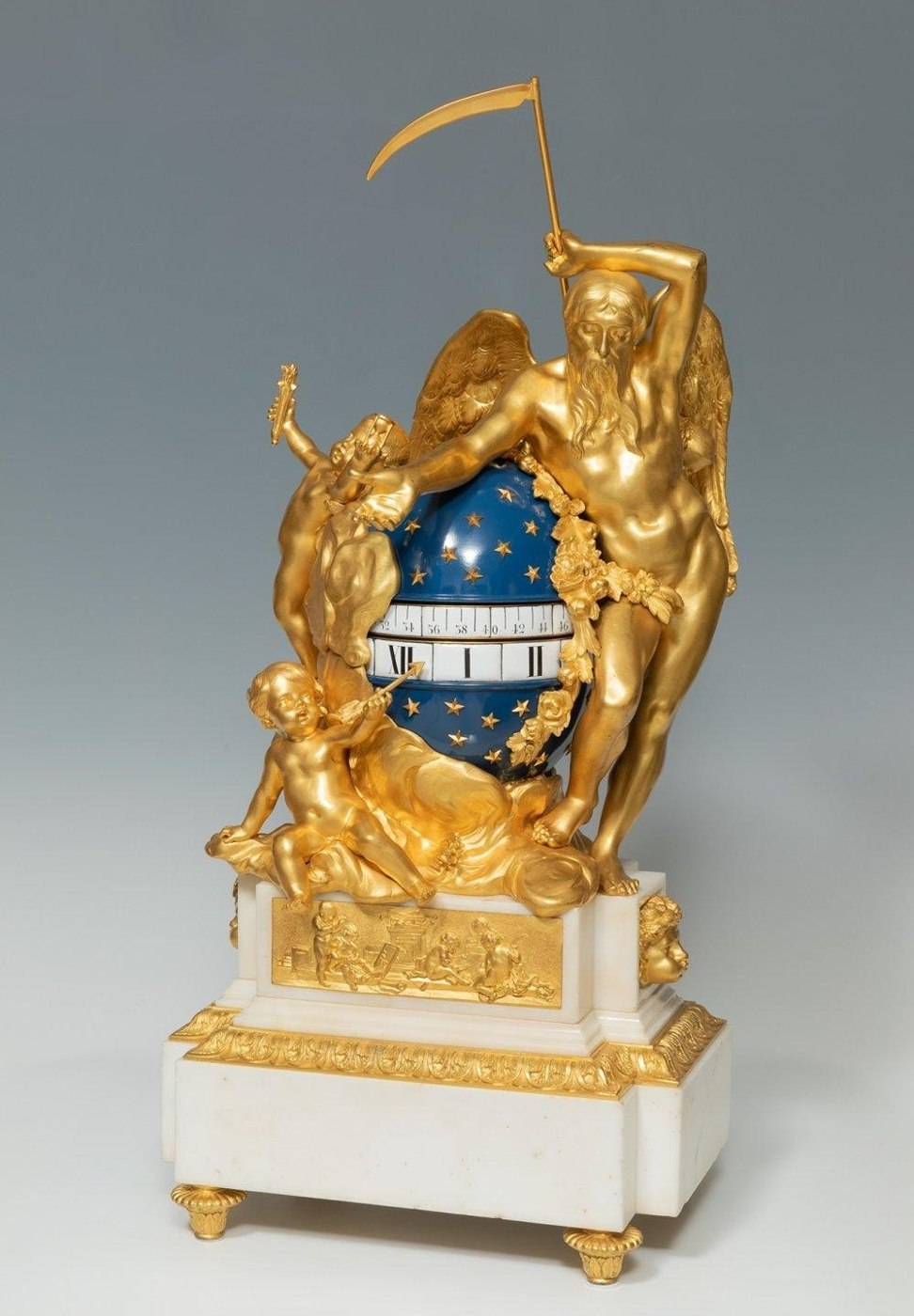
This 19th-century French table clock, described as a "Pendule à cercles tournants," is constructed from mercury gilt bronze, Carrara marble, enamel, and copper, measuring 69 x 32 x 22 cm. The design features a central blue globe decorated with golden stars, which serves as the clock dial displaying Roman numerals for the hours and a graduated ring for minutes. The globe is accompanied by a sculpted figure of Cronus, depicted as a winged, muscular old man holding a scythe, alongside several childlike figures. The rectangular base is crafted from white marble and accented with gilt bronze relief panels illustrating scenes of human activity. The mechanism is stated to be in operation, and the clock retains its winding key. The object's iconography and technical form relate to 18th-century clock designs attributed to Etienne Martincourt and Augustin Pajou, though this specific example is identified as a 19th-century production.

The table clock displays the blue globe dial and the figure of Cronus holding a scythe, mounted on a white Carrara marble base.
The table clock displays the blue globe dial and the figure of Cronus holding a scythe, mounted on a white Carrara marble base. — Setdart Auction House / Invaluable. Rights pending — permission not yet requested. Original source

Catalogue identity

Source
orbiscollectibles.com
Category
Clock · Table clock
Maker / attribution
Not established
Reference
Not recorded
Catalogue / lot identifier
194983673
Source-reported date
19th century
Source-reported place
France

Source-reported attribution and specifications are not independent authentication. A listing does not establish present ownership, current display, availability or permission to reproduce.

Object description

Composition and Iconography

The clock is constructed from mercury gilt bronze, Carrara marble, enamel, and copper. The centerpiece is a blue globe decorated with golden stars that acts as the clock face, featuring Roman numerals for the hours and a graduated ring for the minutes.

The primary figure is Cronus, shown as a muscular, winged old man holding a scythe. He is accompanied by childlike figures at the foot of the globe, intended to represent childhood and youth. The rectangular marble base is decorated with gilt relief panels showing figures involved in reading and teaching activities.

Evidence for this section
  • “The centerpiece is dominated by the figure of Cronus”
  • “At his side, a blue globe adorned with golden stars acts as the clock face”
  • “The gilt relief at the base of the clock depicts scenes related to human activities, such as reading and teaching”

Relationship to Historical Designs

The source notes that the present piece exhibits iconography similar to 18th-century designs, specifically referencing a Louis XVI clock titled "The triumph of Love Over Time" and another held in the Wallace Collection (inv F264).

These historical prototypes have been linked to the sculptor Augustin Pajou and the bronze caster Etienne Martincourt. The current 19th-century clock shares common figures with these pieces, although variations exist in elements such as the cloud formations, star positions on the dial, and hour band design.

Evidence for this section
  • “The present clock shows an iconography very similar to that of these examples”
  • “finding some differences as is normal since each piece is unique”
  • “linked to the caster Etienne Martincourt (act.1763-1791) and the design by Augustin Pajou (1730-1809)”

Condition and Operation

The object is described as being in working order. It retains its original key used for winding the movement.

The auction description confirms that the clock is currently operational, with no mention of necessary repairs for basic functionality.

Evidence for this section
  • “In operation.”
  • “Keeps key.”

Open research questions

  • Identify the maker or movement manufacturer of this 19th-century reproduction.
  • Determine the exact date of production within the 19th century.

Source evidence

Recorded claims and source quotations for Pendule à cercles tournants table clock
FieldSource-reported valueSource quotation
MaterialMercury gilt bronze, Carrara marble, enamel and copper“Mercury gilt bronze, Carrara marble, enamel and copper”
Dimensions69 x 32 x 22 cm“69 x 32 x 22 cm”
Date19th century“19th century”
CountryFrance“France, XIX century”
FunctionWorking order“In operation”
IconographyCronus with scythe and globe dial“figure of Cronus, the god of time in Greek mythology, depicted as a muscular old man with wings holding a scythe aloft”
AccessoriesKey“Preserves key.”

Visible details

  • Features a blue enamel globe with star motifs.
  • Base includes gilt bronze reliefs showing figures reading.
  • Supported on four small gilt feet.
  • Cronus figure carries a scythe.

Research qualifications

  • The specific maker of this 19th-century example is not identified.
  • While the iconography is linked to 18th-century designs, the actual date of manufacture is cited as 19th century.

Photograph identity and source facts were screened before import; rights clearance remains pending.

Consulted source

Clock, table, France, 19th century

Reviewed 2026-11-02 · Record 4bc553e160

Terms in this record

Glossary explanations for terms named in this object’s record.