
Skip to content
The Encyclopedia of Horology

Clock · Ball clock

Pendule à Bille Constant Force Clock

Partially verified

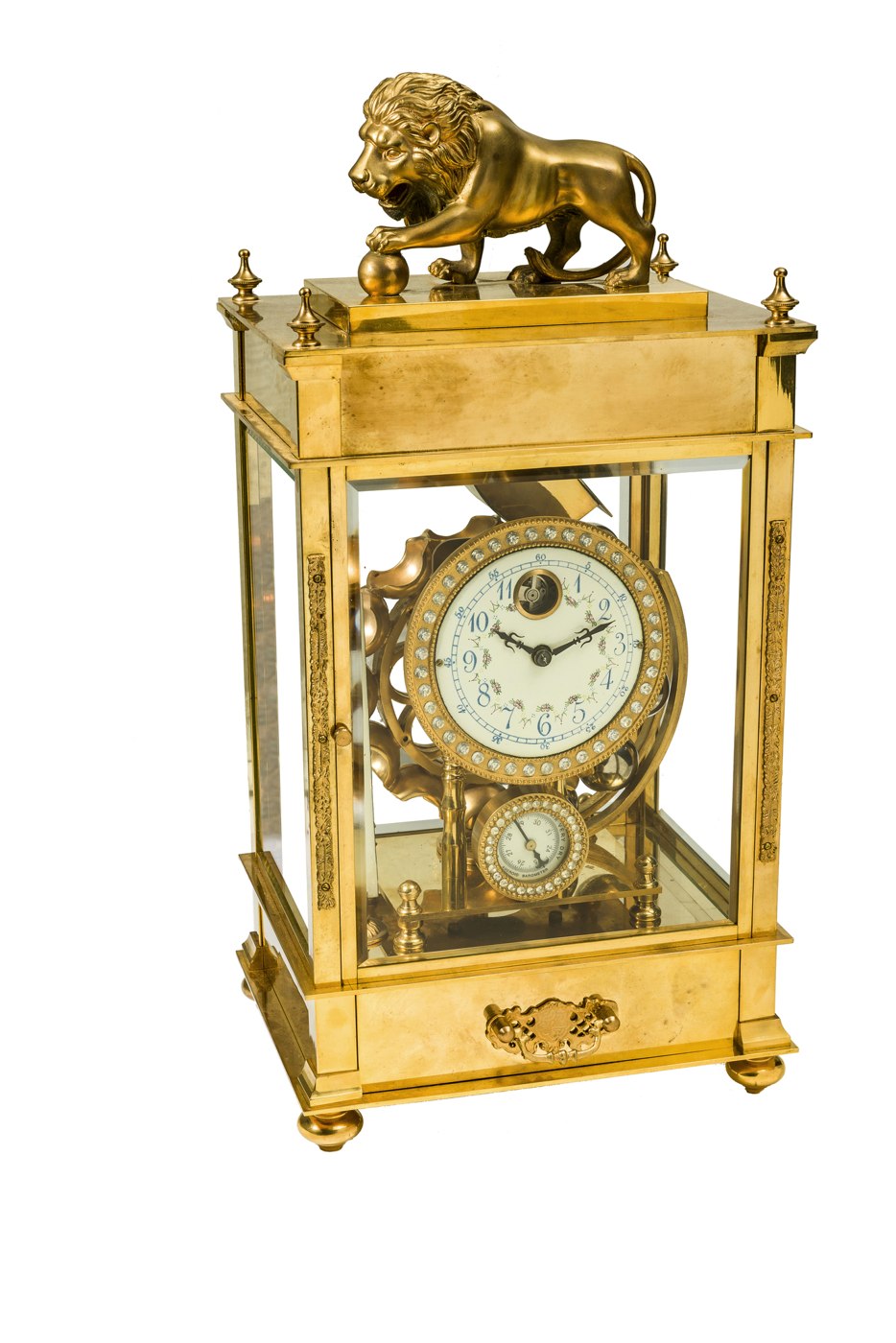
This is a gilt brass constant force ball clock, which features an integrated perpetual calendar, thermometer, and barometer. Measuring 55 x 29 cm, the clock is designed with a movement utilizing 18 steel balls for the constant force mechanism. The primary dial is set with decorative elements, while the perpetual movement is credited in the auction description to the work or inspiration of Mathieu Planchon (1842-1921), a watchmaker and horological historian who created modern copies of older designs. The mechanism draws conceptual inspiration from medieval water clocks. According to the auction description, this piece is one of six similar known models, with others historically located in diverse collections including the Peking horology museum and a specimen gifted to the British consulate in Tunis.

Front view of the gilt brass Pendule à Bille constant force clock, showing the dial with thermometer and barometer, the lion finial, and the ball-bearing mechanism.
Front view of the gilt brass Pendule à Bille constant force clock, showing the dial with thermometer and barometer, the lion finial, and the ball-bearing mechanism. — Antiquorum. Rights pending — permission not yet requested. Original source

Catalogue identity

Source
catalog.antiquorum.swiss
Category
Clock · Ball clock
Maker / attribution
Not established
Reference
Not recorded
Catalogue / lot identifier
410
Source-reported date
circa 1895-1905
Source-reported place
Not established

Source-reported attribution and specifications are not independent authentication. A listing does not establish present ownership, current display, availability or permission to reproduce.

Object description

Case and Exterior Construction

The clock is housed in a gilt brass case featuring glass panels on the sides, providing visibility to the internal mechanism. The top of the case is surmounted by a brass sculpture of a lion holding a sphere, which the auction description associates with the Medicis lions found in Rome.

The dial is fitted within the case and is surrounded by an ornamental border. Additional indicators for the barometer and thermometer are displayed on the dial, integrated alongside the timekeeping functions. The overall aesthetic emphasizes the gilt brass metalwork and the visibility of the ball-driven mechanism.

Evidence for this section
  • “The two lions at the top of the clock are inspired by the Medicis lions that can be found on either side of their house in Rome.”
  • “gilt brass, constant force, perpetual calendar ball clock with thermometer and barometer.”

Mechanism and Movement

The movement is identified as an 8-day running perpetual movement utilizing a constant force system. The system relies on 18 steel balls to regulate the power delivery, a design described by the auction house as being inspired by medieval water clocks. The mechanism is intended to solve the challenge of maintaining regular power in a mechanical clock.

The auction description links this design to the documentation of Mathieu Planchon, who studied and wrote about similar mechanisms in the context of the Paris Universal Exhibition. The complexity of the movement is designed to be visible within the glass-enclosed case, highlighting the movement of the steel spheres.

Evidence for this section
  • “constant force, perpetual calendar ball clock”
  • “understand the concept of constant force due to the 18 steel balls.”
  • “These models are inspired by the antique water clocks from the middle ages”

Provenance and Attribution

The object is unsigned, but the auction description connects the model to the horologist and historian Mathieu Planchon. Planchon was noted for creating modern copies of antique timekeeping devices and published extensive research on perpetual clocks and constant force mechanisms, specifically in relation to the Paris Universal Exhibition of 1900.

The auction description notes the existence of six other similar models globally, including one conserved at the Peking horology museum and another historically gifted to the British consulate in Tunis. These comparisons suggest a limited production run for this specific type of ball-powered perpetual clock.

Evidence for this section
  • “It is not, in fact, unthinkable that Mathieu Planchon himself designed and built these clocks”
  • “There are to this day, 6 other similar models known: one in Florida, one gifted in 1894 to the British consulate in Tunis, another sold to the Imperial court of China and conserved in the Peking horology museum.”

Open research questions

  • Are there any internal maker's marks or hidden signatures on the movement plates?
  • Does the thermometer or barometer mechanism correspond to specific 19th-century scientific instrument makers?

Source evidence

Recorded claims and source quotations for Pendule à Bille Constant Force Clock
FieldSource-reported valueSource quotation
ModelPendule a Bille“Model Pendule a Bille”
Dimensions55 x 29 cm“Dimensions 55 x 29 cm.”
Materialgilt brass“gilt brass, constant force, perpetual calendar ball clock”
DateCirca 1895-1905“Year Circa 1895-1905”
MakerUnsigned“Brand Unsigned”
Mechanism18 steel balls“concept of constant force due to the 18 steel balls.”
Design InspirationMedicis lions“The two lions at the top of the clock are inspired by the Medicis lions”

Visible details

  • Gilt brass case with glass panels and a lion finial
  • Movement features an array of 18 steel spheres
  • Dial includes thermometer and barometer indicators
  • Perpetual calendar functionality incorporated into the clock

Research qualifications

  • Attribution to Mathieu Planchon as designer or maker is speculative
  • Exact date of manufacture is estimated as circa 1895-1905

Photograph identity and source facts were screened before import; rights clearance remains pending.

Terms in this record

Glossary explanations for terms named in this object’s record.