
Skip to content
The Encyclopedia of Horology

Wristwatch · Tourbillon wristwatch prototype

Omega 1947 Tourbillon Wristwatch Prototype

Partially verified

This prototype wristwatch was produced by Omega in 1947 and houses a 30mm Calibre 30 I tourbillon movement. Phillips states that Omega originally produced twelve Calibre 30 I movements in 1947 for observatory timing trials, none of which were intended for commercial sale. Historical documents and drawings preserved at the Omega Museum later revealed plans to case the movement in a wristwatch, with this piece representing at least one surviving pre-series prototype. The watch was sold at Phillips Bacs & Rosso Auction Six in Geneva.

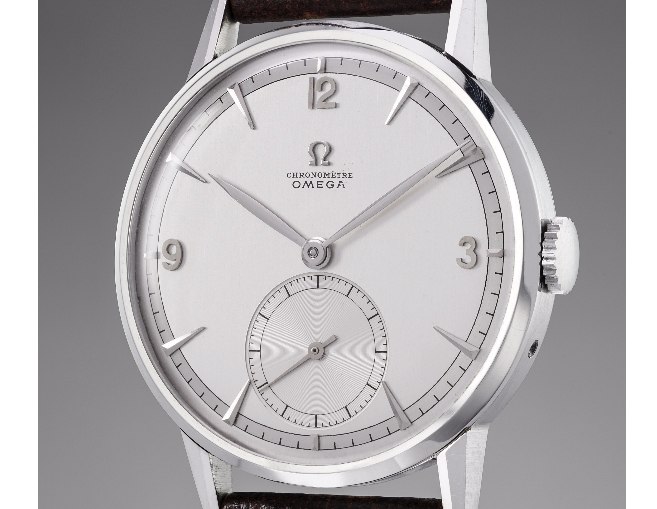
Front view of the 1947 Omega tourbillon wristwatch prototype dial and case
Front view of the 1947 Omega tourbillon wristwatch prototype dial and case — Phillips via WatchPro. Rights pending — permission not yet requested. Original source

Catalogue identity

Source
www.watchpro.com
Category
Wristwatch · Tourbillon wristwatch prototype
Maker / attribution
Omega
Reference
Not recorded
Catalogue / lot identifier
Source URL identifies the listing
Source-reported date
1947
Country
Switzerland

Source-reported attribution and specifications are not independent authentication. A listing does not establish present ownership, current display, availability or permission to reproduce.

Object description

Prototype Identity and Production Context

According to auction cataloguing cited by the source, this watch represents a pre-series wristwatch prototype produced by Omega in 1947. Omega had originally created twelve Calibre 30 I tourbillon movements measuring 30mm in diameter specifically to compete in the 'wristwatch' category of timing trials at the Geneva, Neuchâtel, and Kew-Teddington Observatories, with none intended for public retail.

While seven of the initial twelve competition calibres were later rediscovered and cased by Omega in 1987, historical documentation and drawings preserved at the Omega Museum indicate an initiative to house a 30mm tourbillon in a wristwatch case. This discovery brought the known count of Calibre 30 I movements to thirteen, with the present piece identified as a surviving prototype resulting from that development program.

Evidence for this section
  • “produced as a prototype in 1947 and never intended for sale”
  • “In 1947, Omega created twelve Calibre 30 I tourbillon movements of only 30mm in diameter to run in the “wristwatch” category of the Geneva, Neuchatel and Kew-Teddington Observatory trials.”
  • “illustrations and information contained in letters preserved at the Omega Museum showcase plans for a 30mm tourbillon movement to be housed in a wristwatch, at least one such movement was created thus increasing the total count of cal. 30 I to thirteen.”

Visual Observations

Visual inspection shows a light-toned dial configured with applied Arabic numerals at 12, 3, and 9 and dart-style hour markers. Below 12 o'clock, the dial is printed with the Omega symbol, 'CHRONOMÈTRE', and 'OMEGA'. An engine-turned subsidiary seconds dial sits above 6 o'clock, encircled by an outer railway-style or segmented minute track.

The watch features a polished silver-toned metal case with faceted lugs and a fluted winding crown at 3 o'clock. The piece is mounted on a dark brown leather strap.

Evidence for this section
  • “Light-toned dial with applied Arabic numerals at 12, 3, and 9 and dart-style hour markers”
  • “Dial printed beneath 12 o'clock with the Omega symbol, 'CHRONOMÈTRE', and 'OMEGA'”
  • “Engine-turned subsidiary seconds dial positioned above 6 o'clock”
  • “Outer railway-style or segmented minute track”
  • “Polished silver-toned metal case with faceted lugs and a fluted winding crown at 3 o'clock”
  • “Mounted on a dark brown leather strap”

Historical Background and Archival Sources

The conceptual motivation for casing the Calibre 30 I tourbillon is tied to a 1947 letter written by Marcel Vuilleumier, the head of the Watchmaking School of the Vallée de Joux, preserved in the Omega Museum. In it, Vuilleumier emphasized the imperative for the Swiss watch industry to focus on precision instruments and suggested developing a tourbillon wristwatch in response to foreign competition.

Archival holdings also yielded a contemporary 1947 technical drawing outlining a wristwatch prototype case intended to house the 30mm Calibre 30 I movement. The auction house cited this drawing as material evidence that development progressed beyond bench testing into physical pre-series watch assembly.

Evidence for this section
  • “In a letter dated 1947 and preserved in the Omega Museum, Mr. Marcel Vuilleumier, head of the Watchmaking School of the Vallée de Joux, dreading the arrival of American and British timepieces, underlines the necessity of the Swiss watchmaking industry to concentrate on precision timepieces and suggests creating a tourbillon wristwatch.”
  • “Recently, an original drawing from the year 1947 of the design of a tourbillon wristwatch prototype case was discovered that further illustrates the proceedings towards the integration of the Calibre 30 I tourbillon movement into a production wristwatch.”

Open research questions

  • What specific metal or alloy comprises the prototype case (e.g., stainless steel, white gold, or silver)?
  • What specific lot number was assigned to this timepiece in the Phillips Bacs & Rosso Geneva Auction Six sale?
  • What individual movement or serial number is marked on the Calibre 30 I movement inside this watch?

Source evidence

Recorded claims and source quotations for Omega 1947 Tourbillon Wristwatch Prototype
FieldSource-reported valueSource quotation
Year of Production1947“A 1947 Omega Tourbillon set a new world record price”
Movement CalibreCalibre 30 I“In 1947, Omega created twelve Calibre 30 I tourbillon movements of only 30mm in diameter”
Intended PurposePrototype never meant for sale“produced as a prototype in 1947 and never intended for sale”
Auction VenuePhillips Bacs & Rosso Geneva Auction Six“Phillips Bacs & Rosso Auction Six in Geneva”
Auction ResultCHF 1.43 million (£1.1 million)“it eventually went under the hammer for CHF 1,43 million (£1.1 million)”
Auction Pre-Sale EstimateCHF 100,000–200,000“Phillips Bacs & Rosso Auction Six in Geneva put a pre-sale estimate of CHF 100-200,000 on the timepiece”
Movement Diameter30 mm“movements of only 30mm in diameter”
Original Movement Production Run12 movements (subsequently revised to 13 with this prototype)“Omega created twelve Calibre 30 I tourbillon movements of only 30mm in diameter”
1987 Rediscovered Movements7 movements rebuilt and cased in gold and silver“In 1987, seven of these twelve movements were discovered by Omega and entirely rebuilt, they were then cased in gold and silver livery and offered to a select group of collectors.”

Visible details

  • Light-toned dial with applied Arabic numerals at 12, 3, and 9 and dart-style hour markers
  • Outer railway-style or segmented minute track
  • Engine-turned subsidiary seconds dial positioned above 6 o'clock
  • Dial printed beneath 12 o'clock with the Omega symbol, 'CHRONOMÈTRE', and 'OMEGA'
  • Polished silver-toned metal case with faceted lugs and a fluted winding crown at 3 o'clock
  • Mounted on a dark brown leather strap

Research qualifications

  • Case material and movement are not visible or specified in the article text
  • Exact lot number is not provided in the article

Photograph identity and source facts were screened before import; rights clearance remains pending.

Consulted source

World Record Broken For Vintage Omega Selling At Auction

Reviewed 2026-10-21 · Record be04e24814

Terms in this record

Glossary explanations for terms named in this object’s record.