
Skip to content
The Encyclopedia of Horology

Tool · Pocket sundial

Octagonal Equatorial Pocket Sundial by Johann Georg Vogler

Partially verified

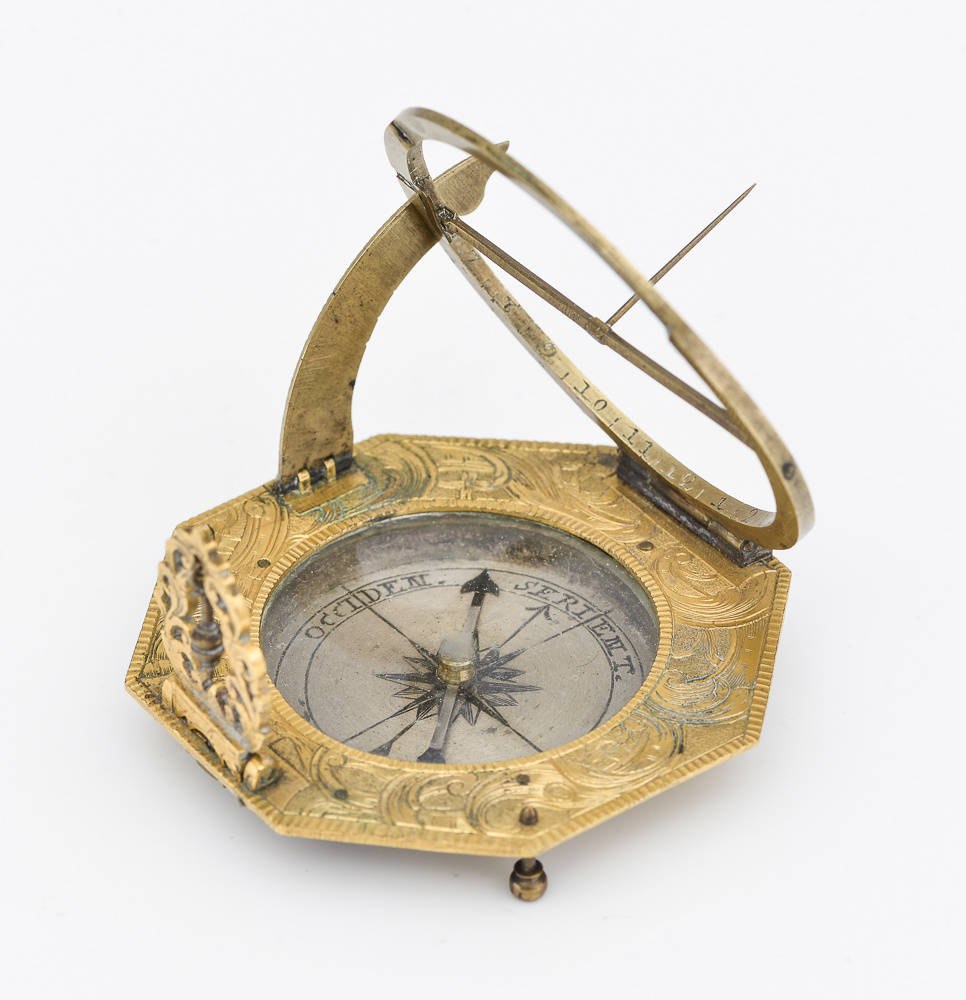
This octagonal equatorial pocket sundial is held by the City Museum Berlin and attributed to the Augsburg clockmaker Johann Georg Vogler (1720–1765). The instrument features a fire-gilded, florally engraved metal construction and incorporates an integrated compass on a silvered base. The compass includes an iron magnetic needle with a blued arrowhead and tail. Designed for precise orientation, the sundial is equipped with three small leveling feet and a plumb bob. The reverse of the instrument is engraved with pole height data for sixteen cities, including Prague, Dresden, and Warsaw, alongside the signature "J.G.V.". Accompanying the device are printed paper instructions for use, which identify the maker as a "Compass-Macher". The piece measures 7.1 x 7.1 cm in its folded state and is designed to unfold for operation with an adjustable equatorial dial ring.

Octagonal equatorial pocket sundial featuring an integrated compass and hinged gnomon ring.
Octagonal equatorial pocket sundial featuring an integrated compass and hinged gnomon ring. — City Museum Berlin via Europeana. Rights pending — permission not yet requested. Original source

Catalogue identity

Source
orbiscollectibles.com
Category
Tool · Pocket sundial
Maker / attribution
Johann Georg Vogler
Reference
Not recorded
Catalogue / lot identifier
/191/item_TBX6R532CWYKZL2O53YLREGFTVAK6VGR
Source-reported date
1720-1765
Source-reported place
Germany

Source-reported attribution and specifications are not independent authentication. A listing does not establish present ownership, current display, availability or permission to reproduce.

Object description

Construction and Design

The sundial is constructed in an octagonal format, featuring metal components that are fire-gilded and decorated with floral engraving. The design incorporates an integral compass, which is set upon a silvered base plate featuring a compass rose.

The instrument is functional as an equatorial sundial, featuring a hinged dial ring that can be set for use. Its design includes an iron magnetic needle with a blued arrowhead and tail, intended to facilitate accurate directional alignment. Leveling is achieved through the use of three small feet and a plumb bob.

Evidence for this section
  • “Florally engraved, fire-gilded.”
  • “The compass on a silvered base with compass rose. Iron magnetic needle with blued arrowhead and tail.”
  • “Three small leveling feet allow for precisely horizontal placement, aided by the plumb bob.”

Signatures and Geographical Data

The reverse of the sundial is engraved with a list of cities and their corresponding pole heights (elevations). The recorded locations include Gorsü, Lion, Bozen, Osen, Ingolstadt, Landau, Prag, Dresden, Warschau, and Riga. The maker, Johann Georg Vogler, is identified by the signature "J.G.V." on this surface.

Additional documentation is provided by a printed paper instruction sheet. On this document, Vogler explicitly describes his professional role, referring to himself as a "Compass-Macher" based in Augsburg. The reverse of the instruction sheet contains further data related to 160 cities and their associated pole heights.

Evidence for this section
  • “Engraved on the back are the elevations (pole heights) for Gorsü, Lion, Bozen, Osen, Ingolstadt, Landau, Prag, Dresden, Warschau, Riga. And the signature J.G.V.”
  • “The instructions for use printed on paper, at the bottom Johann Georg Vogler refers to himself as Compass-Macher in Augsburg. On the reverse the data for 160 cities and their pole heights.”

Dimensions and Provenance

The object is recorded with specific physical measurements depending on its orientation. When folded, it occupies a footprint of 7.1 x 7.1 cm with a height of 1.5 cm. When set up for use, the dimensions increase to 7.3 x 6.5 x 8.2 cm. The printed instructions measure 17.5 x 12.6 cm.

The sundial is currently held by the City Museum Berlin. Documentation confirms that the instrument is one of over 130 documented pieces attributed to the Vogler workshop, which was later managed by the maker's brother, Andreas Vogler.

Evidence for this section
  • “The collection record gives measurements folded (HxWxD): 1.5 x 7.1 x 7.1 cm; instructions for use (HxW): 17.5 x 12.6 cm; set up (HxWxD): 7.3 x 6.5 x 8.2 cm”
  • “Pocket sundial signed JVG is held by City Museum Berlin (Germany)”
  • “More than 130 instruments have been documented in collections and museums.”

Open research questions

  • What is the significance of the city list specifically including Gorsü, Lion, Bozen, and Osen in relation to trade routes or user profiles?
  • How do the technical specifications of this J.G.V. instrument compare to other extant examples attributed to the Vogler workshop?

Source evidence

Recorded claims and source quotations for Octagonal Equatorial Pocket Sundial by Johann Georg Vogler
FieldSource-reported valueSource quotation
MakerJohann Georg Vogler“Johann Georg Vogler, who was born in Augsburg in 1720 and died there on 27 March 1765.”
SignatureJ.G.V.“And the signature J.G.V.”
MaterialMetal, fire-gilded“Florally engraved, fire-gilded.”
Dimensions (folded)1.5 x 7.1 x 7.1 cm“The collection record gives measurements folded (HxWxD): 1.5 x 7.1 x 7.1 cm”
Compass DetailsSilvered base with iron needle“The compass on a silvered base with compass rose. Iron magnetic needle with blued arrowhead and tail.”
Included componentsInstructions for use“The instructions for use printed on paper, at the bottom Johann Georg Vogler refers to himself as Compass-Macher in Augsburg.”
FunctionalityEquatorial sundial with leveling“Three small leveling feet allow for precisely horizontal placement, aided by the plumb bob.”

Visible details

  • Fire-gilded octagonal case with floral engraving
  • Compass dial labeled with "OCCIDEN" and "SERIEM" (Orient)
  • Three small leveling feet for horizontal alignment
  • Iron magnetic needle with blued components

Research qualifications

  • The exact year of manufacture within the maker's lifespan is not provided
  • Specific interpretation of the dial's full functionality in the absence of original usage context

Photograph identity and source facts were screened before import; rights clearance remains pending.

Consulted source

Pocket sundial signed JVG, Vogler, Johann Georg (1720-1765) (clockmaker)

Reviewed 2026-11-02 · Record 809049e20b

Terms in this record

Glossary explanations for terms named in this object’s record.