
Skip to content
The Encyclopedia of Horology

Tool · Pocket sundial

Butterfield-type pocket sundial

Partially verified

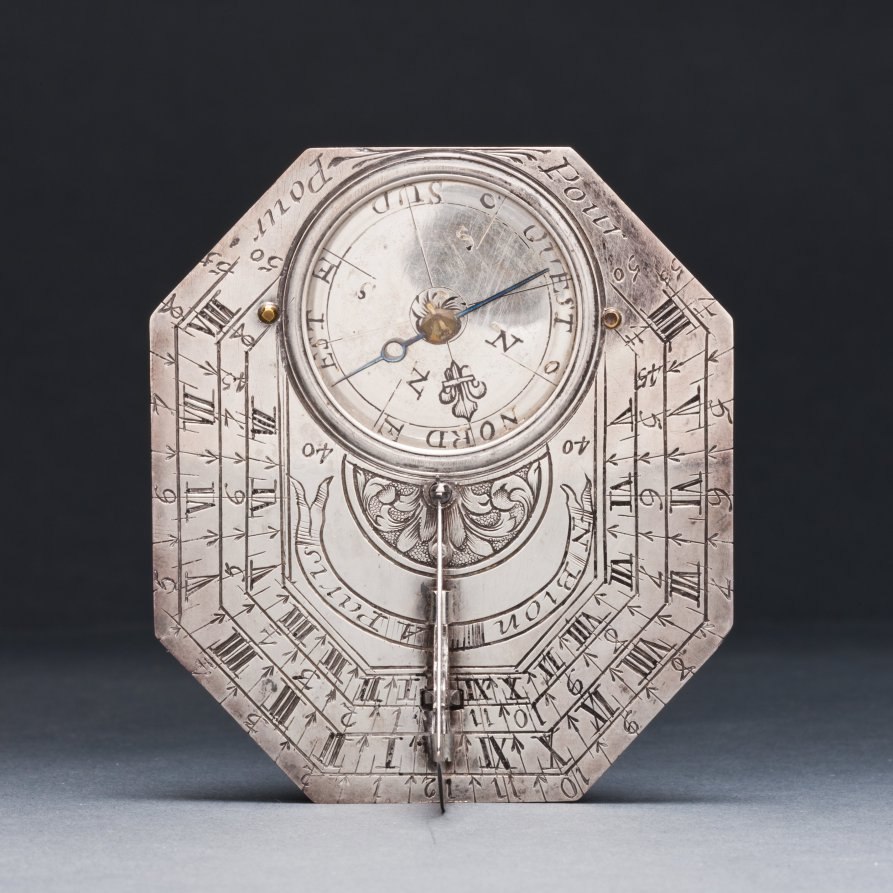
This silver pocket sundial, attributed to the maker N. Bion in Paris, belongs to the Butterfield-type category. Measuring 7.7 by 7.4 cm, the instrument features an octagonal plate with an adjustable gnomon designed for latitudes between 40° and 60° north. The face includes engraved hour scales corresponding to these specific latitudes, while an integrated magnetic compass facilitates orientation. The back of the plate is densely engraved with a geographical reference list containing the names and latitudes of 26 European cities, such as Paris, Rome, and London. The signature "N. BION A Paris" is engraved on a ribbon band positioned above the compass. The object is held in the collection of the Cleveland Museum of Art.

Face of the silver Butterfield-type sundial showing the hour scales, the folding gnomon, and the integrated compass.
Face of the silver Butterfield-type sundial showing the hour scales, the folding gnomon, and the integrated compass. — Cleveland Museum of Art. Rights pending — permission not yet requested. Original source

Catalogue identity

Source
orbiscollectibles.com
Category
Tool · Pocket sundial
Maker / attribution
N. Bion
Reference
Not recorded
Catalogue / lot identifier
1942.490
Source-reported date
1700s
Source-reported place
France

Source-reported attribution and specifications are not independent authentication. A listing does not establish present ownership, current display, availability or permission to reproduce.

Object description

Design and Construction

The sundial is constructed from a silver octagonal plate. This fold-down component functions as the shadow-casting mechanism, allowing the user to measure time based on the sun's position.

The face of the dial is finely engraved with hour scales for various latitudes, organized to provide accurate timekeeping depending on the user's geographic location. The dial layout includes integrated numerical indices and markings, with a central magnetic compass inset into the upper portion of the plate to ensure proper alignment with the cardinal directions.

Evidence for this section
  • “scale adjustable between latitudes of 40° to 60° north”
  • “With an intricately engraved silver face, it would have functioned as a fashionable traveler’s accessory.”

Signatures and Geographical Reference

The instrument is signed "N. BION A Paris" on a ribbon band positioned directly above the compass unit. This signature identifies the maker and the location of production.

The reverse of the sundial serves as a reference guide for travelers, featuring an extensive list of 26 European cities paired with their respective latitudes. This information allowed the user to manually adjust the gnomon to the appropriate setting for their location when using the device in different cities across Europe.

Evidence for this section
  • “The latitudes of 26 European towns are engraved on its back for quick reference.”

Accession and Identification

This object is recorded as item 1942.490 in the Cleveland Museum of Art collection. It is categorized as a silver instrument dating to the 1700s. The museum classifies the item based on its physical properties and its construction as a tool for timekeeping, specifically noting the inclusion of both city-specific latitude data and a navigational compass.

The physical condition of the piece is maintained as part of the museum's open access collection. While the source describes the object as a Butterfield-type, it acknowledges that this is a museum-documented specimen, and further research is suggested to fully verify the specific production history and the formal classification relative to other known horological examples of this type.

Evidence for this section
  • “Cleveland Museum of Art object 1942.490: Butterfield Sundial, 1700s.”
  • “this record describes a single museum object; confirm the wider type, maker attribution and specifications against horological references.”

Open research questions

  • What specific archival evidence confirms N. Bion's role in the production of this particular instrument?
  • Are there variations in the city list compared to other recorded Butterfield-type dials of the same era?

Source evidence

Recorded claims and source quotations for Butterfield-type pocket sundial
FieldSource-reported valueSource quotation
MakerN. Bion“N. BION A Paris”
MaterialSilver“Silver; overall: 7.7 x 7.4 cm”
InstitutionCleveland Museum of Art“Cleveland Museum of Art object 1942.490”
Latitude Range40° to 60° north“scale adjustable between latitudes of 40° to 60° north”
Geographical Indices26 European towns“The latitudes of 26 European towns are engraved on its back for quick reference.”
OriginFrance“France.”

Visible details

  • Adjustable folding gnomon hinged at the base
  • Engraved list of European cities with corresponding numerical latitude values on the reverse
  • Integrated horizontal magnetic compass with cardinal directions
  • Octagonal silver plate with intricate scrollwork engraving

Research qualifications

  • The source classifies the object as a Butterfield-type, but notes that its wider type and maker attribution require confirmation against horological references.
  • The dating to the 1700s is presented as a general chronological attribution by the source.

Photograph identity and source facts were screened before import; rights clearance remains pending.

Consulted source

Butterfield Sundial (Cleveland Museum of Art 1942.490)

Reviewed 2026-11-02 · Record fe874e0b36

Terms in this record

Glossary explanations for terms named in this object’s record.