
Skip to content
The Encyclopedia of Horology

Tool · French nocturnal

Nocturnal with horizontal dial and moondial

Partially verified

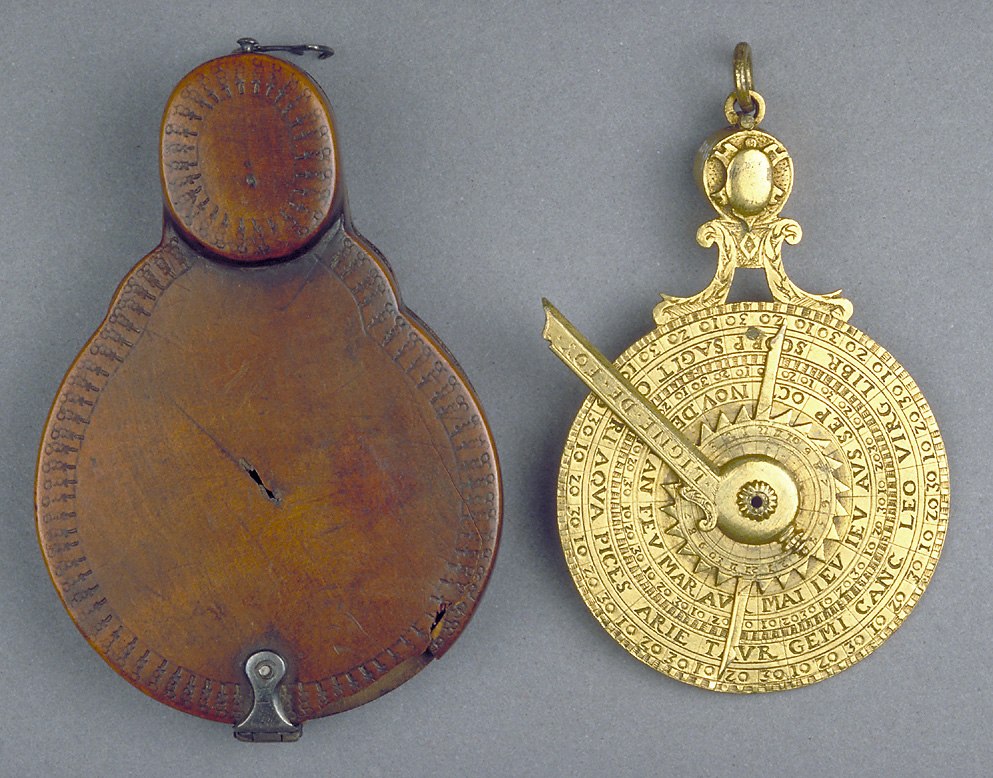
This 52 mm diameter gilt brass nocturnal, dated 1588 and of French origin, serves as a multifunctional scientific instrument. It combines a nocturnal, a horizontal dial, and a moondial with lunar time conversion capability. The obverse features a horizontal dial with a folding gnomon calculated for a latitude of approximately 49 degrees, accompanied by a moondial volvelle and a lunar age scale. The compass, integrated into the handle, displays cardinal directions with a 10-degree east deviation. The reverse functions as a nocturnal, containing zodiacal scales, a Julian calendar, and a central rotating volvelle with a 24-hour scale and a 'LIGNE DE FOY' index. The instrument retains its original wooden storage case with red lining. It is currently held in the British Museum collection.

The nocturnal and its wooden case.
The nocturnal and its wooden case. — British Museum, London. Rights pending — permission not yet requested. Original source

Catalogue identity

Source
www.mhs.ox.ac.uk
Category
Tool · French nocturnal
Maker / attribution
Not established
Reference
Not recorded
Catalogue / lot identifier
MLA 1891,8-3.1
Source-reported date
1588
Source-reported place
France

Source-reported attribution and specifications are not independent authentication. A listing does not establish present ownership, current display, availability or permission to reproduce.

Object description

Front Dial and Moondial Features

The obverse of the circular brass plate is configured as a horizontal dial, featuring a folding gnomon calibrated for a latitude of approximately 49 degrees. An hour scale numbered IV to XII to VIII occupies the outer edge, with half-hours marked by small dots. Internal to this is a lunar age scale numbered 1 to 29.

A volvelle is located within the centre, serving as a moondial for converting lunar time to solar time. This mechanism includes a circular aperture for indicating moon phases and an index that correlates with the moon's age scale. The date '1588' is engraved on the rim near the lunar scale.

A compass is attached to the instrument's handle, featuring cardinal points marked by initial letters of Latin names. The compass demonstrates a 10-degree east deviation.

Evidence for this section
  • “The front is laid out for a horizontal dial with the folding gnomon set for a latitude of circa 49?”
  • “Further to the inside is a scale for the age of the moon numbered 1 to 29”
  • “A circular aperture shows the phases of the moon”
  • “The compass, fixed to the handle, has the cardinal points indicated by the first letter of the usual Latin names with a deviation of circa 10?E”

Nocturnal and Calendar Functions

The reverse of the plate functions as a nocturnal. It incorporates several concentric scales: the outermost displays zodiacal signs with 30-degree divisions, shaded for clarity. A Julian calendar scale follows, featuring abbreviated Latin month names, though the source notes a discrepancy in the division intervals used for this scale.

At the centre lies a rotating volvelle marked with a twice-12-hour scale, arranged anticlockwise. Small teeth on this disc indicate full hours. An index arm, labeled 'LIGNE DE FOY', rotates over the central dial, allowing the user to align the instrument with the time of year using the two indices at 12 o'clock.

Evidence for this section
  • “The reverse is laid out as a nocturnal with several circular scales”
  • “A Julian calendar scale with the names of the months given as 'IAN' FEV, MAR, AVR, MAI, IEV, IEV, AVS, SEP, OCT, NOV, DEC'”
  • “An index rotating over this disc is marked 'LIGNE DE FOY'”

Documentation and Provenance

The instrument is part of the collection at the British Museum, where it was registered under the number MLA 1891,8-3.1 following its purchase in 1891. The instrument is stored in a dedicated wooden case with interior red lining.

The nocturnal is catalogued in F. A. B. Ward's 1981 publication, 'A Catalogue of European Scientific Instruments in the Department of Medieval and Later Antiquities of the British Museum', appearing as entry number 209.

Evidence for this section
  • “The instrument is contained in a wooden case with red lining.”
  • “The instrument was purchased in 1891”
  • “described in F. A. B. Ward, A Catalogue of European Scientific Instruments in the Department of Medieval and Later Antiquities of the British Museum (London, 1981), p. 75, no. 209”

Open research questions

  • What is the specific intended location or significance of the 49-degree latitude calibration?
  • Can the discrepancy noted in the Julian calendar divisions be attributed to a specific manufacturing error common in instruments of this period?

Source evidence

Recorded claims and source quotations for Nocturnal with horizontal dial and moondial
FieldSource-reported valueSource quotation
MaterialGilt brass“Gilt brass; 52 mm in diameter”
Date1588“Dated 1588”
OriginFrench“French”
Inventory NumberMLA 1891,8-3.1“Registration no. MLA 1891,8-3.1”
Dimensions52 mm diameter“52 mm in diameter”
Compass Deviation10 degrees east“with a deviation of circa 10?E”

Visible details

  • Folding gnomon for horizontal sundial
  • Compass integrated into the handle
  • Ligne de foy index on the nocturnal side
  • Wooden case with red lining

Research qualifications

  • The Julian calendar scale appears confused with the zodiacal scale division
  • The exact maker remains unattributed

Photograph identity and source facts were screened before import; rights clearance remains pending.

Consulted source

Nocturnal

Reviewed 2026-10-26 · Record 9eafb04095

Terms in this record

Glossary explanations for terms named in this object’s record.

Other french nocturnal records