
Skip to content
The Encyclopedia of Horology

Tool · French nocturnal and quadrant

Nocturnal and Quadrant

Partially verified

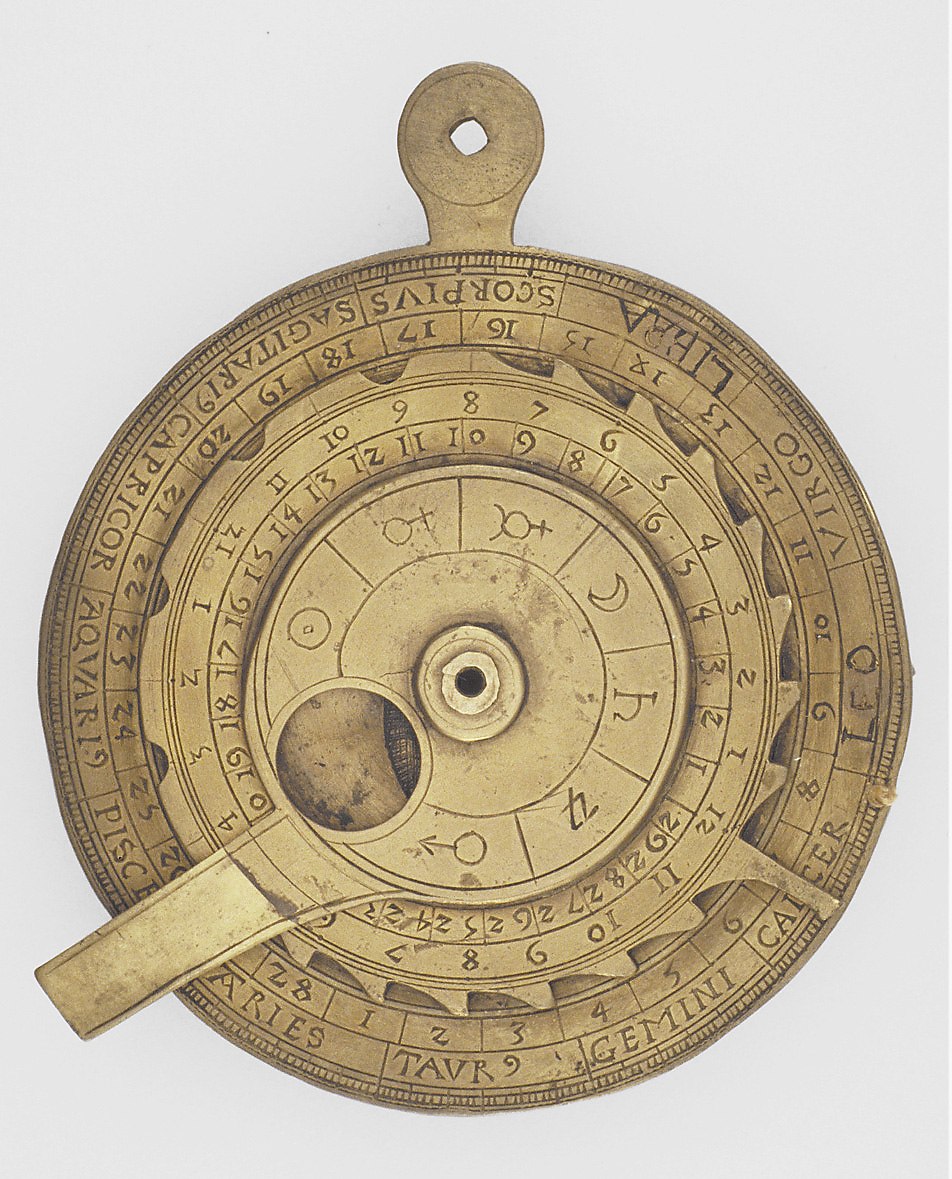
This 71 mm brass instrument, dated 1543 and identified as French, serves dual functions as both a nocturnal and a horary quadrant. The nocturnal side features a zodiac scale with constellations and a moveable volvelle disc. This disc includes an index arm, an hour scale marked 1 to 12 twice, and a moon-age scale. A secondary moveable disc, decorated with signs representing Ptolemaic planets, includes an aperture to indicate lunar phases. The reverse side integrates two distinct horary quadrants, a degree quadrant, and a shadow square labeled 'VMBRE DR[OI]CT' and 'VMBRE VERSE'. The quadrant face also incorporates lines for the quadrans vetus and a separate set of ordinary hour lines, alongside a solar declination scale marked with zodiac signs. Three engraved scrolls are present on the instrument, one of which contains the date.

Front view showing the nocturnal scale and rotating planetary disc.
Front view showing the nocturnal scale and rotating planetary disc. — Museum of the History of Science, Oxford. Rights pending — permission not yet requested. Original source

Catalogue identity

Source
www.mhs.ox.ac.uk
Category
Tool · French nocturnal and quadrant
Maker / attribution
Not established
Reference
Not recorded
Catalogue / lot identifier
55203
Source-reported date
1543
Source-reported place
France

Source-reported attribution and specifications are not independent authentication. A listing does not establish present ownership, current display, availability or permission to reproduce.

Object description

Nocturnal Functionality

The nocturnal side of the brass instrument is configured to determine the time at night based on stellar positioning. It utilizes a zodiac scale that displays the names of constellations, each further divided into segments of 1/6 and 1/30. An interior scale numbered 1 to 28 complements the zodiac markings.

To facilitate the calculation of time and lunar cycles, the instrument features a moveable volvelle disc. This disc carries an index arm that extends across the zodiac scale and provides a dual-12 hour scale, with night hours specifically indicated by points. Furthermore, a moon-age scale, divided from 1 to 20, is integrated onto the component. A second disc, marked with the signs of the Ptolemaic planets, features a circular aperture designed to reveal the current phase of the moon.

Evidence for this section
  • “The nocturnal side has a zodiac scale with the names of the constellations”
  • “A moveable volvelle disc has an index arm extending across the zodiac scale”
  • “a scale for the age of the moon, divided 1 to 20”
  • “A second moveable disc, marked with the signs of the Ptolemaic planets, has an index arm for the nocturnal function and a circular aperture revealing the phase of the moon.”

Quadrant and Horary Functions

The reverse of the instrument functions as a multifaceted horary quadrant. It is equipped with two pinhole sights and a plumb-line, though the weight originally associated with the latter is currently missing. The quadrant incorporates a degree scale from 0 to 90 and a shadow square numbered 0 to 12.

The instrument also features the lines of the quadrans vetus and a separate set of ordinary hour lines. These functions are used in conjunction with a solar declination scale marked with zodiac signs. A specific line designated as 'LORIZON DE SOLEIL LEVANT' indicates sunrise and sunset, while three engraved scrolls are present on the device, one of which contains the inscribed date of 1543.

Evidence for this section
  • “The quadrant side has a pair of pinhole sights and a plumb-line with a weight (bead missing)”
  • “The quadrant scale enclosed the unequal-hour lines of the quadrans vetus”
  • “There is a second set of hour lines for ordinary hours”
  • “There are three engraved scrolls; two are blank, one has the date '1543'.”

Condition and Identification

The instrument is catalogued by the Museum of the History of Science in Oxford under inventory number 55203. It is currently unsigned by any maker. The attribution of the object as French and the date of 1543 are provided by the museum's documentation of the piece.

The physical condition of the object is noted by the museum, specifically identifying the absence of the plumb-line weight. Despite the small diameter of 71 mm, the instrument is densely packed with multiple overlapping scales, lines, and functions, including various zodiac scales and hour markers intended for different astronomical applications.

Evidence for this section
  • “Unsigned”
  • “Dated 1543; French”
  • “plumb-line with a weight (bead missing)”
  • “all squeezed onto a small disk with their lines overlapping.”

Open research questions

  • What specific astronomical observations were intended for the secondary zodiac scale?
  • Which specific Ptolemaic planetary signs are depicted on the moveable disc?

Source evidence

Recorded claims and source quotations for Nocturnal and Quadrant
FieldSource-reported valueSource quotation
Dimensions71 mm“71 mm in diameter”
Date1543“Dated 1543”
OriginFrench“French”
Inventory Number55203“Inventory number: 55203”
Moon Phase FunctionA circular aperture reveals the phase of the moon.“a circular aperture revealing the phase of the moon.”
Quadrant MarkingsShadow square marked with French labels“the sides marked 'VMBRE DR[OI]CT' and 'VMBRE VERSE'”

Visible details

  • Pinhole sights on quadrant side
  • Moveable volvelle with circular aperture for moon phase
  • Signs of Ptolemaic planets on rotating disc
  • Engraved scrolls with 1543 date

Research qualifications

  • Plumb-line weight is missing
  • Origin attributed as French by source without further documentation

Photograph identity and source facts were screened before import; rights clearance remains pending.

Consulted source

Nocturnal And Quadrant

Reviewed 2026-10-26 · Record b90afb4d99

Terms in this record

Glossary explanations for terms named in this object’s record.