
Skip to content
The Encyclopedia of Horology

Clock · Night Watchman's Clock

Night Watchman's Clock or Noctuary

Partially verified

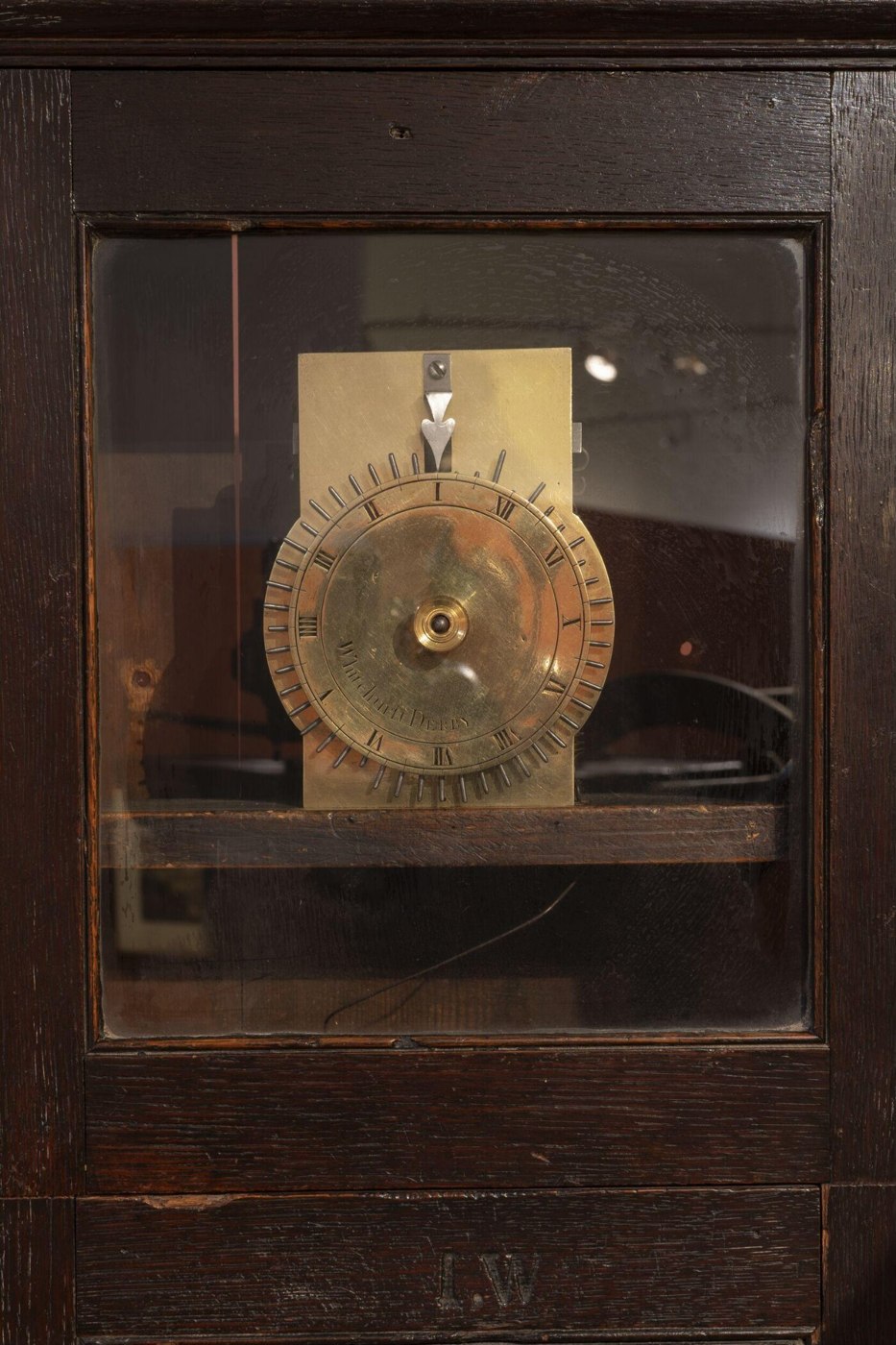
The Night Watchman's Clock or Noctuary is a specialized timekeeping device manufactured by John Whitehurst of Derby in 1806. The clock is housed in an engraved wood case standing 1940 mm high and 330 mm wide. The mechanism features a revolving brass 12-hour dial, which is sub-divided into quarters. At each quarter-hour position, the rim is drilled to accommodate pins that protrude approximately 5/8 inches. The operational system requires the watchman to depress a lever located within the locked case, which activates a small hammer to push down a pin on the dial. A foreman could monitor the watchman's activities by inspecting the depressed pins. The actual time is indicated by a fixed brass pointer relative to the rotating dial. After a 12-hour cycle, the pins are automatically reset as they pass over a ramp mechanism inside the clock.

Full view of the Night Watchman's Clock showing the tall wooden case and the internal brass dial mechanism.
Full view of the Night Watchman's Clock showing the tall wooden case and the internal brass dial mechanism. — V&A Wedgwood Collection. Rights pending — permission not yet requested. Original source

Catalogue identity

Source
collections.vam.ac.uk
Category
Clock · Night Watchman's Clock
Maker / attribution
John Whitehurst
Reference
Not recorded
Catalogue / lot identifier
WE.7566-2014
Source-reported date
1806
Source-reported place
UK

Source-reported attribution and specifications are not independent authentication. A listing does not establish present ownership, current display, availability or permission to reproduce.

Object description

Construction and Design

The object is constructed of engraved wood with a brass clock mechanism and a brass dial. It stands at a height of 1940 mm and a width of 330 mm. The design includes a revolving brass 12-hour dial, which serves as the primary interface for the watchman's monitoring system. The clock is housed in a wooden case, which is designed to be locked to ensure security and prevent unauthorized access to the internal mechanism.

The dial is specifically modified for its function, featuring quarters sub-divided around its circumference. At each of these divisions, the rim is drilled to hold pins that protrude approximately 5/8 of an inch. A brass pointer is positioned to allow for the reading of the current time against the rotating dial, enabling both timekeeping and monitoring functions simultaneously.

Evidence for this section
  • “Engraved wood with clock mechancism and a brass dial”
  • “The clock has a revolving brass 12 hour dial, each is sub-divided into quarters, at each of which the rim was drilled to take pins which protrude about 5/8 ths of an inch.”

Operational Functionality

The clock was intended to regulate the movements of watchmen within factories or country homes, a requirement linked to the Industrial Revolution. Operation involves the watchman depressing a lever inside the locked case, which triggers a small hammer to depress one of the pins located on the dial rim. By observing which pins have been depressed, a foreman can verify that the watchman attended the clock at the required times.

The system is designed for continuous use, with an automatic reset feature. Once the pins have completed a 12-hour cycle, they are reset as they pass over a ramp located within the clock mechanism. This ensures that the clock is ready for the subsequent shift without manual intervention from the foreman.

Evidence for this section
  • “The need for a clock to regulate the movements of Watchmen in factories (and indeed country homes), was very much the product of the new orders of the Industrial Revolution”
  • “After 12 hours the pins were automatically re-set by passing over a ramp.”

Identification and Provenance

The clock is identified by the accession number WE.7566-2014 and is held as part of the V&A Wedgwood Collection. The provenance states that it was presented by the Art Fund with major support from the National Lottery Heritage Fund, private donations, and a public appeal. The timepiece is signed 'Whitehurst Derby' on the dial, attributing the work to John Whitehurst.

The object is presented as an example of equipment produced to meet the specific requirements of the Industrial Revolution.

Evidence for this section
  • “V&A Wedgwood Collection. Presented by Art Fund with major support from the National Lottery Heritage Fund, private donations and a public appeal.”
  • “Night Watchman's Clock or Noctuary, John Whitehurst of Derby, 1806”

Open research questions

  • What is the specific meaning of the initials 'I.W.' carved into the wooden case?
  • Does the original ramp mechanism remain fully functional after more than two centuries of use?

Source evidence

Recorded claims and source quotations for Night Watchman's Clock or Noctuary
FieldSource-reported valueSource quotation
Object typeClock“Object type: Clock”
Accession numberWE.7566-2014“Accession number: WE.7566-2014”
Date1806“Date: 1806”
MakerJohn Whitehurst“John Whitehurst of Derby”
Height1940 mm“Height: 1940 mm”
Width330 mm“Width: 330 mm”
Materialswood, brass“wood, brass, engraved”
FunctionRegulating watchmen“The need for a clock to regulate the movements of Watchmen in factories (and indeed country homes)”

Visible details

  • The clock case features the initials I.W. carved near the top section below the glass
  • The brass dial is engraved with the maker's name and location, 'Whitehurst Derby'
  • The dial rim contains a series of evenly spaced metal pins
  • The clock is tall, narrow, and features a glazed upper door providing access to the dial

Research qualifications

  • The exact identity of the 'I.W.' initials on the case is not documented in the source
  • The source does not explicitly describe the interior ramp mechanism beyond its stated function

Photograph identity and source facts were screened before import; rights clearance remains pending.

Consulted source

Clock

Reviewed 2026-10-26 · Record 354e09d6d2

Terms in this record

Glossary explanations for terms named in this object’s record.