
Construction and Design
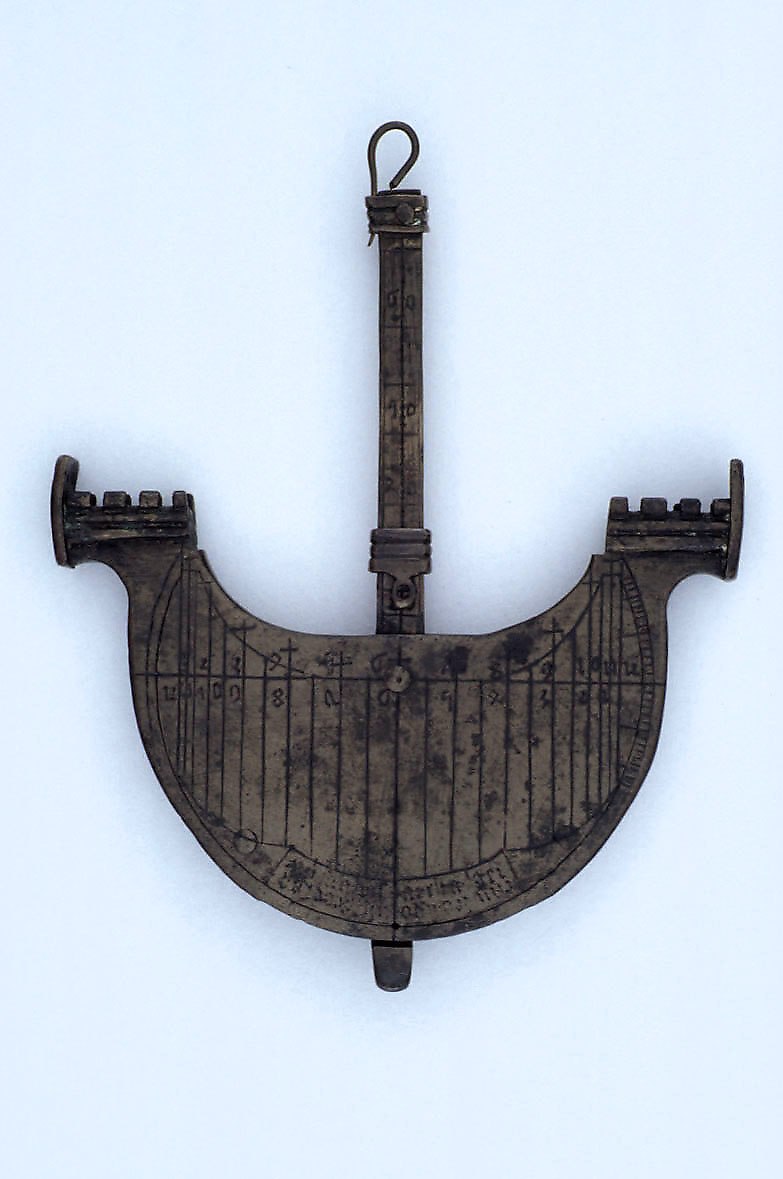
The instrument is fashioned from brass and measures 82 mm across its widest point. Its design is based on the 'navicula' or 'little ship of Venice', which is a specific form of altitude dial. The body of the dial is engraved with hour-lines and shaped to resemble a ship, with castellated sections at either end representing the poop and forecastle. Each of these castellated ends contains a double pinhole sight to facilitate observations.
The vertical component, termed the mast, is fitted with a sliding suspension point. This mechanism was designed to hold a plumb-line, which is presently missing. A suspension hook is attached to the upper extremity of the mast, providing a means of holding the instrument upright during use.
Evidence for this section
- “The main body, engraved with the hour-lines, is given the shape of a ship; in this case the sights are incorporated into a castellated 'poop' and 'forecastle'.”
- “The 'mast' carries the suspension for a plumb-line , adjustable for date and latitude .”
- “The castellated ship decks each incorporate double pinhole sights.”
- “A suspension hook it attached to the top of the mast.”