
Skip to content
The Encyclopedia of Horology

Clock · Mystery clock

Mystery Clock with Female Figurine

Partially verified

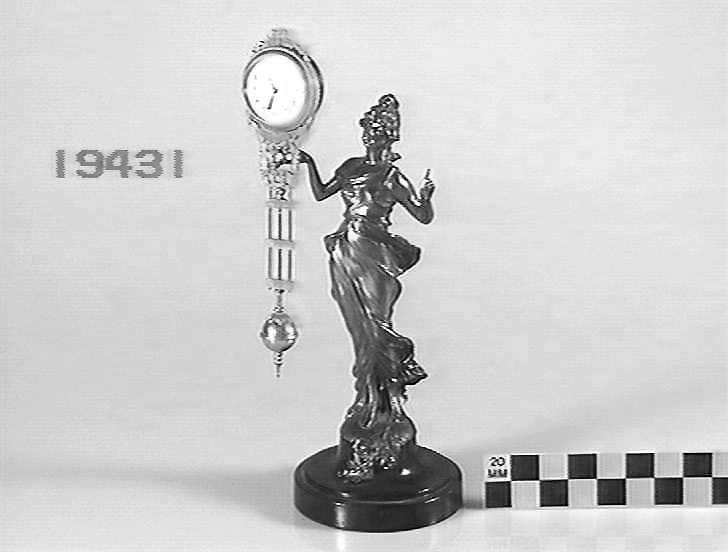
This mystery clock, dating to approximately 1910, is attributed to the manufacturer Junghans. Standing 34 cm tall, the clock comprises a spring-wound mechanism integrated into an ornamental display. The primary structure is a metal sculpture of a female figure, created by the artist Franz Iffland, whose base bears the inscription 'F. Iffland'. The clock unit is suspended from the right hand of the figure on a horizontal support. The oscillation of the timepiece is achieved through a pendulum system; a small internal pendulum shifts the centre of gravity to produce motion, while a larger pendulum bob serves as a counterpoise for the mass of the clock housing. The timekeeping mechanism is concealed within the frame of the timepiece, which is a characteristic feature of this category of clock. The piece was acquired by the museum through a loan and subsequent bequest from Mr. John Askew in 1933.

Mystery clock held by a female figure, exhibiting a pendulum bob and a base marked F. Iffland.
Mystery clock held by a female figure, exhibiting a pendulum bob and a base marked F. Iffland. — Museums Victoria. Rights pending — permission not yet requested. Original source

Catalogue identity

Source
collections.museumsvictoria.com.au
Category
Clock · Mystery clock
Maker / attribution
Junghans
Reference
Not recorded
Catalogue / lot identifier
ST 19431
Source-reported date
circa 1910
Source-reported place
Germany

Source-reported attribution and specifications are not independent authentication. A listing does not establish present ownership, current display, availability or permission to reproduce.

Object description

Construction and Design

The object is a mystery clock designed to oscillate while held by a cast metal sculpture of a female figure. The clock is suspended from the figure's right hand via a horizontal support. The total height of the assembly is 34 cm.

The sculpture is attributed to artist Franz Iffland, with the name 'F. Iffland' inscribed on the base. The timepiece features a dial suspended above an ornamental frame that incorporates a large, spherical pendulum bob which acts as a counterpoise for the overall mass of the clock.

Evidence for this section
  • “Clock held by a female figure, whose right hand holds the horizontal support on which the clock oscillates.”
  • “Original scuplture by Franz Iffland.”
  • “Marked on base of sculpture 'F. Iffland'.”

Mechanism

The clock is spring-wound. The mystery function relies on the concealment of the mechanism within the frame or border of the timepiece, which creates the visual effect that the clock is not powered by traditional means.

To achieve oscillation, a small pendulum is located inside the clock body. This small pendulum moves the centre of gravity left and right, causing the entire clock to sway. The speed of this oscillation can be adjusted by altering the length of the pendulum.

Evidence for this section
  • “Physical description: Spring wound.”
  • “The secret to the mystery clock is due to a fine craftsperson cleverly concealing the mechanism within the frame or border of the timepiece.”
  • “Small pendulum inside clock moves centre of gravity left and right and causes clock to oscillate. Speed is adjusted by lengthening pendulum.”

Provenance and Documentation

The object is recorded under the registration number ST 19431. It was brought into the collection of the museum via a loan and subsequent bequest from Mr. John Askew, dated 27 June 1933.

The manufacturer is listed as possibly Junghans, with an associated date of circa 1910. The museum categorizes the item under Science & Measurement and Horology.

Evidence for this section
  • “Registration number: ST 19431”
  • “Acquisition: Loan & Subsequent Bequest from Mr John Askew, 27 Jun 1933”
  • “Manufacturer (Possible), name: Junghans, date: circa 1910”

Open research questions

  • Can Junghans production records confirm this model of mystery clock?
  • Are there other known instances where Iffland sculptures were combined with Junghans mystery movements?

Source evidence

Recorded claims and source quotations for Mystery Clock with Female Figurine
FieldSource-reported valueSource quotation
MakerJunghans“Manufacturer (Possible), name: Junghans”
Datecirca 1910“circa 1910”
Registration NumberST 19431“Registration number: ST 19431”
Height34 cm“34 cm (Height)”
SculptorFranz Iffland“Original scuplture by Franz Iffland.”
Movement typeSpring wound“Physical description: Spring wound.”
AcquisitionBequest from Mr John Askew“Acquisition: Loan & Subsequent Bequest from Mr John Askew”

Visible details

  • Clock is held aloft by the right hand of a female figurine.
  • A spherical pendulum bob hangs below the clock dial.
  • The sculpture base is signed 'F. Iffland'.
  • Registration number 19431 is visible in the photograph.

Research qualifications

  • The attribution to Junghans is stated as a possibility rather than a certainty.
  • The exact internal arrangement of the concealment mechanism is not externally visible.

Photograph identity and source facts were screened before import; rights clearance remains pending.

Consulted source

Mystery Clock - Junghans, circa 1910

Reviewed 2026-10-26 · Record 04e89ba111

Terms in this record

Glossary explanations for terms named in this object’s record.