
Skip to content
The Encyclopedia of Horology

Clock · Advertising clock

Mystery Clock

Partially verified

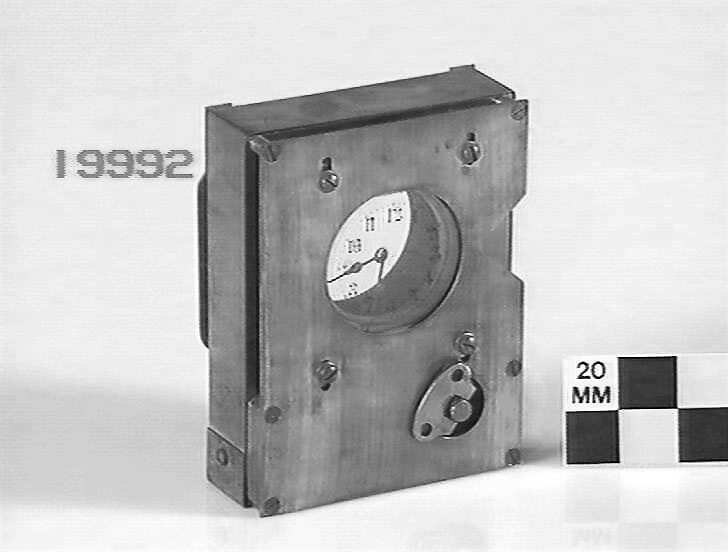
This mystery clock, an advertising timepiece originating from England around 1900, is housed in a rectangular brass case measuring 10 cm in length, 5 cm in width, and 14 cm in height. The object is designed for integration into a magic lantern or projector, enabling the hands, dial, and promotional content to be displayed on a screen. Its mechanism is constructed to be concealed during projection; the hands are operated via gear wheels positioned on their outer ends, eliminating visible internal components. The dial is made of glass and features ornate Arabic numerals. The timepiece is spring-wound and functions using a lever escapement. The object entered the collection of Museums Victoria through a loan and subsequent bequest from Mr. John Askew on July 29, 1936, and is identified by registration number ST 19992.

Front view of the mystery clock showing the dial and gear-driven hands.
Front view of the mystery clock showing the dial and gear-driven hands. — Museums Victoria. Rights pending — permission not yet requested. Original source

Catalogue identity

Source
collections.museumsvictoria.com.au
Category
Clock · Advertising clock
Maker / attribution
Not established
Reference
Not recorded
Catalogue / lot identifier
ST 19992
Source-reported date
circa 1900
Source-reported place
England
Source-reported serial
163

Source-reported attribution and specifications are not independent authentication. A listing does not establish present ownership, current display, availability or permission to reproduce.

Object description

Case and Dial Construction

The object is housed within a rectangular brass case designed for compatibility with projection equipment. The front of the case features a circular aperture that frames a glass dial, which is marked with black Arabic numerals. This configuration is specifically engineered to allow for the projection of timekeeping information alongside advertising materials when the device is mounted within a magic lantern.

The exterior of the brass case is marked with the number 163 on the back side. The compact dimensions of the clock, measuring 14 centimeters in height, allow it to fit within the constraints of projection hardware, ensuring it serves its intended function as an advertising clock for public viewing.

Evidence for this section
  • “Rectangular brass case.”
  • “Glass dial has ornate black arabic numerals.”
  • “Brass case marked '163' on back.”

Movement and Projection Mechanism

The clock operates via a spring-wound mechanism that utilizes a lever escapement. The movement is designed to prevent visible obstructions during projection. To achieve this effect, the gear wheels responsible for driving the hands are placed at the outer extremities of the hands themselves.

This layout ensures that the inner mechanism remains hidden from the light path of the projector. By mounting the driving gears on the outer ends, the clock allows the time to be projected onto a screen without revealing the internal gear train, which is a defining feature of this mystery clock design.

Evidence for this section
  • “Spring wound; lever escapement.”
  • “The hands are moved by gear wheels on the outer end of the hands, so that no mechanism is visible in the projection.”
  • “Outer ends of hands are attached to gear wheels that rotate.”

Acquisition and Provenance

The clock was acquired by the museum through a process involving a loan followed by a bequest. The donor associated with the object is Mr. John Askew, and the transfer of ownership was finalized on July 29, 1936.

This item is categorized under the museum's science and measurement collections, reflecting its specific utility in historical advertising and projection technology.

Evidence for this section
  • “Acquisition: Loan & Subsequent Bequest from Mr John Askew, 29 Jul 1936”
  • “Collecting areas: Science & Measurement”

Open research questions

  • Are there identifiable remnants of the original advertising materials designed for this specific unit?
  • Does the number 163 correspond to a patent or specific model batch from an English maker?

Source evidence

Recorded claims and source quotations for Mystery Clock
FieldSource-reported valueSource quotation
Registration NumberST 19992“Registration number: ST 19992”
Dimensions10 cm x 5 cm x 14 cm“10 cm (Length), 5 cm (Width), 14 cm (Height)”
MaterialBrass and glass“Rectangular brass case. Glass dial”
Maker LocationEngland“made in England”
Datecirca 1900“circa 1900”
EscapementLever escapement“lever escapement”
Markings163 on the back“Brass case marked '163' on back.”

Visible details

  • Rectangular brass casing with flat face
  • Glass dial with black Arabic numerals
  • External gear mechanism for hand rotation
  • Manual winding component visible on face

Research qualifications

  • Specific original manufacturer unknown
  • Intended display advertising content not present

Photograph identity and source facts were screened before import; rights clearance remains pending.

Consulted source

Mystery Clock - England, circa 1900

Reviewed 2026-10-26 · Record 84e009eab7

Terms in this record

Glossary explanations for terms named in this object’s record.