
Skip to content
The Encyclopedia of Horology

Clock · Musical picture clock

Musical Picture Clock with Fusee Movement

Partially verified

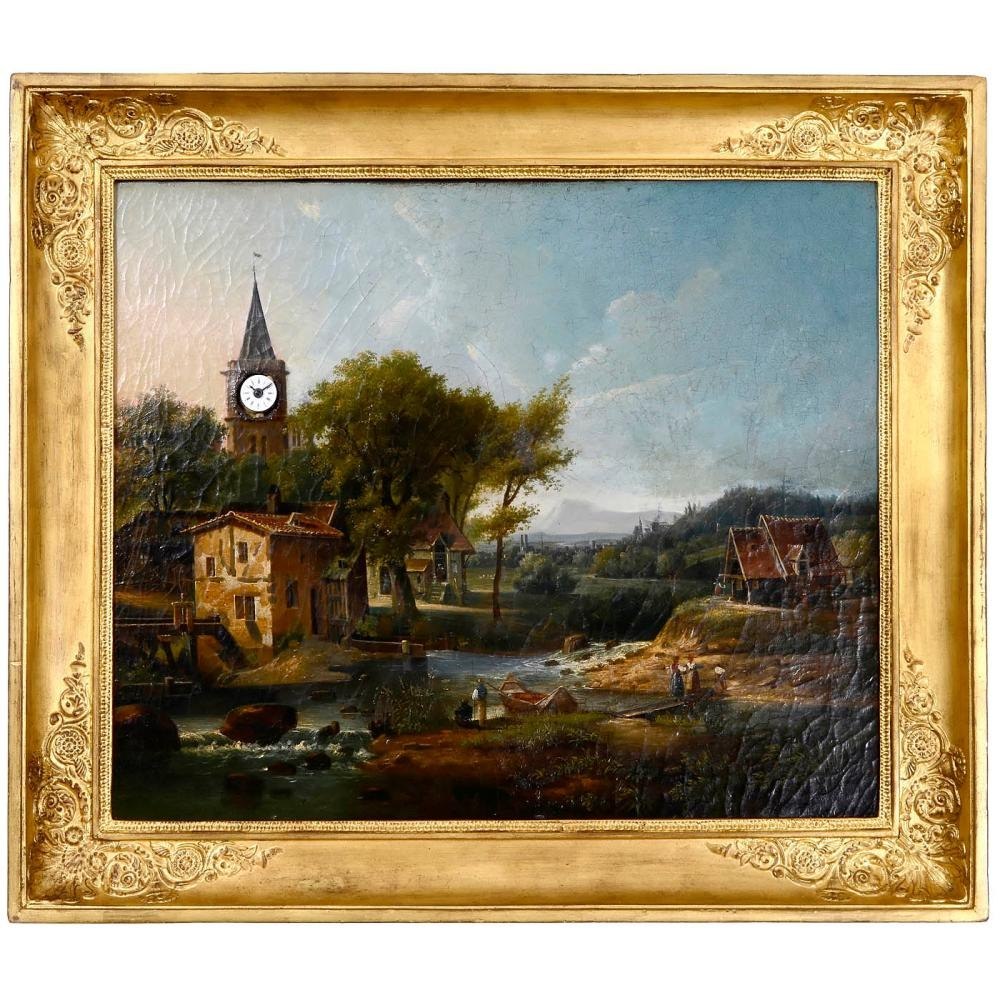
This musical picture clock, dated circa 1850, features an oil on canvas painting of a riverside landscape. The scene includes various buildings and figures, with a clock face integrated into the steeple of a depicted church. The assembly is set within a substantial giltwood and gesso frame, which displays relief carvings of shells and flowers at each corner. Mechanically, the object incorporates a two-train movement that provides timekeeping and strikes the hours upon a gong. Complementing this is an independent cylinder-type musical movement, which is programmed to activate on the hour. This musical component operates via a fusee spring and features a sectional comb comprising 37 sets of three teeth alongside a single separate bass tooth. The musical mechanism is secured to a brass bedplate and governed by a three-gear train. The painting shows evidence of historical wear, including craquelure, repairs, and areas of overpaint.

Front view of the musical picture clock showing the riverside landscape, integrated clock face, and giltwood frame.
Front view of the musical picture clock showing the riverside landscape, integrated clock face, and giltwood frame. — Auction Team Breker, via Invaluable. Rights pending — permission not yet requested. Original source

Catalogue identity

Source
orbiscollectibles.com
Category
Clock · Musical picture clock
Maker / attribution
Not established
Reference
Not recorded
Catalogue / lot identifier
Source URL identifies the listing
Source-reported date
c. 1850
Source-reported place
Not established

Source-reported attribution and specifications are not independent authentication. A listing does not establish present ownership, current display, availability or permission to reproduce.

Object description

Frame and Artistic Composition

The object is centered on an oil on canvas painting that illustrates a rural riverside landscape. The scene is populated with architectural elements, including a church, and human figures positioned within a natural setting. A functional clock face is directly integrated into the steeple of the painted church, allowing the artwork to serve as a visual facade for the timepiece.

The canvas is mounted within a frame crafted from giltwood and gesso. This frame is decorated with intricate relief carvings, specifically featuring floral and shell motifs at the corners. The painting itself exhibits visible signs of age and history, with the documentation noting the presence of craquelure across the surface, as well as areas of overpaint and past repairs. Dimensions for the entire piece are recorded as 27 by 31 inches.

Evidence for this section
  • “oil on canvas painting depicting a riverside landscape populated with figures and buildings”
  • “ornate giltwood and gesso frame decorated with relief carvings of flowers and shells at the corners”
  • “The painting shows signs of age, including craquelure, overpaint, and historical repairs.”

Clock and Musical Mechanisms

The horological functionality is provided by a two-train movement, which enables the display of time and the striking of hours on a gong. This system works in tandem with an independent cylinder-based musical movement that is timed to trigger on the hour. The musical mechanism is mounted on a brass bedplate and relies on a three-gear governor train to regulate its performance.

The musical movement is powered by a fusee spring mechanism. The sound is produced by a sectional comb that contains 37 sets of three teeth, supplemented by one separate bass tooth. The total width of the cylinder is 10.5 inches. There is physical evidence on the backboard and frame, in the form of extra holes, that suggests the possibility that the current musical assembly may not be the original configuration installed in this frame.

Evidence for this section
  • “two-train clock movement that strikes the hours on a gong”
  • “cylinder musical movement utilizes a fusee spring and features a sectional comb consisting of 37 sets of three teeth plus one separate bass tooth”
  • “Additional holes in the backboard and frame indicate the potential prior installation of a different musical component.”

Technical Observations and Documentation

The assembly relies on a mixture of media, combining traditional oil painting techniques with complex mechanical clockwork and cylinder music box components. The governor mechanism for the musical section is specifically identified as a three-gear train. All primary elements are housed within the physical constraints of the 27 by 31-inch frame.

The record is based on a single auction-house listing. As is common with such items, while the current configuration is documented, the history of the object's assembly and the origin of its components are not definitively established. Documentation is limited to physical observations of the object as it was presented at auction.

Evidence for this section
  • “three-gear governor train”
  • “total dimensions of the piece are 27 by 31 inches”
  • “Described from a single auction-house listing”

Open research questions

  • What is the identification or origin of the two-train clock movement?
  • Could the extra holes in the backboard be linked to specific historical musical movement types standard to this period?

Source evidence

Recorded claims and source quotations for Musical Picture Clock with Fusee Movement
FieldSource-reported valueSource quotation
Datec. 1850“dating to circa 1850”
Frame typeGiltwood and gesso“ornate giltwood and gesso frame”
Musical comb configuration37 sets of three teeth plus one separate bass tooth“sectional comb consisting of 37 sets of three teeth plus one separate bass tooth”
Musical movement driveFusee spring“cylinder musical movement utilizes a fusee spring”
Clock strikingStrikes the hours on a gong“strikes the hours on a gong”
Painting subjectRiverside landscape“oil on canvas painting depicting a riverside landscape populated with figures and buildings”
Physical conditionCraquelure, overpaint, and historical repairs“signs of age, including craquelure, overpaint, and historical repairs”

Visible details

  • The giltwood frame displays decorative relief carvings featuring floral and shell motifs at the corners.
  • The oil painting incorporates a physical clock face positioned within the painted steeple of a church.
  • The painting surface displays visible craquelure and areas consistent with historical restoration or overpainting.
  • The overall composition measures approximately 27 by 31 inches.

Research qualifications

  • The exact origin or maker of the clock remains unverified.
  • The presence of extra holes in the backboard suggests the possibility that the current musical movement is a replacement or was not the original component.

Photograph identity and source facts were screened before import; rights clearance remains pending.

Consulted source

Musical Picture Clock with Fusee Movement

Reviewed 2026-11-02 · Record def7b14d6a

Terms in this record

Glossary explanations for terms named in this object’s record.

Other musical picture clock records