
Skip to content
The Encyclopedia of Horology

Clock · Musical bracket clock

Musical Bracket Clock by Stephen Rimbault

Partially verified

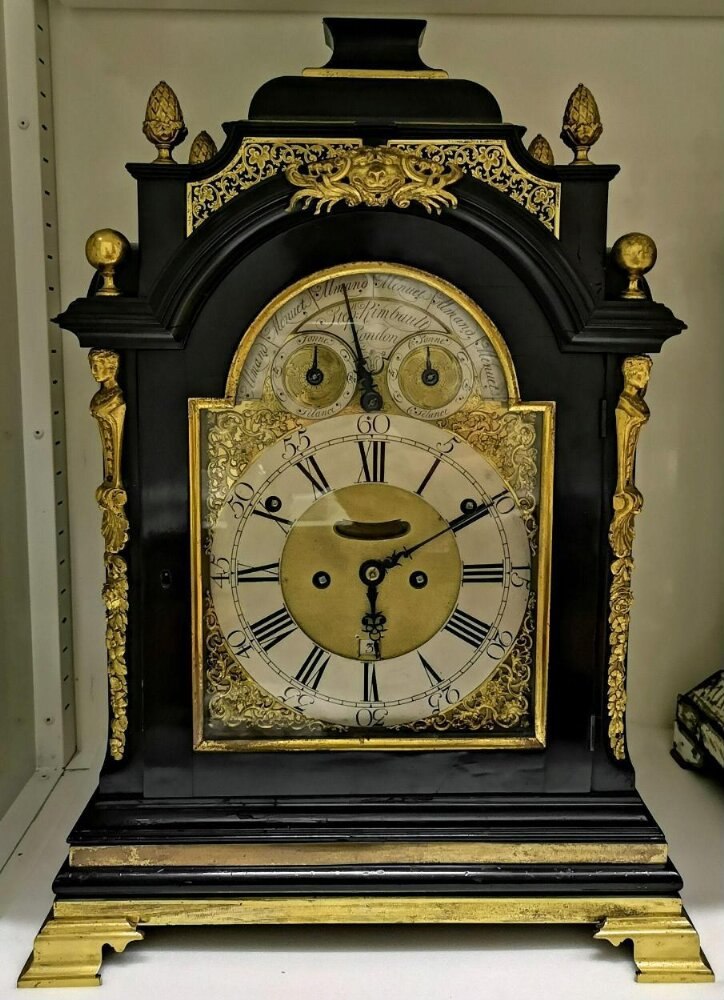
This musical bracket clock, manufactured in London circa 1770, is attributed to the maker Stephen Rimbault, who was active between 1760 and 1781. The clock is housed in an oak case featuring ebony veneer and is decorated with gilt brass mounts. Standing 55 cm in height, 39 cm in width, and 26.5 cm in depth, the piece functions as both a timekeeper and a musical instrument. It is designed to play a selection of six tunes on bells, which are engaged via a pull cord located on the right side of the clock. The dial and mounting elements incorporate brass, while the structural base is made of oak. The clock is held in a museum collection, donated through the Art Fund.

Musical bracket clock, oak case with ebony veneer and gilt brass mounts, by Stephen Rimbault, London, c. 1770.
Musical bracket clock, oak case with ebony veneer and gilt brass mounts, by Stephen Rimbault, London, c. 1770. — Victoria and Albert Museum. Rights pending — permission not yet requested. Original source

Catalogue identity

Source
collections.vam.ac.uk
Category
Clock · Musical bracket clock
Maker / attribution
Stephen Rimbault
Reference
Not recorded
Catalogue / lot identifier
W.30:1 to 4-1959
Source-reported date
c.1770
Source-reported place
London, UK

Source-reported attribution and specifications are not independent authentication. A listing does not establish present ownership, current display, availability or permission to reproduce.

Object description

Case Construction and Decorative Elements

The clock is contained within an oak structure that serves as the foundation for the external appearance. The primary exterior finish is an ebony veneer, which provides a dark, high-contrast backdrop for the various metallic components fixed to the housing. The design incorporates a substantial use of gilt brass, which is applied to the clock in the form of decorative mounts.

These mounts are prominently placed, including the finials at the top corners of the arched hood and vertical appliqués along the side panels of the case.

Evidence for this section
  • “Oak case veneered with ebony, gilt brass mounts”
  • “Musical bracket clock in an oak case veneered with ebony, with gilt brass mounts”

Dial and Musical Mechanism

The face of the clock is designed to support both timekeeping and the integrated musical selection system. The primary dial displays standard timekeeping functions, with Roman numerals marking the hours and Arabic numerals marking the intervals. A subsidiary dial located at the top center of the main face provides an interface for the musical component of the clock.

This musical system is capable of playing a total of six distinct tunes on bells. The mechanism is triggered manually by a user via a pull cord positioned on the right side of the clock.

Evidence for this section
  • “This clock plays six tunes, on bells, activated by a pull cord on the right.”
  • “Stephen Rimbault (working 1760-1781) was a maker of repute”

Attribution and Provenance

The clock is inscribed with the name of the maker, Stephen Rimbault, and his location, London. Rimbault was active between 1760 and 1781 and gained a reputation for the manufacture of complex clocks. The object is recorded in museum documentation as having been acquired through the Art Fund.

The provenance is attributed to the donation by Mr. C. D. Rotch. The records confirm the manufacture date to be approximately 1770, based on the working life of the maker and the technical characteristics identified in the design. The item is held under the accession number W.30:1 to 4-1959.

Evidence for this section
  • “inscribed ‘Stephen Rimbault, London’”
  • “Given by Mr C. D. Rotch, through Art Fund”
  • “Accession number: W.30:1 to 4-1959”

Open research questions

  • What is the identity of the six musical tunes programmed into the mechanism?
  • Are there any internal maker marks or signatures on the movement plates aside from the dial inscription?

Source evidence

Recorded claims and source quotations for Musical Bracket Clock by Stephen Rimbault
FieldSource-reported valueSource quotation
MakerStephen Rimbault“Stephen Rimbault”
Datec.1770“made in about 1770”
Place of OriginLondon“London”
MaterialsOak, ebony, brass“Oak case veneered with ebony, gilt brass mounts”
Musical FunctionSix tunes on bells“This clock plays six tunes, on bells, activated by a pull cord on the right.”

Visible details

  • Arched dial with tune selection indicator at the top
  • Gilt brass mounts include corner finials and side caryatid-style appliqués
  • Dial features Roman numerals for hours and Arabic numerals for five-minute intervals
  • Pull cord mechanism visible for activating the musical function

Research qualifications

  • Specific mechanical details beyond the musical function are not provided
  • Provenance beyond the credit line of the donor is not detailed in the source

Photograph identity and source facts were screened before import; rights clearance remains pending.

Consulted source

Bracket clock, Rimbault, Stephen, London, c.1770

Reviewed 2026-11-02 · Record 646cb7ba62

Terms in this record

Glossary explanations for terms named in this object’s record.