
Skip to content
The Encyclopedia of Horology

Clock · Mantel clock

Minerva clock

Partially verified

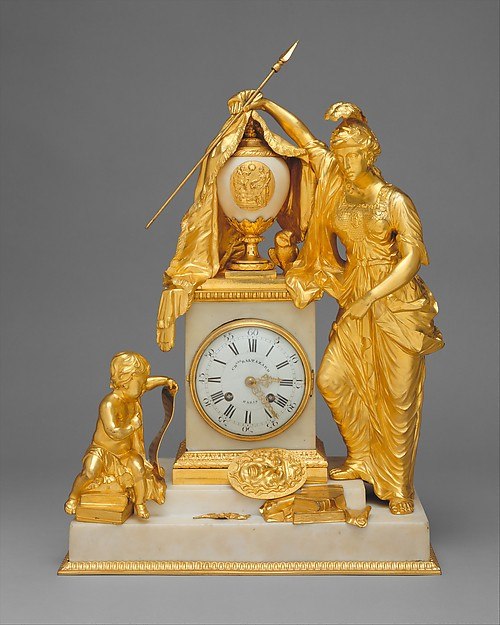
This mantel clock, known as the Minerva clock, is held by The Metropolitan Museum of Art (accession number 1993.489). The object is based on a design by the English manufacturer Matthew Boulton and is dated to circa 1772, though it incorporates later alterations. The construction utilizes gilt bronze, marble, enamel, brass, and steel. The movement of the clock is recorded as the work of Theodore Rodel, a maker active in Paris around 1840. The overall dimensions of the clock are 19 by 13 by 8 1/4 inches. The composition features a central dial set into a marble plinth, flanked by a standing figure of Minerva and a seated putto, with a decorative vase surmounting the plinth.

The Minerva clock, featuring a central enamel dial, gilt bronze figures of Minerva and a putto, and a marble base.
The Minerva clock, featuring a central enamel dial, gilt bronze figures of Minerva and a putto, and a marble base. — The Metropolitan Museum of Art — Gift of Horace Wood Brock, in loving memory of his parents, Hope and Horace Brock, 1993. Rights pending — permission not yet requested. Original source

Catalogue identity

Source
orbiscollectibles.com
Category
Clock · Mantel clock
Maker / attribution
Matthew Boulton (design); Theodore Rodel (movement)
Reference
Not recorded
Catalogue / lot identifier
1993.489
Source-reported date
ca. 1772, with later alterations
Source-reported place
British

Source-reported attribution and specifications are not independent authentication. A listing does not establish present ownership, current display, availability or permission to reproduce.

Object description

Composition and Materials

The Minerva clock is constructed using a combination of gilt bronze, marble, enamel, brass, and steel. The overall height of the piece is 19 inches, with a width of 13 inches and a depth of 8 1/4 inches. The structure comprises a central marble plinth which houses the clock dial, surmounted by a decorative vessel draped in fabric.

The ornamental scheme features a bronze figure of Minerva positioned to the right of the plinth, accompanied by a small figure of an owl. To the left, a putto sits upon a pile of books, holding a scroll. The base is decorated with bronze mounts, including a mask and additional book motifs, all executed in gilt bronze.

Evidence for this section
  • “The museum records its materials as: Gilt bronze, marble, enamel, brass, steel.”
  • “Overall: 19 × 13 × 8 1/4 in. (48.3 × 33 × 21 cm)”

Maker and Chronology

The object is associated with Matthew Boulton, the English manufacturer based in Birmingham. The design is attributed to him with a dating of circa 1772. The source documentation indicates that the clock has undergone later alterations.

The clock movement is credited to Theodore Rodel, a maker recorded in Paris in 1840. This suggests a period of assembly or modification in the 19th century, connecting the English-designed bronze elements with a French-made movement.

Evidence for this section
  • “After a design by Matthew Boulton (British, Birmingham 1728–1809 Birmingham)”
  • “made by Theodore Rodel (recorded 1840) (Paris, France)”
  • “dated ca. 1772, with later alterations”

Provenance and Documentation

The clock is part of the collection of The Metropolitan Museum of Art, identified by the accession number 1993.489. It was presented to the institution as a gift from Horace Wood Brock.

The Metropolitan Museum of Art classifies the piece within the categories of horology and gilt bronze metalwork. The documentation notes that details provided are based on the museum's records of this specific specimen.

Evidence for this section
  • “The Metropolitan Museum of Art holds this object as 1993.489”
  • “Gift of Horace Wood Brock, in loving memory of his parents, Hope and Horace Brock, 1993”

Open research questions

  • What specific alterations were performed on the clock after its initial circa 1772 production?
  • At what point was the movement by Theodore Rodel integrated into the Boulton-designed housing?

Source evidence

Recorded claims and source quotations for Minerva clock
FieldSource-reported valueSource quotation
Maker (Design)Matthew Boulton“After a design by Matthew Boulton (British, Birmingham 1728–1809 Birmingham)”
Maker (Movement)Theodore Rodel“made by Theodore Rodel (recorded 1840) (Paris, France)”
Dateca. 1772, with later alterations“dated ca. 1772, with later alterations”
MaterialsGilt bronze, marble, enamel, brass, steel“The museum records its materials as: Gilt bronze, marble, enamel, brass, steel.”
Dimensions19 x 13 x 8 1/4 in.“Overall: 19 × 13 × 8 1/4 in. (48.3 × 33 × 21 cm)”
Holding InstitutionThe Metropolitan Museum of Art“The Metropolitan Museum of Art holds this object as 1993.489”

Visible details

  • The clock dial is inscribed with 'Chles. Halewyck' and 'Paris'
  • The dial features Roman numerals for the hours and Arabic numerals for the minutes

Research qualifications

  • The exact nature and date of the 'later alterations' are not specified in the source documentation
  • The relationship between the movement by Theodore Rodel and the original design by Matthew Boulton requires further historical clarification

Photograph identity and source facts were screened before import; rights clearance remains pending.

Consulted source

Minerva clock, Matthew Boulton, ca. 1772, with later alterations

Reviewed 2026-11-02 · Record 7b2701f9db

Terms in this record

Glossary explanations for terms named in this object’s record.